

IEU'S FEATURED TOPICS CONCERNING THE PEOPLE OF UKRAINE AND UKRAINIANS ABROAD
I. Ukrainians and the Ukrainian Language
II. From Nobles to Peasants: Historical Estates of Ukrainian Society
III. The Expressive Culture of Traditional Ukrainian Folklore
IV. Ukrainian Folk Oral Literature
V. Ukrainian Folk Customs and Rites
VI. Ukrainian Traditional Folk Beliefs, Mythology, and Demonology
VII. Ukrainian Christmas and New Year Traditions
VIII. Traditional Handicrafts of the Ukrainian People
IX. Ukrainian Folk Musical Instruments
X. The Ukrainian Highlanders: Hutsuls, Boikos, and Lemkos
XI. The Crimean Tatars and Other Turkic-speaking Peoples of Ukraine
XII. History of the Jews in Ukraine
XIII. Romanians and Moldavians in Ukraine
XIV. The History of Russians in Ukraine
XV. Belarusians in Ukraine and Ukrainians in Belarus
XVI. The History of Ukrainians in Poland
XVII. Ukrainians in Romania
XVIII. Ukrainians in Russia (1): Ukrainian Ethnic Territories in Southwestern Russian Federation
XIX. Ukrainians in Russia (2): Ukrainians in the Kuban Region
XX. Ukrainians in Russia (3): The Far East
XXI. The History of Ukrainians in Slovakia
XXII. Ukrainians in Canada (Part 1): The Prairie Provinces
XXIII. The History of Ukrainians in the Czech Lands
XXIV. Ukrainians in South America (1): Argentina
XXV. Ukrainians in South America (2): Brazil
XXVI. Ukrainians in South America and Latin America (3): Paraguay, Uruguay, Chile, Venezuela, Mexico, and Cuba
 UKRAINIANS AND THE UKRAINIAN LANGUAGE
The oldest recorded names used for the Ukrainians are Rusyny, Rusychi, and Rusy (from Rus'), which were transcribed in Latin as Russi, Rutheni, and Ruteni (later Ruthenians). In the 10th to 12th centuries those names applied only to the Slavic inhabitants of what is today the national and ethnic territory of Ukraine. Later a similar designation was adopted by the proto-Russian Slavic inhabitants of the northeastern principalities of Kyivan Rus'--Russkie (of Rus'), an adjectival form indicating that they were initially subjects of ('belonged to') Rus'. Beginning in the 16th century Muscovite documents referred to the Ukrainians as Cherkasy, alluding perhaps to the fact that in and around the town of Cherkasy there were many Cossack settlements. In the 17th- and 18th-century Cossack Hetman state the terms Malorosiiany and Malorosy, from Mala Rus' (Rus' Minor, the name introduced by the Patriarch of Constantinople in the 14th century to refer to the lands of Halych metropoly and reintroduced by Ukrainian clerics in the 17th century), became accepted by the inhabitants as their designation. Those terms were retained in a modified Russian form and used officially under tsarist rule and by foreigners (eg, Little Russia) until 1917. By the 1860s, however, some opposition to the terms became evident in Russian-ruled Ukraine, on the ground that they were as pejorative as the term khokhol. The modern name Ukraintsi (Ukrainians) is derived from Ukraina (Ukraine), a name first documented in the Kyiv Chronicle under the year 1187. The terms Ukrainiany (in the chronicle under the year 1268), Ukrainnyky, and even narod ukrainskyi (the Ukrainian people) were used sporadically before Ukraintsi attained currency under the influence of the writings of Ukrainian activists in Russian-ruled Ukraine in the 19th century. Western Ukrainians under Austro-Hungarian rule used the term 'Ukrainians' to refer to their ethnic counterparts under Russian rule but called themselves 'Ruthenians.' The appellation 'Ukrainian' did not take hold in Galicia and Bukovyna until the first quarter of the 20th century, in Transcarpathia until the 1930s, and in the Presov region until the late 1940s... Learn more about Ukrainians and the Ukrainian language by visiting the following entries:

|
UKRAINIANS. The East Slavic nation constituting the native population of Ukraine; the sixth-largest nation in Europe. According to the concept of nationality dominant in Eastern Europe the Ukrainians are people whose native language is Ukrainian (an objective criterion) whether or not they are nationally conscious, and all those who identify themselves as Ukrainian (a subjective criterion) whether or not they speak Ukrainian. Isolated attempts to introduce a territorial-political concept of Ukrainian nationality on the Western European model (eg, by Viacheslav Lypynsky) were unsuccessful until the 1990s. Because territorial loyalty has also been manifested by the historical national minorities living in Ukraine, the accepted view in Ukraine today is that all permanent inhabitants of Ukraine are its citizens (ie, Ukrainians) regardless of their ethnic origins or the language in which they communicate. The official declaration of Ukrainian sovereignty of 16 July 1990 stated that 'citizens of the Republic of all nationalities constitute the people (narod) of Ukraine.' Until the final quarter of the 19th century the Ukrainians, with few exceptions, lived on their aboriginal lands, which now, basically, constitute Ukrainian ethnic territory. In the last few decades of the 19th century Ukrainians under Russian rule began a massive emigration to the Asian regions of the empire, and their counterparts under Austro-Hungarian rule emigrated to the New World. The number of Ukrainians outside of their homeland had grown from 1 million in 1880 to over 14 million by 1989. Today more than one-quarter of all Ukrainians in the world live outside of Ukraine... |
| Ukrainians |
.jpg)
|
RUTHENIANS. A historic name for Ukrainians corresponding to the Ukrainian rusyny. The first use of the word Ruteni in reference to the inhabitants of Rus' was in the Annales Augustiani of 1089. (Rus' was the former name of Ukraine. In the Kyiv Chronicle the term was a collective noun referring initially to the Varangians and then to the land of the Polianians around Kyiv. Gradually it came to signify the entire realm of the grand prince of Kyiv, ie, Kyivan Rus'). For centuries thereafter Rutheni was used in Latin as the designation of all East Slavs, particularly Ukrainians and Belarusians. In the 16th century the word more clearly began to be associated with the Ukrainians and Belarusians of the Polish-Lithuanian Commonwealth as distinct from the Muscovites (later known as Russians), who were designated Moscovitae. After the partitions of Poland (1772-95) the term 'Ruthenian' underwent further restriction. It came to be associated primarily with those Ukrainians who lived under the Habsburg monarchy, in Galicia, Bukovyna, and Transcarpathia. Although the term Ruthenen remained in official use until the collapse of the Habsburg monarchy in 1918, Galician Ukrainians themselves began to abandon that name (from around 1900) in favor of the self-designation ukraintsi (Ukrainians). Since the Second World War the term 'Ruthenian' has been used as a self-designation almost exclusively by descendants of emigrants from Transcarpathia in the United States, but since the 1970s they have begun to abandon it in favor of the designation 'Rusyn' or 'Carpatho-Rusyn'... |
| Ruthenians |

|
UKRAINIAN LANGUAGE. The second most widely spoken language of the 12 surviving members of the Slavic group of the large Indo-European language family. Geographically, it is classified with Russian and Belarusian as an East Slavic language. Actually, like Slovak, it occupies a central position: it borders on some West Slavic languages, and it once bordered on Bulgarian, a South Slavic language, before being separated from it by Romanian and Hungarian. Accordingly, Ukrainian shared in the historical development of all three branches of the Slavic languages. Today Ukrainian borders on Russian in the east and northeast, on Belarusian in the north, and on Polish, Slovak, and two non-Slavic languages--Hungarian and Romanian--in the west. Before the steppes of southern Ukraine were resettled by the Ukrainians, this was an area of contact with various Turkic languages, such as Crimean Tatar. Within its geographic boundaries Ukrainian is represented basically by a set of dialects, some of which differ significantly from the others. Generally, however, dialectal divisions in Ukrainian are not as strong as they are, for example, in British English or in German. Standard Ukrainian, which is accepted as such by the speakers of all the dialects and represents Ukrainian to outsiders, is a superstructure built on this dialectal foundation. It is the only form of Ukrainian taught in school and, except for clearly regional manifestations, used in literature. The standard language is based mainly on the Poltava-Kyiv dialects of the southeastern group, but it also contains many features from other dialects, particularly the southwestern ones... |
| Ukrainian language |

|
STANDARD UKRAINIAN. The standard, or literary, version of the Ukrainian language evolved through three distinct periods: old (10th-13th centuries), middle (14th-18th centuries), and modern (19th-20th centuries). The cardinal changes that occurred were conditioned by changes in the political and cultural history of Ukraine. Old Ukrainian is found in extant Kyivan Rus' church and scholarly texts dating from the mid-11th century and the Kyivan charter of 1130, in Galician church texts dating from the late 11th century, and in Galician charters dating from the mid-14th century. The language of all these genres is basically Church Slavonic, with an ever-increasing admixture of local lexical, phonetic, morphological, and syntactic features. Although the language was not institutionally regulated, it remained quite stable, because of the patronage of the church and the concentration of literary life around religious centers. The decline of Kyivan Rus' and later the Principality of Galicia-Volhynia and the resulting annexation of most Ukrainian lands (except for Galicia, Bukovyna, and Transcarpathia) by Lithuania interrupted the literary tradition of Old Ukrainian. This is particularly evident in the rift that occurred between the language of the church and that of government. The political division of the Ukrainian lands between Poland and Lithuania led to the development of two variants of administrative language, Galician and Volhynian-Polisian. The growth of towns, the rise of a Ukrainian burgher class, and the influence of the Reformation brought about a shift in the language of the higher genres toward the chancery and vernacular languages. There were even attempts at translating the Bible into a language approximating the vernacular... |
| Standard Ukrainian |

|
CYRILLIC ALPHABET (kyrylytsia). Slavic system based on the Greek majuscule script. When, after their expulsion from Moravia in 885, the disciples of Saint Cyril and Saint Methodius settled in Bulgaria, they had recourse to the Greek alphabet as a replacement for the Glagolitic alphabet developed by Saint Cyril. The Greek alphabet was adapted to Slavic and supplemented by letters from the Glagolitic that rendered phonemes lacking in the Greek language. The original Cyrillic alphabet had 36 to 38 letters, some of which were used only, or primarily, in the writing of Greek words. With the expansion of eastern Christianity, the Cyrillic alphabet spread from Bulgaria to other Slavic lands. The Cyrillic alphabet (with certain modifications) is still used today in the Ukrainian, Russian, Belarusian, Bulgarian, Macedonian, and Serbian writing systems... |
| Cyrillic alphabet |

|
DIALECTS. Ukrainian dialects are classified into two basic groups--the northern (Polisian) and the southern dialects--between which there extends a wide belt of 'transitional' dialects, southern dialects on northern foundations (that is, historically northern dialects that were assimilated by southern dialects). The northern dialectal group is subdivided into the following dialects: the east Polisian (east of the Dnipro River), the central Polisian (between the Dnipro and the Horyn River), the west Polisian (between the Horyn and the Buh River and Lisna River), and the Podlachian dialects. The southern group of dialects is divided into two subgroups: the more uniform southeastern dialects (central Dnipro dialects, Slobidska Ukraine dialects, and steppe dialects) and the southwestern dialects, which are highly differentiated. The southwestern group is composed of the following dialects: South Volhynian dialects, Podilian dialects, Dnister dialects, Sian dialects, Bukovyna-Pokutia dialects, Hutsul dialect, Boiko dialect, Middle-Transcarpathian dialects, and Lemko dialects. After the Ukrainian literary language, ie, Standard Ukrainian, stabilized in the 19th century, the use of dialects came to characterize primarily the peasantry. But in the course of the 20th century, with the influence of the church, education, the press, and radio, elements of the literary language began, and continued increasingly, to penetrate even the language of the peasants... |
| Dialects |
The preparation, editing, and display of the IEU entries about Ukrainians and the Ukrainian language were made possible by the financial support of the SENIOR CITIZENS HOME OF TARAS H. SHEVCHENKO (WINDSOR) INC. FUND.
II. FROM NOBLES TO PEASANTS: HISTORICAL ESTATES OF UKRAINIAN SOCIETY
The beginning of the estate system in Western Europe can be traced to the 12th-13th century and in Central and Eastern Europe, including Ukrainian territories, to the 13th-14th century. The clearest example of an estate structure (affecting Ukrainian lands) was found in the social order of the Grand Duchy of Lithuania. There the higher aristocracy consisted of princes and magnates who were descended from princes or notable boyars. The lower boyars, large landowners, and distinguished warriors organized themselves under Polish influence into the nobility (shliakhta), which at the end of the 15th and the beginning of the 16th century was the most influential estate in society. From 1522 to the Union of Lublin (1569) the nobility of Lithuania evolved gradually into a closed, politically influential estate. A magnate oligarchy, which determined the policy of the Polish Commonwealth, arose within this estate. Several Polonized Ukrainian families belonged to this oligarchy. In theory the Ukrainian clergy, both Orthodox and Uniate, belonged to the clerical estate, but only certain church hierarchs and archimandrites possessed the political rights of their estate, the common clergy being treated rather like the peasantry. In the later 16th century a new and more distinctly defined estate--the burghers--became an important political force. Consisting of merchants and artisans, the burgher estate gained certain individual and corporate privileges set down in Magdeburg law. Among the collective privileges was the right to municipal self-government. Although it was the largest social group, the peasantry did not possess rights similar to those of the burghers. The peasants were economically and legally dependent on their feudal lords and on the nobility, and in this context they cannot be treated as a separate estate. The position of the Ukrainian peasantry was somewhat different, because part of it participated in colonizing the frontier and thus received certain favors. In the steppes of eastern and southern Ukraine a special social group--the Ukrainian Cossacks--arose. The Cossack-peasant rebellions of the 16th and 17th centuries were a manifestation of the conflict between the two models of the estate system--the Polish nobility model and the Ukrainian Cossack model... Learn more about the historical estates of Ukrainian society by visiting the following entries:

|
ESTATES. Closed social groups that originated in the medieval period and survived in various forms until the mid-19th century. Members of each estate enjoyed certain rights or privileges and fulfilled various duties towards the sovereign and other members of their estate. The estates differed in social function and economic status; they were basically legally defined entities. Each estate was an autonomous group, with its own courts and administration and its own representation at the level of state government. Membership in a given estate was hereditary, and mobility from one estate to another was difficult, although not impossible. Only the admission to the clerical estate, which was purely functional, was open, although in the Eastern church, where the clergy could marry, there existed a semihereditary estate. The principal estates were the nobility, the clergy, the burghers, and the free peasantry. Most historians do not detect clear attributes of the estate system in the society of Kyivan Rus'. Apart from the princes, the social groups of Rus' differed rather in economic status, service obligations, and social function than in hereditary rights. In Galicia-Volhynia the boyars and the leading members of the princely retinue organized themselves into a separate estate after the example of the aristocracy in Poland and Hungary. Yet, in Galicia the estate system was firmly established only in the 15th century when Rus' law was replaced by Polish law... |
| Estates |

|
NOBILITY. The privileged and titled elite class of society. The concept of a noble class is largely a European one that developed out of the feudal experience. In Eastern Europe the nobility as a social elite with inherent rights established itself most strongly in the Polish-Lithuanian Commonwealth. In Ukraine, after the Princely era, the existence of a distinctive elite class of native nobles was largely pre-empted by the country's domination first by Poland and then by the Russian Empire (which prompted the considerable assimilation of Ukraine's upper class by foreign aristocracies). The notable exceptions to that long-standing state of affairs could be found in the Lithuanian-Ruthenian state, where Orthodox Ukrainian nobles constituted a distinctive subgroup of the aristocracy, and in the Hetman state, where the Cossack starshyna was developing into a noble class. The aspirations of the Cossack starshyna was increased in 1743, when their legal compendium established that descendants of appointed or hereditary nobles registered under the former state were entitled to nobility within the Russian Empire. As a result of the assimilation of the Ukrainian nobility, the social structure of Ukraine was truncated for many years, and Ukrainian society was left without a leading element. Nevertheless, individual noblemen emerged at various times as key figures in the defence of Ukrainian social, religious, and political rights... |
| Nobility |

|
COSSACKS. Because of the conjunction of certain geographic and social conditions, a special social group--the Ukrainian Cossacks--arose in Ukraine as an attempt of the Ukrainian population to liberate itself from under the control of the nobility. The name Cossack (Ukrainian: kozak) is derived from the Turkic kazak (free man). By the end of the 15th century this name was applied to those Ukrainians who went into the steppes to practice various trades and engage in hunting, fishing, beekeeping, and so on. The history of the Ukrainian Cossacks has three distinct aspects: their struggle against the Tatars and the Turks in the steppe and on the Black Sea; their participation in the struggle of the Ukrainian people against socioeconomic and national-religious oppression by the Polish magnates; and their role in the building of an autonomous Cossack state. The growth of Cossackdom posed a dilemma for the Polish government: on the one hand the Cossacks were necessary for the defense of the steppe frontier; on the other hand they presented a threat to the magnates and the nobles, who governed the Polish-Lithuanian Commonwealth. The Polish offensive against the Cossacks, together with intensified socioeconomic and national-religious oppression of the other classes of Ukrainian society, resulted in the outbreak of the Cossack-Polish War in 1648 led by Hetman Bohdan Khmelnytsky and the consequent establishment of the Hetman state... |
| Cossacks |

|
CLERGY. From earliest times in the Christian church the clergy has constituted a group sharply differentiated from the laity by being initiated into the service of God through the sacrament of ordination (laying on of hands). In the Ukrainian Orthodox church and the Ukrainian Catholic church, the clergy is divided into the lower (deacons, priests) and higher (the hierarchy or episcopate) clergy and into the secular (white) and regular (black) clergy. The secular clergy lives 'in the world,' among the people, and fulfils its spiritual functions among them in their religious communities. The regular clergy, having renounced the world, lives in monasteries and devotes itself to prayer and works of Christian charity (schools, shelters, hospitals, and the like)... The legal position of the clergy in Kyivan Rus' derived from the self-government of the church. The clergy constituted a social class with its own courts, whose jurisdiction extended not only to the priests, but also to groups associated with the church. Church property was exempt from state taxes. But the status of the Ukrainian clergy declined significantly during the Polish-Lithuanian period, first in the lands under Polish rule and then in the Lithuanian-Ruthenian state. Under Poland, and especially in Galicia, the Ukrainian clergy was merely tolerated, for all the estate privileges were reserved for the Roman Catholic clergy as representatives of the interests of the foreign power on Ukrainian soil... |
| Clergy |

|
BURGHERS. In the broad sense of the term, urban dwellers employed in various skilled trades, industries, and commerce, as well as suburban residents employed in farming. In the narrow sense, which is particularly applicable to Ukraine, burghers were a social stratum that used to be self-governing and then became 'tax-paying estate' of the Russian Empire in the 19th and 20th centuries. In Kyivan Rus' the burghers were not legally defined, even though they constituted a socially and economically distinct stratum. The elite upper-stratum were prominent men, city elders, and wealthy merchants; in the middle were the merchants; beneath them were the commoners. The burghers became a separate stratum in Galicia-Volhynia at the end of the 13th century, and particularly under Polish- Lithuanian rule, when Magdeburg law was granted to many cities in Ukraine. During this period a distinct hierarchy, consisting of patricians, middle burghers, and plebeians, emerged among the burghers. In Western Ukraine this division was complicated by national-religious differences. As a result, different groups of burghers had different rights; for example, non-Catholic burghers (Orthodox Ukrainians, Armenians, Jews) lost the right to elect their own representatives to the city council and to certain guilds. In spite of social and national-religious discrimination, the Ukrainian burghers formed the leading stratum in the towns of the 16th and 17th centuries... |
| Burghers |

|
PEASANTS. The peasants of Kyivan Rus' arose in conjunction with the new state system that replaced the disintegrating ancestral social structure of the Slavic tribes. The peasants of Rus' were grouped in relatively autonomous settlements, where they worked together to cultivate land using slash-and-burn techniques. The vast majority of peasants fell into the category of smerds. The smerds were of two types, either entirely free or dependent. The free peasants formed the largest group and enjoyed the rights of free persons. The dependent smerds, whose numbers grew with princely gifts of land to servitors, lived on princely and boyar lands, paying rents primarily in kind. After the Mongol invasion (1240) and the passage of Ukrainian lands under Polish and Lithuanian rule (mid-14th century) the peasants' rights were further restricted and their rents increased, until they lost their personal freedom and became serfs wholly dependent on the landowners. Ukrainian peasants resisted enserfment (eg, the Mukha rebellion in 1490-2), but they were forced to submit. They sometimes ran away from their owners' estates and headed for the steppe of Southern Ukraine, where they became Cossacks... In the 19th century, the peasants played a major role in the revival of the Ukrainian nation, when the Ukrainian literary language was reconstructed on the basis of the peasant vernacular, and the traditions of village life were mined for the components of a national culture... |
| Peasants |
The preparation, editing, and display of the IEU entries associated with the historical estates of Ukrainian society were made possible by the financial support of the CANADIAN FOUNDATION FOR UKRAINIAN STUDIES.
III. THE EXPRESSIVE CULTURE OF TRADITIONAL UKRAINIAN FOLKLORE
Ukrainian folk oral literature, poetry, and songs (including epic historical songs and dumas) are among the most distinctive ethnocultural features of Ukrainians as a people. The particularly vital role of folklore in the formation of modern Ukrainian culture and national consciousness was the result of an unusually important role that peasantry played in the history of Ukraine. Not only did peasants make up the overwhelming majority of the Ukrainian population until the 1930s, but they also contributed much to the preservation and development of the Ukrainian language and traditional way of life. Their conservative attitude toward traditions, language, and faith--in short, their fostering of national and ethnic characteristics, some of which extend back to pre-Christian times and even to Indo-European roots--was of great importance for the Ukrainian nation, which had been subdued by powerful neighbors and, particularly in the case of the upper classes and the urban strata, exposed to assimilatory influences. In the 19th century, folk songs and folk oral literature not only served as the basis for the reconstruction of the Ukrainian literary language, but also provided Ukrainian writers, composers, and intellectuals with the components for the creation of a modern national culture. Apart from collecting and studying works of Ukrainian folk oral literature, the leading Ukrainian cultural figures and intellectuals have also been fascinated with the richness of Ukrainian folk customs and such aspects of traditional folk culture as dances, regional costumes, folk art, and unique folk architecture... Learn more about the expressive culture of traditional Ukrainian folklore by visiting the following entries:

|
FOLKLORE. In Ukrainian folklore scholarship there is an overwhelming tendency to equate folklore with folk oral literature. In this discipline folk tales (tales of magic, animal tales, legends, anecdotes, etc), folk songs (ritual songs and non-ritual songs), and items of the minor verbal genres (proverbs and riddles) have been collected and studied. Some of the above (animal tales, some songs and games, and certain types of proverbs and riddles) are children's folklore. Oral literature consists of variant texts whose authorship is unknown, the texts being passed along by word of mouth and in the process changed to some degree by each performer. Some descriptions of Ukrainian folklore originated back in the Middle Ages. Pre-Christian Ukrainian folk customs and rites were described in medieval Arabic and Byzantine sources. Other documentation of Ukrainian folklore is found in the earliest of literary monuments in Ukraine (ie, the chronicles and Slovo o polku Ihorevi), where instances of folk prose, proverbs, and ritual songs can be found. Christianity introduced into Ukraine not only dogma but also apocryphal and classical folklore traditions. A systematic study and publication of Ukrainian oral folklore originated in the 19th century, and the largest organized folklore collecting took place then under the leadership of Pavlo Chubynsky...
|
| Folklore |

|
FOLK ORAL LITERATURE. The sum of oral works, both poetry and prose, which are produced usually by anonymous authors and are preserved in the people's memory for a long time by being passed on orally from generation to generation. Ukrainian folk oral literature has its distinctive artistic qualities, its unique poetic devices--metaphors, similes, epithets, and symbolism. The poetic folk literature consists mostly of folk songs, which are subdivided into various genres. Folk prose can be divided into fables, fairy tales, stories, legends, anecdotes, and others. Poetic-prose folk literature consists of spells, proverbs, sayings, and riddles. In the 19th century the works of folk oral literature were held to be the products of a collective popular mind. Today folklorists favor the theory that individuals are the creators of the oral tradition. With the coming of Christianity and the church's rejection of folk literature and folk customs as pagan relics, folk oral literature nevertheless managed to retain its vitality and to absorb the Christian influences of medieval written literature. Beginning with the Renaissance and baroque periods there was a constant interchange between oral and written literature. Mixed folklore-literary genres of the baroque appeared, such as interludes, through which Christmas, Easter, and satirical verse passed into folklore... |
| Folk oral literature |

|
FOLK SONGS. The song is one of the oldest and most prevalent forms of folklore. It unites a poetic text with a melody. The poetic imagery determines the character and emotive quality of the melody. Songs usually have a well-defined strophic structure: all stanzas are set to the same melody as the first stanza. Each stanza is often followed by a refrain. Folk songs are usually monodic choral songs, but Ukrainian folk songs are exceptional for their rich polyphony. The folk songs express the common experience of the Ukrainian people: all the important events in life from the cradle to the grave are accompanied by song. By their content and function folk songs can be divided into four basic groups: (1) ritual songs; (2) harvest songs and wedding songs; (3) historical and political songs, such as dumas and ballads; and (4) lyrical songs. Chumak songs, wanderers' songs, and cradle songs belong to separate groups. Together these genres of folk song encompass the variegated life of the Ukrainian people. The universal content and the artful clarity of expression of Ukrainian folk songs account for their survival for many centuries. In many songs--historical, social--the epic and lyrical elements form an organic unity. In numerous Ukrainian folk songs nature manifests human emotions.... |
| Folk songs |

|
FOLK CUSTOMS AND RITES. Ritual actions and verbal formulas belonging to the traditions of familial, tribal, and folk life and connected with the changing seasons and the resulting changes in agricultural or other work. These customs and rites are regulated by the folk calendar and are often accompanied by magical acts, religious ceremonies, incantations, folk songs, dances, and dramatic plays. They arose in prehistoric times and evolved through the centuries of Ukrainian history, blending in many cases with Christian rites. They can be divided into: (1) familial customs and rites, which consist of birth, wedding, and burial rites; (2) seasonal-productive customs and rites, which are tied to farming, herding, and hunting tasks; and (3) communal customs and rites, which mark certain events in the life of the community. With the spread of modern civilization and urban culture, as well as the changes triggered by the two world wars, the folk customs and rites in Ukraine have been greatly transformed. However, Soviet efforts to eradicate them did not succeed. Believers continued to practice the folk customs of the Christian calendar, particularly those of Christmas and Easter, while the country people were turning to ancient folk rites such as New Year's rites... |
| Folk customs and rites |

|
FOLK DANCE. In prehistoric and ancient times dance was a ritual means of communicating with nature and the divine forces. Only isolated elements of ancient folk calendar ritual and cult dances have survived through the centuries. With the introduction of Christianity in Ukraine, the archaic relics of these dances blended with Christian rituals and were adapted to the church calendar and Christian festivals. Ancient Ukrainian dances were actually agricultural dance games (khorovody); their basic form was the circle, associated with the cult of the sun, the greatest life-giving power. The most widely known are the spring khorovody (circular choral dances). In the summer the dances of the Kupalo festival were performed. In the late summer and early autumn the harvest feast was celebrated by circular dances, which constituted a dramatization of the song content and an imitation of agricultural work. The pre-Lenten carnival period was also the time for weddings, which have in part preserved the traditional ritual character of dance. Ukrainian ritual dances are performed mostly to the accompaniment of a churchlike, antiphonic chant. They are rarely performed to music. In general, Ukrainian folk dances can be divided into two groups: those performed to the accompaniment of songs and those performed to music... |
| Folk dance |

|
FOLK COSTUMES. In general, Ukrainian folk dress can be classified into five regional groups. The people of the Middle Dnipro River region, including the Left-Bank and steppe areas, dressed in clothes originating in the Cossack Hetmanate period. In the second region, Polisia, very old features of dress, dating back to the Princely era, have been preserved. In general, women wore an embroidered blouse with a predominance of red, a colorful woven skirt, and a white headband; men wore a shirt outside the trousers and a white or gray coat. In the third region, Podilia, women wore a multicolored embroidered blouse, a rectangular, woven wraparound skirt, and a coat of dark woolen cloth; men wore a mantle, coat, short woolen overcoat, and sheepskin coat. The fourth region, consisting of central Galicia and Volhynia, preserved many old features of dress but also displayed foreign influences. The extensive use of linen in men's and women's outerwear is distinctive of this region. The fifth region encompasses the Carpathian Mountains and Subcarpathia and can be subdivided into four districts--Pokutia and Bukovyna, the Hutsul region, the Boiko region, and the Lemko region. The clothing of the Hutsul area was particularly distinguished by its vivid colors and rich ornaments... |
| Folk costumes |
The preparation, editing, and display of the IEU entries about the expressive culture of traditional Ukrainian folklore were made possible by the financial support of the CANADIAN FOUNDATION FOR UKRAINIAN STUDIES.
IV. UKRAINIAN FOLK ORAL LITERATURE
The traditional scholarship of Ukrainian folklore has paid special attention to folk oral literature, at times effectively equating folklore with the rich complex of folk tales, folk songs (ritual and non-ritual songs), and items of minor verbal genres (such as proverbs and riddles). Folk oral literature is the sum of oral works, both poetry and prose, which are produced usually by anonymous authors and are preserved in the people's memory for a long time by being passed on from generation to generation by word of mouth and in the process changed to some degree by each performer (storyteller, singer, etc). Ukrainian folk oral literature has its distinctive artistic qualities, its unique poetic devices--metaphors, similes, epithets, and symbolism. The poetic folk literature consists mostly of folk songs, which are subdivided into various genres: ritual songs (songs associated with spring rituals, including vesnianky-hahilky, carols, shchedrivky, Easter songs, Kupalo festival songs, harvest songs, wedding songs, and funeral songs), historical songs and dumas (which are often quite complex and sophisticated), lyrical songs, and dance songs. Folk prose can be divided into fables, fairy tales, tales of magic, animal tales, stories, legends, anecdotes, and others. Poetic-prose folk literature consists of spells, proverbs, sayings, and riddles. The first systematic recording and publication of Ukrainian oral folklore took place at the beginning of the 19th century. Inspired by the Romantic interest in folklore and history, the process of rediscovering folk oral literature profoundly influenced the development and growth of Ukrainian literature written in the vernacular Ukrainian language and greatly contributed to the formation of modern Ukrainian national identity and consciousness... Learn more about the Ukrainian folk oral literature by visiting the following entries:
|
|
FOLK ORAL LITERATURE. In the 19th century the works of folk oral literature were held to be the products of a collective popular mind. Today folklorists favor the theory that individuals are the creators of the oral tradition. In the basic examples of ancient folk oral literature, however, the words are associated with ritual actions. The basic changes that occur in the works of the oral tradition are caused by their dissociation from the original ritual contexts. The verbally conveyed image that is divorced from the ritual loses its original practical motivation and either becomes forgotten or else acquires a new motivation and begins a new life. Thus, with the coming of Christianity and the church's rejection of folk literature and folk customs as pagan relics, folk oral literature nevertheless managed to retain its vitality and to absorb the Christian influences of medieval written literature. Beginning with the Renaissance and baroque periods there was a constant interchange between oral and written literature. Mixed folklore-literary genres of the baroque appeared, such as interludes, through which Christmas, Easter, and satirical verse passed into folklore. The Ukrainian populist movement of the 19th century declared folk oral tradition as the norm for all literature, while literature of the beginning of the 20th century systematically grew closer to the folk roots by absorbing certain elements of the language, genres, and content of the folk tradition...
|
| Folk oral literature |

|
DUMAS. Lyrico-epic works of folk origin about events in the Cossack period of the 16th-17th century. The dumas differ from other lyrico-epic and historical poetry by their form and by the way in which they were performed. They did not have a set strophic structure, but consisted of uneven periods that were governed by the unfolding of the story. Each period constituted a finished, syntactical whole and conveyed a complete thought. Rhyme played an important role. The dumas were not sung, but were performed in recitative to the accompaniment of a bandura, kobza, or lira. The chanting had much in common with funeral lamentation. Scholars connect the dumas with the poetic forms that appeared in Ukraine in the 12th century, such as Slovo o polku Ihorevi (The Tale of Ihor's Campaign). One widely accepted theory of the origin of the dumas is that proposed by Pavlo Zhytetsky, according to which they were a unique synthesis of popular and 'bookish-intellectual' creativity. The dumas were based on folk songs, modified by the influence of the syllabic poetry produced in the schools of the 16th-17th century. The vernacular Ukrainian language of the dumas retains many archaisms and Church Slavonic expressions. The dumas can be divided into two thematic cycles. The first and older cycle consists of dumas about the struggle with the Tatars and Turks. The second cycle consists of dumas about the Cossack-Polish struggle... |
| Duma |
.jpg)
|
HISTORICAL SONGS. A genre of folk songs that presents historical events and individuals in a generalized, artistic manner with details, names, and facts that may be inaccurate. Ukrainian historical songs appeared at the same time as the dumas, and perhaps even preceded them. They differ from the dumas in that they describe concrete historical events and figures; their story line is less developed, their emotive range is greater, and in them the lyrical element prevails over the epic element. The oldest cycle of historical songs dates back to the 16th century and depicts the Cossacks' struggle against the Tatars and Turks; the best known are the songs about Baida (Dmytro Vyshnevetsky) of 1564, the capture of Varna of 1605, and the siege of the Pochaiv Monastery of 1675. A second cycle consists of songs about the Cossacks' struggle against Poland; the best known are the songs about Bohdan Khmelnytsky, the Battle of Zhovti Vody, the Battle of Berestechko, the curse on Khmelnytsky for the Tatar captivity of 1653, and about Danylo Nechai, Maksym Kryvonis, and Stanyslav Morozenko. A third cycle deals with Russian oppression and includes songs about construction work on the Saint Petersburg canals, the destruction of the Zaporozhian Sich, and the death of a Cossack in Russian captivity. A fourth cycle consists of songs about the Haidamaka uprisings. There is also a large corpus of songs describing Cossack daily life... |
| Historical songs |
|
|
LEGENDS. In the Western tradition a legend was originally a text about the life of a saint that was prescribed reading in churches on that saint's day and during meals in monasteries. Because medieval legends were similar to fairy tales, the term was extended to refer to various kinds of tales (historical, folk, and religious). Now the term is used for tales in which the characters are actual historical personages, including saints. In Ukraine, in addition to religious legends and apocrypha, there were also legends about Rus' princes, Cossacks, hetmans, haidamakas, opryshoks, and other famous people (eg, Marusia Churai, Hryhorii Skovoroda, Taras Shevchenko). They were published by Panteleimon Kulish in his Zapiski o Iuzhnoi Rusi (Notes on Southern Rus'), by Oleksander Afanasiev-Chuzhbynsky in his Narodnye legendy (Folk Legends 1859 and 1921), and, chiefly, by researchers of Ukrainian fairy tales, such as Pavlo Chubynsky, Mykhailo Drahomanov, and Volodymyr Hnatiuk. Manuscripts of folk legends were collected and edited by Ivan Franko and published in 1899. The historical legends that appeared in the oldest Ukrainian chronicles were collected by F. Giliarov and published in 1878. Many legends became part of the Cossack chronicles. Istoriia Rusov could be considered a historical legend. Legends have reappeared in the historical novel and drama, and folk legends are frequently drawn upon in Ukrainian poetry... |
| Legends |

|
PROVERBS (prykazky, prypovidky, pryslivia). Brief, pithy popular maxims which are often rhymed and easily remembered. Dating back to prehistoric times, they typically express a universal concept through a concrete image, often with a dash of humor. Proverbs are part of the oral rather than the literary tradition. Proverbs deal with various aspects of life and are said to constitute an encyclopedia of popular wisdom. Their principal themes are nature, farming, flora and fauna, domestic life, human nature, family and social relations, customs, folk wisdom, religion, and morality. In content and form they are similar to adages, folk metaphors, puns, and fables. Because of their simple structure they can be memorized easily. Usually they consist of two symmetrical sections that rhyme. Proverbs can be found in the literary monuments of Kyivan Rus', such as the Primary Chronicle and Slovo o polku Ihorevi (The Tale of Ihor's Campaign). The first written collections of Ukrainian proverbs did not appear until the late 17th century. In the 19th century, Ivan Yuhasevych-Skliarsky's collection of 370 Ukrainian proverbs from Transcarpathia, published in 1809, was unique in its time. The first printed collection, of 618 Ukrainian proverbs, was published in Kharkiv in 1834. The second collection, of 2,715 Galician proverbs, was published in Lviv in 1841. To this day Ivan Franko's collection of over 30,000 proverbs published in 6 volumes in 1901-10 has not been surpassed... |
| Proverbs |

|
RIDDLES (zahadky). Mystifying or puzzling questions that are posed as a game and answered by guessing. Most folk riddles are aphoristic expressions in which the subject to be identified is depicted by a mere metaphor. Some are nonmetaphorical; they consist of a partial description of the subject that is to be identified. Riddles are the simplest form of folk oral literature. In the past, when most of the Ukrainian population was illiterate, riddles played an important role in the life of the peasants. A person's knowledge of riddles and ability to solve them was accepted as an indication of his or her intelligence. A candidate to a bachelors' group was often required to answer publicly a series of riddles before he was accepted. At a wedding the best man or the master of ceremonies answered riddles for the groom. Riddles were among the games played by young people at evening gatherings and at collectively undertaken tasks. In the Middle Ages a correct answer to a riddle sometimes saved a condemned man from death. In ancient times riddles were believed to have magical powers. During courtship a suitor would address the family of the courted girl in riddles to deceive the evil spirits. Riddles are an important component of spells, carols, rusalka songs, wedding songs, funeral rituals, legends, and anecdotes. Riddles appear throughout Ukrainian literature, in the works of Hryhorii Skovoroda, Ivan Kotliarevsky, Taras Shevchenko, etc... |
| Riddle |
The preparation, editing, and display of the IEU entries featuring the Ukrainian folk oral literature were made possible by the financial support of the SENIOR CITIZENS HOME OF TARAS H. SHEVCHENKO (WINDSOR) INC. FUND at the Canadian Institute of Ukrainian Studies.
V. UKRAINIAN FOLK CUSTOMS AND RITES
The Ukrainian folk culture displays a particularly rich array of customs, ritual actions, and verbal formulas belonging to the traditions of familial, tribal, and folk life and connected with the changing seasons and the resulting changes in agricultural work. These customs and rites are regulated by the folk calendar and are often accompanied by magical acts, religious ceremonies, incantations, songs, dances, and dramatic plays. They arose in prehistoric times and evolved through the centuries of Ukrainian history, blending in many cases with Christian rites. With the spread of modern civilization and urban culture, the folk customs and rites in Ukraine have been greatly transformed. Soviet efforts to eradicate them have not succeeded. In 1970s and 1980s an increasingly persistent effort was made to revive folk rites, particularly in the family and communal sphere. Believers continued to practice the folk customs and rites of the Christian calendar, particularly those of Christmas and Easter, but the country people were turning to ancient folk customs and rites such as New Year's rites and its special carols (shchedrivky); spring rituals and songs (vesnianky-hahilky); the procession of nymphs (mavkas) and Kupalo festival, which are associated with harvest celebrations (obzhynky); wedding rites, with their ritualized dramas; celebrations of birth, involving godparents and christening linen; and farewells to army or labor recruits. These customs and rites, like the Christianized customs and rites, are steeped in tradition and are tied to ancient ancestral beliefs, symbols, and images... Learn more about the Ukrainian folk customs and rites by visiting the following entries:

|
FOLK CUSTOMS CONNECTED WITH BIRTH. Such customs have survived since ancient times. When a child was born, a ritual nativity banquet was held. The church tried to suppress these feasts for many centuries, but they have survived with all the old folk rituals. When labor began, the husband summoned a midwife. On entering the patient's house, the midwife bowed 30 times and performed an introductory ritual while uttering her prayers. A godfather (kum) and godmother (kuma) were invited for the baptism. The newborn infant was carefully protected from all kinds of evil by being kept behind a veil, out of sight not only of strangers but even of family members. The baptism was a ritual salvation of the infant from the forces of evil. Forty days after birth the mother submitted to a cleansing ritual, and the child was admitted to the church: the mother brought the infant to church and waited in the women's vestibule until after the cleansing prayers were read over her. A year or more after birth the child underwent a ritual haircutting. All the customs surrounding birth originated in pre-Christian times but were assimilated by the church... |
| Folk Customs Connected with Birth |
|
|
SPRING RITUALS. Traditional folk rituals practiced in the spring, from the equinox (20-21 March) to the summer solstice (21-22 June). Originally these rituals were believed to possess magical powers that ensured a bountiful harvest and fertility in domestic animals. The ritual cycle began with the rite of provody (bidding winter farewell and welcoming spring), just before the beginning of Lent. Winter was usually personified by minor deities (Kostrub, Morena, Smertka, or Masliana) effigies of which were burned or drowned ceremonially. Spring was personified by a young girl crowned with a wreath and holding a green branch in her hand. She was the central figure in the ritual games, dances, and songs (vesnianky-hahilky). The arrival of migratory birds signaled the beginning of the spring festival called Stricha (from 'greeting'). On the Feast of the 40 Martyrs (22 March) bird-shaped buns called zhaivoronky (larks) were baked and tossed into the air by children and told to bring spring with them. The largest number of agrarian rituals was designated for the Lenten period and Easter, including the ritual first sowing, the first release of livestock to pasture, and the decorating of fields and farmhouses with green branches (Rosalia)...
|
| Spring Rituals |
.jpg)
|
KUPALO FESTIVAL. A Slavic celebration of ancient pagan origin marking the end of the summer solstice and the beginning of the harvest (midsummer). In Christian times, the church tried to suppress the tradition, substituting it with the feast day of the Nativity of Saint John the Baptist (24 June), but it remained firmly part of folk ritual as the festival of Ivan Kupalo. Kupalo was believed to be the god of love and of the harvest and the personification of the earth's fertility. According to popular belief, 'Kupalo eve' was the only time of the year when the earth revealed its secrets and made ferns bloom to mark places where its treasures were buried, and the only time when trees spoke and even moved and when witches gathered. It was also the only time of the year when free love received popular sanction. On the eve unmarried young men and women gathered outside the village in the forest or near a stream or pond. There they built 'Kupalo fires'--a relic of the pagan custom of bringing sacrifice--around which they performed ritual dances and sang ritual songs, often erotic. They leaped over the fires, bathed in the water (an act of purification), and played physical games with obviously sexual connotations... |
| Kupalo Festival |

|
WEDDING. In Ukraine the traditional wedding was a well-planned ritual drama, in which the leading roles were played by the bride and bridegroom, called princess and prince, and the other clearly defined roles (matchmaker, groomsman, bridesmaids) by the couple's parents, relatives, and friends. The wedding combined the basic forms of folk art--the spoken word, song, dance, music, and visual art--into a harmonious whole. It was reminiscent of an ancient theatrical drama with chorus, whose spectators were also actors. The rituals date back to pre-Christian times (traces of matriarchy, the abduction of the bride) and were influenced extensively by medieval practices (ransoming the bride, simulating a military campaign, the fighting between two camps, addressing the guests as princes and boyars, and the church ceremony). The ceremony included traces of ancient customs, which had lost their original, mainly magical, significance and had become mere play. Gradually the church ceremony assumed the central role in the wedding. The traditional Ukrainian wedding usually took place in the early spring or the autumn and lasted several days... |
| Wedding |

|
HARVEST RITUALS. Folk rituals dating back to ancient times and marking the opening and closing of the harvest period. These ceremonies were characterized by a sequence of magical rituals that interacted with natural processes and phenomena. The spiritualization of nature was at the essence of these rites, which could influence critically the fate of the harvest. Zazhynky marked the commencement of harvesting and took place at the end of June or the beginning of July. In the morning, all the reapers went into the fields together. The master or village elder took off his hat, turned to the sun, and uttered a special incantation requesting the fields to surrender their harvest and to give the reapers sufficient strength with which to gather it in. Then, the mistress or a woman reputed to be lucky cut the first sheaf of grain, which was called voievoda. In the evening, the voievoda sheaf was brought to the master's house and was placed in the icon corner where it was to stand until the end of the harvesting. Obzhynky marked the end of the harvesting, usually at the end of July or the beginning of August, and was associated with an array of customs and rituals... |
| Harvest Rituals |

|
BURIAL RITES. The ancient burial rites of the Ukrainian people were based on various folk customs and beliefs. The body of the deceased was washed, dressed, and placed on a bench under a window, with the head towards icons and the feet towards the door. As long as the deceased remained in the house, all work ceased, except that required for the funeral. The house was not swept during the funeral proceedings. The body was carried to the grave feet first, and the mourners followed, to prevent the deceased from 'seeing' them. The coffin was knocked against the threshold three times so that the deceased might bid farewell to his or her home and not return. Kolyvo--cooked wheat or barley covered with honey--was carried in front of the coffin in the funeral procession and was always the first course of the funeral meal. The ritual was accompanied by wailing and lamentation. Following the requiem, the 'final embrace,' a formal leave-taking of the deceased, took place, after which the coffin was lowered into the grave, in a position so that the deceased faced the sunrise. Those people who were directly involved in the burial purified themselves by washing their hands and touching the stove before sitting down to dinner... |
| Burial Rites |
The preparation, editing, and display of the IEU entries about Ukrainian folk customs and rituals were made possible by the financial support of the PETER SALYGA ENDOWMENT FUND at the CANADIAN INSTITUTE OF UKRAINIAN STUDIES (Edmonton, AB, Canada).
VI. UKRAINIAN TRADITIONAL FOLK BELIEFS, MYTHOLOGY, AND DEMONOLOGY
According to the earliest historical record of pre-Christian religious beliefs in Ukrainian territory (from 6th-century AD), the proto-Ukrainian tribes were monotheist. They believed in a god of lightning and thunder and sacrificed cattle and other animals to him. Through millennia of progressive development, a complex system of Ukrainian mythology, demonology, and folk beliefs developed that encompassed almost all events and objects of the external world, as they were seen to influence collective and individual destiny. The institution of Christianity did not completely destroy these traditional beliefs. Instead, mythological elements were combined with elements of Christianity, creating a 'dual faith.' The 'lower' mythology (that was older in origin than the pagan belief in 'higher' gods), involving ancestral-clan images and an animistic world view that populates nature with spirits, proved stable and survived until recent times. Learn more about Ukrainian traditional folk beliefs, mythology, and demonology by visiting the following entries:
.jpg)
|
FOLK BELIEFS. A fundamentally religious interpretation of the world that determines the conduct and the attitude of the common people towards the forces of nature and the events of ordinary life. These beliefs are passed on by tradition or spring from an animistic view of natural phenomena, spiritual life (eg, the souls of the dead), and inanimate objects, or from such psychic experiences as illusions, hallucinations, and dreams. Ukrainian folk beliefs encompass almost all events and objects of the external world, which are held to have a determining influence on individual destiny. There is a rich body of beliefs connected with the sun, moon, and stars. There are many different beliefs about atmospheric phenomena and about the actions of fire, water, earth, stones, plants, animals, and birds as well as man-made objects... |
| Folk beliefs |

|
MYTHOLOGY. A body of myths or stories dealing with the gods, demigods, and heroes of a given people. The earliest historical record of pre-Christian religious beliefs in Ukrainian territory belongs to the 6th-century Byzantine historian Procopius of Caesarea. According to him the Sclaveni and Antes were monotheist. They believed in a god of lightning and thunder and sacrificed cattle and other animals to him. Mykhailo Hrushevsky and other scholars assumed it was Svaroh. These peoples also venerated rivers, water nymphs, and other spirits, offered sacrifices to them, and foretold the future from the offerings. Two periods are distinguished in the evolution of eastern Slavic mythology: an earlier one, marked by Svaroh's supremacy, and a later one, dominated by Perun... |
| Mythology |

|
DEMONOLOGY IN UKRAINE. With the institution of Christianity in Ukraine and the official proscription of paganism at the end of the 10th century, elements of the unified pagan religion disappeared rapidly, and the names of the 'higher' gods (Perun, Dazhboh, Veles, Stryboh, Khors, and others) were preserved only in literature. The 'lower' mythology proved much more stable, however, and survived until recent times. This 'lower' mythology, involving ancestral-clan images and an animistic world view that populates nature with spirits, was older in origin than the pagan belief in 'higher' gods. The institution of Christianity did not completely destroy the belief in the 'lower' mythology. Instead, mythological elements were combined with elements of Christianity, creating a 'dual faith'... |
| Demonology |
.jpg)
|
MAGIC. A set system of notions, rituals, and invocations that are believed to have a mysterious mystical power to influence physical phenomena or natural events. Magic played an important role in the life of Ukrainians, particularly the peasantry. Not a step could be taken without it. It was used widely in medicine: shamans used spells and charms, often combined with rational practices, employing medicinal plants or psychotherapy. Water, fire, and eggs were held in the highest esteem by Ukrainian sorcerers. Magic was also an important part of calendric folk rituals tied to farming (sowing, harvesting, taking livestock to pasture) and family life (birth, wedding, and death)... |
| Magic |
The preparation, editing, and display of the IEU entries dedicated to Ukrainian traditional folk beliefs, mythology, and demonology were made possible by a generous donation of the CANADIAN FOUNDATION FOR UKRAINIAN STUDIES.
VII. UKRAINIAN CHRISTMAS AND NEW YEAR TRADITIONS
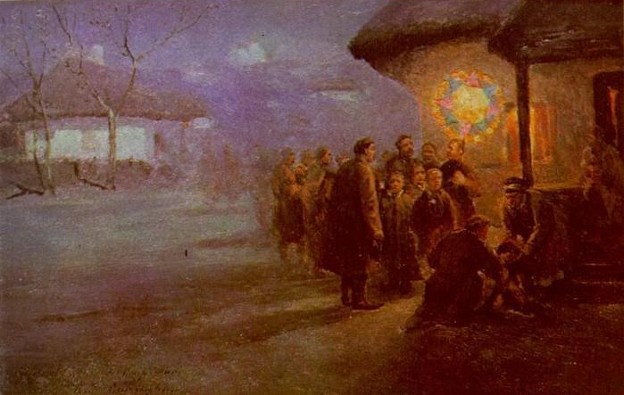
The celebrations of Christmas, New Year, and Epiphany (Yordan) are part of the traditional winter festivities cycle. Their roots reach deep into the past to the ancient pre-Christian times. Christmas as the feast of Christ's birth was at first celebrated in the East on 6 January, together with the feast of Epiphany. Later, in the mid-4th century, it was established by the Roman Catholic church as a separate feast and was celebrated on 25 December according to the Julian calendar. With the introduction of Christianity into Ukraine in the 10th century Christmas was fused with the local pagan celebrations of the sun's return or the commencement of the agricultural year. In some areas the pre-Christian name of the feast--Koliada--has been preserved. The most interesting part of Ukrainian Christmas is Christmas Eve (Sviat-Vechir) with its wealth of ritual and magical acts aimed at ensuring a good harvest and a life of plenty. Dead ancestors and family members are believed to participate in the eve's celebration and are personified by a sheaf of wheat called did or didukh (grandsire). The 'holy supper' on Christmas Eve is a meal of 12 ritual meatless and milkless dishes. The order of the dishes and even the dishes themselves are not uniform everywhere, for every region adheres to its own tradition. A characteristic feature of Christmas is caroling (koliaduvannia), which expresses respect for the master of the house and his children and is sometimes accompanied by a puppet theater (vertep) or by Christmas carolers dressed up as vertep characters, by an individual dressed up as a goat (as part of the folk play Koza), and by a handmade star. The religious festival lasts three days and involves Christmas liturgies (particularly on the first day), caroling, visiting, and entertaining relatives and acquaintances. The Christmas theme has a very important place, more important than Easter, in Ukrainian painting, particularly church painting, and in poetry. The traditional folk Christmas 'holy supper' ritual and caroling are still observed, in a modified fashion, by Ukrainians in the diaspora. In Soviet Ukraine most Christmas rituals disappeared, but many of them have been revived in independent Ukraine, particularly in western oblasts... Learn more about the Ukrainian Christmas and New Year traditions by visiting the following entries:

|
CHRISTMAS. Although there were regional variations, the rituals of Christmas followed a set pattern in Ukraine in former days. Except for the preparation of the 'holy supper,' all work was halted during the day, and the head of the household saw to it that everything was in order and that the entire family was at home. Towards the evening the head of the house went to the threshing floor to get a bundle of hay and a sheaf of rye, barley, or buckwheat; with a prayer he brought them into the house, spread the hay, and placed the sheaf of grain (the didukh) in the place of honor (under the icons). Hay or straw was strewn under and on top of the table, which the housewife then covered with a tablecloth. Garlic was placed at the four corners of the table while iron objects--an ax and a plowshare (or the plow itself)--and a yoke, a horse collar, or pieces of harness, were placed under the table. A pot of kutia, a ritual dish made with wheat or barley grain and ground poppy seeds, was placed high up on the shelf in the corner of honor; the pot was topped with a loaf of bread (knysh) and a lighted candle. The evening meal was accompanied by a special ceremony. When the kutia was served, the head of the house took the first spoonful, opened the window or went out into the yard, sometimes with an ax in his hand, and invited the 'frost to eat kutia.' On re-entering the house, he threw the first spoonful to the ceiling: an adhesion of many grains signified a rich harvest and augured a good swarming of bees. At the evening meal fortunes were told. After the meal three spoonfuls of each dish were placed on a separate plate for the souls of the dead relatives and spoons were left for them... |
| Christmas |
 "> ">
|
CAROLS. The custom of caroling is highly developed and widely practiced in Ukraine. There are two kinds of carols: koliadky and shchedrivky. The koliadky are festive, ritual songs sung at Christmas time, while the shchedrivky are sung on New Year's Eve. Both types of carols have retained traces of their ancient origin, particularly to the cult of the sun, of the ancestor worship, of nature worship, and of the faith in the magical power of words. The koliadky and shchedrivky depict scenes from farm life and express the desire for good harvests, prosperity, good fortune, and health. They are remarkable for their wealth of subject matter and motifs, which vary with the person who is addressed and praised in each carol. There are carols dedicated to the master of the house, the mistress of the house, the young bachelor, the girl, the daughter-in-law, the son-in-law, and so on. The most important aspect of carols is their wish-fulfilling power. By their age and content the carols can be divided into several groups: (1) the oldest carols, which deal with the creation of the universe in a pre-Christian, dualistic, mythological framework; (2) a later stratum describing life in the Princely era; (3) carols about daily life; and (4) recent koliadky and shchedrivky, which have a biblical theme--Christ's birth, the shepherds, the three wise men, Herod. The process of Christianization embraced the whole content of the koliadky and shchedrivky. In some carols the ancient agricultural themes are fused with more recent religious themes. As poetry koliadky and shchedrivky are remarkable for their artistic quality... |
| Carols |
.jpg)
|
KOZA. A traditional mimetic folk play that was acted out during the Christmas cycle by young men, who visited all the houses in a village. The Goat--a youth wearing an inverted sheepskin coat and a mask resembling a goat's head--entered a house, bowed to the head of the household, and performed a ritual dance to bring about an abundant harvest. The other youths sang an accompanying ditty: 'De Koza khodyt', tam zhyto rodyt', de Koza tup-tup, tam zhyta sim kup' (Where the Goat goes, there wheat grows; where the Goat stamps its feet, there are seven sheaves of wheat). A dramatization of a goat being pursued by hunters and wolves, killed, and gutted followed. At the singers' call 'Bud', Kozo, zhyva!' (Come alive, Goat!) the Goat rose from the dead and returned to its 'field,' which then came to life (as acted out by the chorus). The game ended with the Goat delivering a wish: 'Shchob ts'omu hospodariu i korovky buly nevrochlyvii i molochlyvii, i oves-samosii, i pshenytsia-sochevytsia' (May this farmer's cattle be unbedeviled and full of milk, and may his oats sow themselves and his wheat be of the best sort). In the Hutsul region the Goat was 'led around' by children, who 'sowed' grain kernels throughout the house; the Goat's ears were made of grain spikes. Occasionally, the Goat was accompanied by others disguised as the Old Man, the Gypsy, Malanka (the New Year's Eve maiden), the Bear, and other characters. The original purpose of Koza was the same as that of carols: to invoke a successful year for the peasant household... |
| Koza |

|
NEW YEAR. The first day of the yearly cycle, marked with religious and traditional festivities. Before its Christianization in 988, Kyivan Rus' followed the ancient Roman calendar, which began the year on 1 March. With Christianity came the Byzantine calendar, which began the new year on 1 September and followed a chronology which set the date of creation at 5508 BC. The common people, however, continued to use the Roman calendar. In the 14th and 15th centuries, under Polish and Lithuanian influence, the Julian calendar, which began the year on 1 January, was adopted in Ukraine. In Russia this change came only in 1700, under Peter I. The more accurate Gregorian calendar was adopted in Western Europe in 1582, but neither the Ukrainian people nor the church accepted this calendar. Today Ukrainians in and outside Ukraine celebrate the New Year twice: officially on 1 January, according to the Gregorian calendar, and unofficially on 14 January (1 January according to the Julian calendar). The New Year, particularly New Year's Eve, was celebrated with a rich repertoire of folk rituals. Their primary purpose was to secure a bountiful harvest and the family's health and happiness. The key rituals were the eating of kutia, children's caroling, the polaz (bringing cattle into the house), walking Malanka around the village, fortune-telling and forecasting the weather for the next year, and the symbolic sowing of wheat. According to popular superstition, on New Year's Eve domestic animals are able to speak in human language, and buried treasures burn with a blue flame... |
| New Year |

|
MALANKA. A Ukrainian folk feast on New Year's Eve corresponding to Saint Sylvester's Feast in the Latin calendar. The name originates from Saint Melaniia, whose day falls on 13 January (31 December OS). In central and eastern Ukraine the feast was also known as Shchedryi vechir (Generous Eve) or Shchedra kutia. Traditionally, Malanka (a bachelor dressed in women's clothing), with a dressed-up goat, gypsy, old man, old woman, Jew, and other characters and musicians, went from house to house in the village supposedly to put the households in order. But instead of bringing order Malanka played all kinds of pranks. In some locales young men and women brought a plow into the house and pretended to plow a field. The folk play was concluded with caroling. The Malanka traditions were most prevalent in the Dnipro region. They combine old agrarian themes with folk theater (the intermede and vertep). After the Revolution of 1917 the Malanka tradition declined in Soviet Ukraine, but it was revived in the early 1930s as part of the New Year celebrations. Today Ukrainians in and outside Ukraine celebrate Malanka as the traditional way of inaugurating the Julian-calendar New Year... |
| Malanka |

|
EPIPHANY (Ukrainian: Bohoiavlennia). A religious feast on January 6 (OS) or January 19 (NS), popularly called Vodokhreshchi (Blessing of Water) or Yordan (Jordan River), which completes the winter (Christmas-New Year) festivities cycle. Its Christian content is permeated with old agricultural rituals of diverse origins. The Eve of Epiphany is called 'the second Holy Eve' or 'Hungry Kutia'; in Podilia it is also called Shchedryi Vechir (Generous Eve). It calls for a more simple meal than on Christmas Eve but with kutia still as the main traditional dish. The principal ceremony of Epiphany traditionally consisted of the solemn outdoor blessing of waters, usually at a river or at a well, where a cross was erected out of blocks of ice (nowadays water is usually blessed inside the church). A procession was led to the place of ceremony. After the blessing of the water, everyone present drank the water and also took some home to be kept there for a whole year. On the second day of Epiphany (Day of Saint John the Baptist) the head of the household traditionally fed his cattle with bread, salt, and hay, which had been in the house since Christmas Eve, 'to last them till the new bread.' Following the feast of Epiphany, parish priests visit the parishioners' homes and bless them with the new holy water... |
| Epiphany (or Yordan) |
The preparation, editing, and display of the IEU entries dealing with the Ukrainian Christmas and New Year traditions were made possible by the financial support of the SENIOR CITIZENS HOME OF TARAS H. SHEVCHENKO (WINDSOR) INC. FUND.
VIII. TRADITIONAL HANDICRAFTS OF THE UKRAINIAN PEOPLE
Crafts and small-scale manufacture of common articles of daily use, farm implements, clothing, home furnishings, and, in past centuries, arms as well were widely practiced in Ukraine from the earliest times. Crafts were highly developed in the ancient states on the northern Black Sea coast. At the beginning of the 1st millennium AD crafts began to be separated from farming and specialized, and there were two basic branches of craft manufacture--iron making and pottery. In the Princely era the urban crafts differed from the rural crafts in their more complex production process and the higher quality of their product. In the large cities there were close to 60 distinct crafts: specialized branches of metallurgy, blacksmithing, arms manufacturing, pottery, carpentry, weaving, linen and wool cloth making, and others. Crafts specializing in ornamental products such as clothes, church and palace decorations, icons, and jewelry were highly developed. The Mongol invasions caused the crafts to decline. The earliest revival of the crafts occurred in the Principality of Galicia-Volhynia, where in the second half of the 14th century and the first half of the 15th century guilds appeared in the cities and towns governed by Magdeburg law. The largest crafts center was Lviv, where by the second half of the 15th century there were already over 50 crafts and by the first half of the 17th century, 133 crafts. At the same time traditional folk handicrafts developed in village communities... Learn more about the traditional handicrafts of the Ukrainian people by visiting the following entries:

|
CRAFTS. With the decline of the barter economy crafts became separated from home manufacture, which served the needs of the producer and his/her neighbors, and became increasingly specialized. Crafts production was concentrated mostly in the cities and towns in the form of small enterprises. Usually products were made to order; sometimes they were made for the market. There was hardly any division of labor in the craft shops, except for partial help from family members, journeymen, or apprentices. The craftsman was the owner of the shop and the means of production. Alone or with a journeyman he was an independent producer capable of manufacturing the product from beginning to end. His craft was his basic occupation and means of livelihood. At the peak of their development the craftsmen formed a relatively closed social group of the burgher estate with a distinct way of life and civil status and special rights and duties. In these respects crafts differ from cottage industries, which are usually only supplementary occupations undertaken, for example, during a season free of farm work... |
| Crafts |

|
CERAMICS and Pottery. Objects made of natural clays or clays mixed with mineral additives and fired to a hardened state. The ceramics made on the territory of Ukraine from the earliest times to the present reveal a highly developed artistic and technical culture, originality, and creativity. The development of ceramics has been facilitated by the existence of large deposits of various clays, particularly kaolin (china clay). The history of Ukrainian ceramics begins in the Neolithic Period, with the ceramics of the Trypilian culture. Their high technical and artistic level equals that seen in artifacts of the Aegean culture. The development of Ukrainian ceramics was also influenced by the ceramics of the Hellenic colonies on the Black Sea coast, beginning in the 8th and 7th century BC. Ceramics of the so-called Slavic era, which began in the 2nd century AD, were more modest, and only in the Princely era (9th-13th century) did the production of ceramics achieve a high technical level and a variety of artistic forms, while growing into a large industry... |
| Ceramics |

|
WEAVING. Weaving has been practiced in Ukraine for many centuries. Using flax, hemp, or woolen thread, weavers have produced various articles of folk dress, towels, kilims, blankets, tablecloths, sheets, and covers. The colors, ornamentation, and even the techniques of weaving varied from region to region. By the 14th century weaving had developed into a cottage industry. Weavers' guilds modeled on Western European examples were founded in Sambir (1376), Lviv, and elsewhere in Galicia. Later, artistic textiles and kilims were manufactured by small enterprises established by magnates in Brody (1641), Lviv, Nemyriv, Korsun, and other towns. In 17th-century Left-Bank Ukraine the Cossack starshyna established similar enterprises to make decorative furnishings on order for the nobility and churches, using imported silk and gold thread. Eventually such thread was manufactured in Ukraine. Weaving manufactories flourished from the mid-17th to the mid-19th century. The town of Krolevets became one of the largest centers of artistic folk weaving... |
| Weaving |

|
EMBROIDERY. Archeological discoveries in Ukraine indicate that embroidery has existed there since prehistoric times. Embroideries are found on drawings and on the oldest pieces of extant cloth (eg, the veil from the Church of the Tithes, destroyed in 1240). Cloth embroidery was first inspired by faith in the power of protective symbols and later by esthetic motives. Symbolic designs were incorporated into the woven cloth by means of a weaving shuttle or a needle. These symbols formed the basis of ornamentation for both cloth and Easter eggs. Under the influence of Byzantine art a new branch of embroidery--church embroidery--was developed in the Middle Ages. In the course of time and under the influence of new artistic styles, folk embroidery and church embroidery became more differentiated. Centers of church embroidery developed in the monasteries, while certain cities became centers for the embroidery trade, which produced cloth for the Cossack starshyna and the nobility. The later artistic styles did not influence folk embroidery as much... |
| Embroidery |

|
KILIM WEAVING. The term 'kilim' is of Turkic origin and denotes an ornamented woven fabric used to cover floors or to adorn walls. The earliest references to kilims date back to the chronicles of Kyivan Rus' and link them to burial rites. The princes used kilims also as chair covers. Nothing definite can be said about kilim weaving in Ukraine before the 16th century. The earlier kilims belonging to the ruling class most likely had been imported. Kilim production in Volhynia in the 16th century is well documented. There are many 17th-century references to both locally produced and imported kilims. By the 18th century, kilim weaving was widespread: in Right-Bank Ukraine the mills owned by the Czartoryski and Potocki families, and in Left-Bank Ukraine Col Pavlo Polubotok's mill, were well known. Although kilim weaving may have been taken up by peasants much earlier, in the 18th century it became widespread among them. Monks and town craftsmen also engaged in weaving. The industry grew rapidly at the end of the 18th century and in the first half of the 19th century... |
| Kilim weaving |

|
WOOD CARVING. One of the chief branches of the decorative and applied arts in Ukraine. For many centuries the common people carved wooden plates, spoons, bowls, canes, furniture, cards, sleds, gates, beams, and gables and decorated them with designs organically linked with the practical function of those objects. Richly carved crosses and three-armed candlesticks played an important role in family and religious rituals. The carving of iconostases and church objects, which flourished particularly in the 16th and 17th centuries, was distinct from the popular form of the art. It was mostly thematic and large-scale, and its ornamentation, unlike folk ornamentation, was mostly floral and done in relief. Very few examples of pre-19th-century carving have survived. In the 19th century the influence of larger market forces was profound: carvers began producing purely decorative objects, and middlemen, who organized the distribution of such objects, began demanding new and alien designs... |
| Wood carving |
The preparation, editing, and display of the IEU entries featuring the traditional Ukrainian handicrafts were made possible by the financial support of the CANADIAN FOUNDATION FOR UKRAINIAN STUDIES.
IX. UKRAINIAN FOLK MUSICAL INSTRUMENTS
Folk musical instruments in Ukraine were used primarily at dances and for marching (eg, the wedding march), as accompaniment to popular plays (koza, vertep), or for simple listening enjoyment. Dance music (metelytsia, hopak, kolomyika, shumka, etc) was often played by one instrument (usually the violin) or by a small ensemble (violin and drum). Vertep performances were accompanied by single instruments or ensembles consisting of some combination of the violin, bandura, tsymbaly, drum, and sopilka. Strings formed the basis of a folk ensemble. The classic folk ensemble known as troisti muzyky originated probably in the 17th century and consisted of a violin, drum, and tsymbaly or bass viol. About the same time manorial orchestras appeared. They eventually played for the peasants and survived to the beginning of the 20th century in the form of an ensemble of two violins, bass, and flute. In Polisia and Podilia (and before that in other regions) brass orchestras were popular. Imitating military and earlier Cossack bands, they consisted of two to three trumpets (cornets), clarinets, two alto horns, a tenor horn, a baritone, drum, and brass cymbals. Since the 1950s ensembles and orchestras of folk instruments have been gradually disappearing from daily life. Instead, amateur and professional folk-instrument orchestras under the direction of qualified conductors have been organized... Learn more about Ukrainian folk musical instruments by visiting the following entries:

|
FOLK MUSICAL INSTRUMENTS. Musical instruments, usually homemade, that were played by folk musicians. They can be divided into three basic groups according to their emission of sound: (1) string instruments, which are subdivided into (a) plucked instruments--psaltery (husli), bandura or kobza, torban, and drymba (Jews' harp); (b) bow instruments--hudok (three-string ancestor of the violin), violin (skrypka), and bass viol (basolia); (c) key and bow instruments--lira; and (d) string percussion instruments--tsymbaly (dulcimer); (2) wind instruments, which are subdivided into (a) free-reed instruments--sopilka (reed), kuvytsi or svyril; (b) reed-pipe instruments--duda (bagpipe, also known as koza, baran, mikh, or volynka); and (c) woodwind instruments--trembita; and (3) percussion instruments, which are subdivided into (a) membranophones--drum (bubon or taraban), tambourine (resheto), and kettledrum (tulumba or litavry); and (b) idiophones--cymbals, bells, and rattles. The most popular instruments in Ukraine were the bandura, sopilka, violin, and tsymbaly... |
| Folk musical instruments |
.jpg)
|
BANDURA. A Ukrainian musical instrument similar in construction and appearance to a lute. The bandura has 32-55 strings: the 8-14 bass strings (bunty) are stretched along the neck, and the 24-43 treble strings (prystrunky) run along the side of the soundboard. Before the 20th century the bandura had various shapes and tunings (basically diatonic), but in recent times it has been standardized. The oldest record of a bandura-like instrument in Ukraine is an 11th-century fresco of court musicians (skomorokhy) in the Saint Sophia Cathedral in Kyiv. This lute-like instrument is probably the ancestor of the bandura and the kobza. The two instruments were related, but distinct. The kobza was smaller in size and had fewer strings, but these were fretted. Around the 16th century prystrunky were added to the bandura, and from that time only one note was obtained from each string. During the 17th and 18th century the bandura was very popular at the Zaporozhian Sich, among the common people, and at the gentry manors. In the 18th century the bandura displaced the kobza, and both names are now used synonymously. Old banduras were symmetrical. Their shape limited the number of prystrunky and thus the range of the instrument. In 1894 Hnat Khotkevych designed an asymmetrical bandura, thus increasing its range...
|
| Bandura |

|
VIOLIN. A bowed string instrument. Older types of this instrument existed in Ukraine as early as the 9th century. The hudok (medieval fiddle) is depicted on an 11th-century fresco in Kyiv's Saint Sophia Cathedral. In the territories of Western Ukraine a three-stringed fiddle (skrypytsia) was known from the 14th century. The modern violin, developed in Italy, was introduced into Ukraine at the beginning of the 17th century and became extremely popular as a folk instrument in ensembles of troisti muzyky. Vibrato, a modern violin technique, originated in Western Ukraine and Poland and was first described by M. Praetorius in Syntagma musicum (1618). During the 17th and 18th centuries interest in the violin led to the growth of Western-style orchestras in Ukraine. In the early 19th century Havrylo Rachynsky became Ukraine's first touring concert violinist, and in the 20th century Bohodar Kotorovych, Oleh Krysa, and Steven Staryk have emerged as outstanding Ukrainian violinists... |
| Violin |

|
SOPILKA. A wind folk musical instrument of varied construction made of wood or bark. Generally cylindrical, blocked at one end, and with 6 to 8 finger holes (up to 10 since 1970), its related forms include the telenka, floiara, and dentsivka. The earliest-known example found in Ukraine is a mammoth-bone flute from the Paleolithic Period. The flute is known from the Princely era of the Kyivan Rus' and is depicted on an 11th-century fresco in Kyiv's Saint Sophia Cathedral. In folk tradition it was commonly the instrument of shepherds or part of trio ensembles (troisti myzyky). Today it is featured mainly in folk instrumental ensembles. Prominent sopilka performers have included Ivan Skliar, Y. Bobrovnykov, D. Demenchuk, and V. Zuliak... |
| Sopilka |

|
TSYMBALY. (cimbalom or hammered dulcimer). A folk musical instrument whose strings are struck with two small padded sticks. It consists of a shallow rectangular or trapezoidal wooden sound box with 16-35 clusters of gut or wire strings stretched lengthwise across the deck. Its range is usually three octaves. Originating in Byzantium, it was brought to Europe by the Turks. During the 1600s the tsymbaly became widespread throughout Ukraine, supplanting even the husli (psaltery) in popularity. As an ensemble instrument it entered the tradition of troisti muzyky. Today it remains one of the basic instruments of all folk orchestras... |
| Tsymbaly |

|
TROISTI MUZYKY. A trio ensemble of folk musical instruments consisting of violin, bass viol (basolia, folk violoncello), and frame drum. In Western Ukraine the tsymbaly (cimbalom) was commonly used instead of the bass viol. On occasion the sopilka (fipple flute) replaced the violin as the leading instrument. The trio ensemble arose after the violin was introduced into Ukraine early in the 1600s, and became widespread by the end of the 17th century. Until the beginning of the 20th century troisti muzyky provided most of the musical entertainment on feast days, and at weddings, birthdays, social gatherings, and fairs. Their repertoire consisted of dance music and folk songs. Today the tradition is maintained by musicians in such ensembles as the Kyiv Orchestra of Folk Instruments... |
| Troisti muzyky |
The preparation, editing, and display of the IEU entries about Ukrainian folk musical instruments were made possible by the financial support of the CANADIAN FOUNDATION FOR UKRAINIAN STUDIES.
X. THE UKRAINIAN HIGHLANDERS: HUTSULS, BOIKOS, AND LEMKOS
Distinguished by their unique dialects and folk traditions, the Ukrainian highlanders in the eastern Carpathian Mountains are divided into several ethnographic groups: the Lemkos who live in the Low Beskyd and the western part of the Middle Beskyd; the Boikos who inhabit all of the High Beskyd, the eastern part of the Middle Beskyd, the western part of the Gorgany Mountains; and the Hutsuls who live in the Hutsul region situated in the southeasternmost part of the Carpathian Mountains of Galicia, Bukovyna, and Transcarpathia. The central part of Transcarpathia is settled by the Zahoriany (tramontanes) or Dolyniany (lowlanders), who are related to the Boikos and speak a central Transcarpathian dialect. In addition, some inhabitants of the westernmost parts of Transcarpathia refer to themselves as Rusyns... The Hutsuls are renouned for their colorful, richly ornamented folk dress and their masterful handicrafts, such as artistic wood carving, ceramics, handmade jewelry, vibrant handwoven textiles, embroidery, and distinctive wooden folk architecture. Engaged primarily in animal husbandry and agriculture, the Boikos have preserved many ancient folk customs and rites that have disappeared in other parts of Ukraine. In folk architecture a unique type of house with a porch has been preserved in the Boiko region, as have the famed three-domed Boiko churches with their characteristic arcade. The Lemkos are a distinct ethnic group within the Ukrainian nation. Their dialects and spiritual and material culture preserved some unique archaic elements that have been lost by other Ukrainians. However, very few Lemkos have been left to live in the northern (Polish) part of their native Lemko region. Almost all Lemkos were forcefully resettled from there after the Second World War: to the USSR (in 1944-45) and later, during the infamous Operation Wisla, to western Poland (in 1947). The depopulated Lemko region was settled partly by Poles, but most of it remained unsettled... Learn more about the Ukrainian highlanders in the Carpathian Mountains by visiting the following entries:

|
HUTSULS. An ethnographic group of Ukrainian pastoral highlanders inhabiting the Hutsul region in the Carpathian Mountains. According to one theory, the name hutsul was originally kochul ('nomad,' cf literary Ukrainian kochovyk) and referred to inhabitants of Kyivan Rus' who fled from the Mongol invasion into the Carpathian Mountains. Other scholars believed that the name derives from a subtribe of the Cumans or Pechenegs--the ancient Turkic Utsians or Uzians--who fled from the Mongols. Since the 19th century the most widely accepted view has been that the name comes from the Romanian word for brigand, hotul/hot. Archeological evidence of human existence in the region dates back 100,000 years. Certain localities (eg, Kosiv) were settled as early as the Neolithic Period (6,000-4,000 BC). The Hutsuls' rich folklore and folkways and the Hutsul dialect have been preserved to this century. They are not only recorded and described in scholarly studies, but are also depicted in the literary works of Yurii Fedkovych, Ivan Franko, Mykhailo Kotsiubynsky, Olha Kobylianska, and many other writers. The Hutsul folk tradition is rich in folk songs, many of which valorize the deeds of the opryshoks, particularly Oleksa Dovbush. The Hutsuls also have distinctive folk music and folk dance. Their kolomyiky and troisti muzyky have gained popularity far beyond the Hutsul region... |
| Hutsuls |

|
HUTSUL REGION (Hutsulshchyna). A region in the southeasternmost part of the Carpathian Mountains of Galicia, Bukovyna, and Transcarpathia (the basins of the upper Prut River, upper Suceava River, upper Bystrytsia Nadvirnianska River, and upper Tysa River valleys), inhabited by Ukrainian highlanders called Hutsuls. Except for eight settlements in Romania, the Hutsul region lies within the present-day borders of Ukraine. In the southeast the Hutsul region borders on ethnic Romanian lands; in the west, on the region of the Boikos; in the north, on the region of the Subcarpathian Pidhiriany; and in the southwest, on long-cultivated Transcarpathian Ukrainian lands. The region is located in the most elevated and picturesque part of the Ukrainian Carpathians. The gently sloping mountains are densely populated, and the land there is cultivated to a considerable height owing to the moderating climatic influence of the Black Sea and the massiveness of the ranges, which make summers in the region warmer than in other parts of the Carpathians. Highland pastures (polonyny) are widespread, and herding, particularly of sheep, has traditionally been widely practiced. Ninety-five percent of the population of the region is rural, and only the small towns of Verkhovyna, Rakhiv, Yasinia, Putyliv, Vorokhta, and Yaremche lie within the region proper... |
| Hutsul region |

|
BOIKOS. A tribe or ethnographic group of Ukrainian highlanders who inhabit both slopes of the middle Carpathian Mountains, now in Lviv oblast, Ivano-Frankivsk oblast, and Transcarpathia oblast. The name boiko is thought to be derived from the frequent use of the particle boiie by the population. The Boikos are believed to be the descendants of the ancient Slavic tribe of White Croatians who inhabited the region in the first millennium AD and came under the rule of the Kyivan Rus' state during the reign of Prince Volodymyr the Great. The Boikos differ from their neighbors in language (the Boiko dialect), dress, folk architecture, and customs. Until recent times the Boikos wore very distinctive domestically made clothes. A distinguishing type of Boiko folk architecture are the three-domed Boiko churches, such as the renowned Saint George's Church now in Drohobych (15th-16th century). Historically the Boikos supported themselves mostly by animal husbandry. In more recent times they have been engaged mostly in agriculture and dairying. Certain settlements close to the trade route that crossed Boiko territory and ran through the mountain passes practiced trading for centuries. In the 20th century the Ukrainian national awakening took place in these enterprising Boiko urban circles, and the Boiko region produced a large number of Ukrainian cultural and political figures... |
| Boikos |

|
LEMKOS. A Ukrainian ethnic group which until 1946 lived in the most western part of Ukraine on both sides of the Carpathian Mountains and along the Polish-Slovak border. The name seems to be derived from the frequent use of the word lem 'only' by the Lemkos. They usually call themselves rusnaky or rusyny (Ruthenians). Scholars and the intelligentsia began to use the name Lemko for the western groups of Ukrainian highlanders in the mid-19th century, and by the end of the century some Lemkos had accepted the name. It is not used widely in the Presov region of Slovakia. The intrinsic conservatism of the Lemkos preserved them from Polonization but at the same time impeded the rise of Ukrainian national consciousness. The Old Ruthenian cultural mainstream, led mostly by local priests, turned in a Russophile direction in the 1900s and received support from the Russian tsarist government. The Ukrainian national movement gained strength among the Lemkos only toward the end of the 19th century and was centered in Nowy Sacz and Sianik. In the 1920s the Ukrainian movement, supported by young priests and school teachers, began to predominate. But the Polish state attempted to halt the development of the Ukrainian movement. It supported the Russophiles in order to keep the Lemkos divided and then tried to turn the Lemkos into a Polish ethnic group... |
| Lemkos |

|
LEMKO REGION (Lemkivshchyna). The territory traditionally inhabited by the Lemkos forms an ethnographic peninsula 140 km long and 25-50 km wide within Polish and Slovak territory. After the deportation of Lemkos from the northern part in 1947, only the southern part, southwest of the Carpathian Mountains, known as the Presov region in Slovakia, has remained inhabited by Lemkos. The Lemko region occupies the lowest part of the Ukrainian Carpathian Mountains--most of the Low Beskyd, the western part of the Middle Beskyd, and the eastern fringe of the Western Beskyd. The landscape is typical of medium-height-mountain terrain, with ridges reaching 1,000 m and sometimes 1,300 m. A series of mountain passes along the Torysa River and Poprad River facilitate communications between Galician and Transcarpathian Lemkos. Until 1946 the Galician Lemko region extended as far west as the Polish Nowy Targ county; it covered an area of nearly 3,500 sq km and had a population of 200,000, of which 160,000 (1939) were Ukrainians inhabiting about 300 villages. North of the homogeneous Lemko region lie one large and a few small islands of zamishantsi, whose dialect is close to the Lemko dialects. The Transcarpathian Lemko region occupies most of the Presov region--about 3,000 sq km with a population of 110,000 and a series of ethnic islands... |
| Lemko region |

|
RUSYNS (RUTHENIANS). A historic name for Ukrainians. The Latin name Rutheni was applied to the inhabitants of the medieval Kyivan Rus'. In the 16th century the word more clearly began to be associated with the Ukrainians and Belarusians of the Polish-Lithuanian Commonwealth as distinct from the Muscovites (later known as Russians), who were designated Moscovitae. In the 19th century the term 'Ruthenian' underwent further restriction and it came to be associated with those Ukrainians who lived under the Habsburg monarchy, in Galicia, Bukovyna, and Transcarpathia. From around 1900 Galician Ukrainians began to abandon the name rusyny in favor of the self-designation ukraintsi (Ukrainians). But the name 'Ruthenian' (rusyn) was retained by the inhabitants of Transcarpathia and by Transcarpathian emigrants in the United States. After the Second World War the terms 'Ruthenian', 'Rusyn', or 'Carpatho-Rusyn' were used as self-designations almost exclusively by descendants of Transcarpathian emigrants in the United States. In 1991 the government of Slovakia recognized Rusyns as a distinct national minority. The regional variation of Ukrainian, after several years of study, was proclaimed a new Slavic language in 1995 by the Rusyn Renaissance Society of Slovakia. Since then the self-designation 'Rusyn' has been used by some residents of Transcarpatia oblast in Ukraine... |
| Rusyns (Ruthenians) |
The preparation, editing, and display of the IEU entries associated with the regions and cultural legacy of the Hutsuls, Boikos, and Lemkos were made possible by the financial support of the IVAN AND ZENOVIA BOYKO ENDOWMENT FUND at the CANADIAN INSTITUTE OF UKRAINIAN STUDIES.
XI. THE CRIMEAN TATARS AND OTHER TURKIC-SPEAKING PEOPLES OF UKRAINE
Among the first Turkic peoples that came into contact with the Ukrainian territories and, for a time, controlled some of these territories were the Khazars. They appeared in southeastern Europe in the 4th century and later established the Khazar kaganate, the first state in eastern Europe. Located northwest of the Caspian Sea, the kaganate reached its zenith in the late 8th century when it gained control over most of eastern Europe up to the Dnieper River. From the late 9th century Kyivan Rus' emerged as a major opponent of the Khazars, and in 964-5 Prince Sviatoslav I Ihorevych of Kyiv conquered and destroyed the Khazar state. This action proved, to a large extent, to be detrimental to the Ukrainian lands, which became vulnerable to constant nomadic invasions from the east. The Turkic-speaking nomadic tribes of the Pechenegs, Torks, and later Cumans (Polovtsians) settled on the Black Sea steppes and repeatedly invaded the Ukrainian lands of the Kyivan Rus'. In the 13th century, the Tatars--Turkic and Mongol peoples of the Mongol Empire--invaded eastern Europe, sacked Kyiv in 1240, and destroyed the Kyivan state. For over a century Tatars controlled much of eastern Europe, including most of Ukrainian territories, from their state in the Volga Basin, known as the Golden Horde. In the early 15th century the Golden Horde weakened and then disintegrated, and independent khanates, such as the Crimean Khanate, emerged on its peripheries. The Crimean Khanate was the cradle and native region of the Crimean Tatar people. In the mid-16th century another Tatar group, the Nogay Tatars, penetrated into Ukraine from the Volga, Ural, and Caspian steppes and established several hordes in southern Ukraine as vassals of the Crimean Khanate and Ottoman Turkey. These Tatar nations and descendants of other Turkic peoples populated the Crimea and most of southern Ukraine. In the late 18th century the southern Ukrainian lands and the Crimea were annexed by the Russian Empire and the Turkic inhabitants of these lands were subjugated and often resettled or forced to emigrate... Learn more about the Crimean Tatars and other Turkic-speaking peoples of Ukraine by visiting the following entries:

|
TATARS. The name given to various Turkic and Mongol peoples and tribes of the 13th- to 14th-century Mongol Empire. The Tatar army under Batu Khan invaded Kyivan Rus' and took Kyiv on 6 December 1240. It devastated Ukraine and controlled most of its lands from their state in the Volga Basin. The Tatars were successful in controlling their large empire because of their administrative method. It included census-taking to determine the amount of tribute; a system of enumerators, scribes, and tax collectors; the division of conquered lands into districts; and the establishment of local administrators to enforce obedience and the payment of tribute. To maintain full control the Tatars resorted to almost systematic extortion, hostage-taking, and granting of patronage to local princes for faithful service. Periodic bloody raids helped to maintain fear and obedience. The Tatars were primarily nomadic herders and sophisticated warriors. They were shamanists but were tolerant of other religions. Merchants were highly valued by the government, and foreign traders received special privileges. The Lithuanian grand duke Algirdas was the first to wrest Ukrainian lands from the Golden Horde. In the early 15th century the Golden Horde weakened and then disintegrated, and independent khanates, such as the such as the Crimean Khanate, the Kazan Khanate, and the Astrakhan Khanate, emerged on its peripheries. The Great Horde (the nucleus of the former Golden Horde) ceased to exist after the death of its last leader, Khan Shah-Ahmet, in 1505... |
| Tatars |

|
CRIMEAN TATARS. Turkic-speaking nation native to the Crimea. The Crimean Tatars are Sunni Moslems. They emerged as a nation during the formation of the Crimean Khanate in the mid 15th century. The Khanate gained independence from the Golden Horde in 1449 and in 1478 it became a vassal state of Turkey. Following the annexation of the Crimea by Russia in 1783, the religious and economic repression of the Crimean Tatars caused their mass migration to Turkey. The number of Crimean Tatars declined continuously in absolute and relative terms. In 1926 they numbered 179,000 and were divided into two groups: the northern (or steppe) Tatars and the southern Tatars. The steppe Tatars (125,000 in 1926) lived in the northern part of the Crimea and in the adjacent mountain foothills. Their language belongs to the Kipchak (Cuman) group of the Turkic languages, and they are descendants of the Mongol-Tatar invaders of the Crimea intermixed with other Turkic steppe peoples. The Tatars, who inhabited the southern part of the peninsula, including the Crimean Mountains, are descendants (54,000 in 1926) of Tatars intermixed with various other former inhabitants of the southern Crimea--Greeks, Goths, Khazars, Italians, and Slavs. Their language belongs to the Turkish group of the Turkic languages. In 1946 the Crimean Tatars were deported en masse from the Crimea by the Soviet government. They began to return to their native land after Ukraine proclaimed independence in 1991. Today over 250,000 Tatars reside in the Crimea...
|
| Crimean Tatars |
.jpg)
|
NOGAY TATARS. A formerly large horde of Tatars who derived their name from Nogay (d 1300), a prominent military leader of the Golden Horde. Until the 16th century they inhabited the steppe between northern Kazakhstan and southern Siberia. In the mid-16th century the Nogay Tatars split into the Great Horde, which came under Muscovite rule on the lower Volga, and the Little Horde, which migrated into the southern Ukrainian steppe and became a nominal vassal of the Crimean Khanate, constituting 40 percent of its population. The two hordes were reunited in the 1630s after the Great Horde fled from the Siberian Kalmyks. The Nogay Tatars pillaged Ukrainian settlements and were consequently in constant conflict with the Zaporozhian Cossacks. In the 1770s, after the Russian conquest of Southern Ukraine, approximately 120,000 Nogay Tatars were forcibly resettled between the Don River and the Kuban River and then in the Caspian steppe but were soon allowed to return to the coast of the Sea of Azov. After the Crimean War some 180,000 Nogay Tatars emigrated to Ottoman-ruled southern Bessarabia, and a minority remained in Subcaucasia. According to the 1989 census there were 75,181 Nogay Tatars in the USSR. Most of them lived in the Russian Federation. According to the 2001 census there are only 385 Nogay Tatars living in Ukraine today... |
| Nogay Tatars |

|
GAGAUZY. An ethnic group native to southern Bessarabia, which now constitutes parts of Odesa oblast in Ukraine and various regions of the Republic of Moldova. Origins of the Gagauzy are uncertain. Their ancestors were either Turkic Oghuz or Cumans who settled in Dobrudja in the Middle Ages, or perhaps Bulgarians who were forcibly Turkified from the 14th century onward. Although they speak Turkic, they are Orthodox, not Moslem, and are culturally close to Bulgarians, with whom they migrated to Bessarabia in the first half of the 19th century during the Russo-Turkish wars. A part of the Gagauzy resettled in the 1860s from Bessarabia to the vicinity of Berdiansk on the Sea of Azov coast, and in 1908-14 to Central Asia. In 1970, 156,600 Gagauzy lived in the USSR, 26,400 of them in the Ukrainian SSR and 125,000 in the Moldavian SSR. In 1979, 173,200 Gagauzy lived in the USSR. The majority were rural (82 percent in Ukraine in 1970) and have retained Gagauz as their mother tongue (89 percent in 1979). Today approximately 31,000 Gagauzy reside in Ukraine... |
| Gagauzy |

|
KARAITES. A non-Talmudic Jewish sect acknowledging no authority except the Holy Scriptures. It arose in the 8th century. Karaites in Ukraine are ethnically Turkish, probably descendants of the Khazars. They began settling in the Crimea (especially in Chufut-Kaleh) sometime after the 9th century, and in Lithuania, near Trakai and Vilnius, in the 17th century; from there some moved to Western Ukraine, settling near Lutsk and Halych. Until the 20th century they lived in small, tight-knit communities, where they maintained their Turkic language and customs. In 1863 they were officially recognized in the Russian Empire as a distinct ethnic group and exempted from the laws that applied to Jews. From 1837 the Karaim Religious Board in Yevpatoriia administered the Karaite community. Yet, their numbers continued to decline through assimilation. In the USSR they were considered to be a separate nationality and they continue to be recognized as such in independent Ukraine. Their number has fallen steadily, from 8,324 in 1926 to just 3,341 in 1979. In 1970 there were 2,596 in the Crimea. They are also found in Volhynia oblast and Odesa oblast. Today there are no more than 800 Karaites in the Crimea, some 1,200 in Ukraine in total. Their language belongs to the Kipchak (Cuman) group of Turkish, although the Karaites in Western Ukraine and elsewhere have their own dialects. Now, most use Russian... |
| Karaites |

|
KRYMCHAKS (krymchaky). Turkic-speaking Jews in the Crimea who are believed to be descendants of the Khazars. They professed Orthodox, Talmudic Judaism and had their own form of ritual and their own dialect, written mostly in the Hebrew script. Their major centers were Qarasubazar (present-day Bilohirsk) and Simferopol. In 1926 they numbered 6,400. Many were killed by the Nazis during the Second World War, and others emigrated or assimilated, or fled to other parts of the Union of Soviet Socialist Republics. In 1974, estimates placed their number at 2,500 in the USSR, most of them in the Crimea. In 1989 the Krymchakhlar cultural and educational association was established in the Crimea in order to preserve the language and customs of this disappearing national minority. Since the 1990s some Krymchaks have emigrated to Israel. According to the 2001 census, there were 406 Krymchaks living in Ukraine... |
| Krymchaks |
The preparation, editing, and display of the IEU entries about the Crimean Tatars and other Turkic-speaking peoples of Ukraine were made possible by the financial support of the MICHAEL KOWALSKY AND DARIA MUCAK-KOWALSKY ENCYCLOPEDIA ENDOWMENT FUND at the Canadian Institute of Ukrainian Studies (Edmonton, AB, Canada).
XII. HISTORY OF THE JEWS IN UKRAINE
Jews first settled on Ukrainian territories in the 4th century BC in the Crimea and among the Greek colonies on the northeast coast of the Black Sea. In Kyivan Rus' the Jewish population developed a distinct presence. In Kyiv they settled in their own district called Zhydove. Jews fleeing the Crusaders came to Ukraine as well, and the first western-European Jews began to arrive from Germany, probably in the 11th century. By 1500, Jews living in Ukrainian lands under Polish rule could be found in 23 towns and constituted one-third of all Jews in the Polish kingdom. The central European Jews (ashkenazim) spoke Yiddish (a German dialect), wore distinctive dress, and lived apart from the local population, either in separate districts or ghettos of cities, or in small, predominantly Jewish, settlements (shtetl). Barred from owning land and from the professions, the majority of Jews were engaged in modest occupations, as artisans and in petty trade. In the late 15th century Jews from Poland and Germany began arriving in Ukrainian territories under Lithuanian rule (especially the Kyiv region and Podilia). Kyiv became a famous center of Jewish religious education. As Polish and Lithuanian nobles accumulated more land, Jews came to act as their middlemen, providing indispensable services to the absentee and local lords as leaseholders of large estates, tax collectors, estate stewards, and operators and managers of inns, dairies, mills, lumber yards, and distilleries. Jews came to be perceived as the immediate overlords of the peasantry. The situation of the Jewish population became increasingly vulnerable in the early 17th century. Dissatisfaction with the difficult conditions on the part of the enserfed peasantry, the Cossacks, and urban Orthodox Ukrainians led to the 1648 uprising under Bohdan Khmelnytsky. Polish landowners, Catholics, and Jews were the main victims of the uprising... Learn more about the history of the Jews in Ukraine by visiting the following entries:

|
JEWS. The largest migration of Jews to Ukrainian territories took place in the last quarter of the 16th century. Some came from other parts of Poland and Lithuania to settle the newly opened areas; others from as far as Italy and Germany. In 1569, with the creation of the Polish-Lithuanian Commonwealth and the transfer of Ukraine from Lithuanian to Polish administration, vast areas of Ukraine were opened to colonization and to commercial agricultural development for trade with Western Europe. Between 1569 and 1648 the number of Jews in Ukraine increased from about 4,000 to nearly 51,325, dispersed among 115 towns and settlements. Protected by the Polish monarchs, Jews were directly subordinate to the king, paying a separate tax for which they were collectively responsible. The status of Jews was very different in the Russian-dominated Hetman state. The Russian government was opposed to Jewish immigration and, beginning with Peter I, forbade Jews from settling in Left-Bank Ukraine. After the partition of Poland in the late 18th century, the presence of 900,000 Jews on what was now Russian imperial territory forced the Russian government to abandon its previous policy of exclusion of Jews from Russia proper. In 1772 (and 1791, 1804, 1835) the government established a territorial region called the Pale of Settlement beyond which Jewish settlement was prohibited. The Pale existed, with some special criteria permitting individual Jews to live outside it, until 1915... |
| Jews |

|
YIDDISH. A language based primarily on several Middle High German dialects with significant influences from Hebrew, Aramaic, and Romance and Slavic languages. It is written using a slightly modified Hebrew alphabet. The Yiddish spoken by Jews living in Ukrainian ethnolinguistic territory is clearly distinguished from the northeastern dialect (characteristic of Belarus, Lithuania, and Latvia) and the central dialect (characteristic of Poland and west Galicia). Often referred to as the southeast dialect, Ukrainian Yiddish is profoundly marked by the influence of the Ukrainian language. In terms of grammar, for example, Yiddish shows evidence of a form of the Ukrainian aspect, which is absent from Middle High German. Yiddish also has absorbed a multitude of Ukrainian conjunctions, prepositions, and adverbs. The rich variety of Ukrainian diminutives was adapted to Jewish names, and Ukrainian names were sometimes given to Jewish children, particularly girls (eg, Badane, from Bohdana). The Yiddish vocabulary has also been enriched by countless Ukrainian words. The flowering of Yiddish literature in Ukraine is exemplified by one of the greatest writers in this language, Sholom Aleichem (1859-1916). He legitimized the Ukrainian dialect by writing almost exclusively in that medium. With the establishment of Soviet Ukraine, Yiddish was made the official language of the Jewish proletariat to the exclusion of the classical Jewish language, Hebrew...
|
| Yiddish |

|
HASIDISM. (from the Hebrew hasidim, meaning pious, righteous). Jewish religious movement which arose in Ukraine in the 18th century in opposition to the dogmatic and ritualistic formalism of the established orthodox Judaism. It originated as a loose network of small local groups devoted to an ascetic or ecstatic way of life, practicing their own rites, and embracing a mystical world view, which was influenced to some extent by the medieval Jewish Kaballah. These groups were led by charismatic, righteous individuals, the zaddikim. Hasidism was a popular movement that actively preached social reform and appealed particularly to the lower classes of Jewish society. The first Hasidic leader was Israel Ba'al Shem Tov (1700-60), who was active in Podilia and traveled to other parts of the Polish-Lithuanian Commonwealth to propagate his ideas. Important early centers of Hasidism included Mezhyrich, Chornobyl, and Medzhybizh. The movement soon spread to Austria-Hungary, and Hasidic communities sprang up in Galicia, Bukovyna, and Transcarpathia. Hasidic schools and printing presses were set up in Korets, Zhytomyr, Berdychiv, Zhovkva, and other towns. By the mid-19th century the majority of Jews in Ukraine were Hasidic and the movement was accepted by orthodox Jewry. Hasidic folklore (songs, dances, and sayings) is rich in Ukrainian themes. From Ukraine Hasidic Jews immigrated to Palestine and to the United States... |
| Hasidism |

|
POGROM. In its widest meaning the term refers to a violent attack on the persons and property of any weaker ethnic, religious, or national group by members of a dominant group. In its most common sense, however, the term 'pogrom' refers to the attacks accompanied by looting and bloodshed against the Jews of the Russian Empire in the late 19th and early 20th centuries. More precisely the term refers to three waves of widespread assault on the Jewish population that occurred in 1881-4, 1903-6, and 1918-21. The first major series of pogroms took place after members of Narodnaia Volia assassinated Alexander II on 13 March 1881. In Ukraine the attacks were carried out largely by urban dwellers, mainly seasonal workers in factories, railways, and ports who had migrated from Russia. They did not spread to the villages in a significant way. A relatively small number of people were killed in this first wave of pogroms. The pogroms of 1903-6 had a different character. Faced with growing unrest and hoping to divert discontent arising from the Russian Empire's losses in the Russo-Japanese War, the imperial authorities granted reactionary newspapers and ultraconservative loyalist groups known as Black Hundreds a free hand to agitate against 'Jewish machinations' as the cause of the social upheavals of the time. The pogroms followed as an intensification of that campaign. The scope of the attacks went beyond the wholesale destruction of property seen in 1881-2, to include rape and the killing of several hundred Jews. The pogroms had an electrifying effect on the Jewish population and provided an impetus for the Zionist movement as well as emigration to the New World... |
| Pogrom |

|
ZIONIST MOVEMENT. A Jewish political movement formed in the last quarter of the 19th century for the purpose of bringing Jews back to Zion (ie, Jerusalem, the land of Israel). Zionism was born in Ukraine and flourished there despite Soviet persecution. The first Jewish organization intent on systematic settlement of Palestine, then part of the Ottoman Empire, was established in Kharkiv in the wake of the pogroms that followed the assassination of Alexander II. A group of students created BILU (the Hebrew acronym of Isaiah 2:5, 'House of Jacob, Let us Go') and in the summer of 1882 sent a band of settlers to Palestine. Another movement, known as Hibbat Zion (Love of Zion), also became popular in Ukraine. Odesa was a center of Zionist activity. Ukrainian Zionists played a decisive role in defeating the so-called Uganda scheme, a plan to settle East Africa instead of Palestine. A wide range of Zionist ideologies were represented in Ukraine. After the fall of the tsar several world Zionist parties flourished in Ukraine, and Zionism was the most popular ideology of the politically conscious elements of Ukrainian Jewry. Besides the so-called General Zionists, Ukrainian Jews supported Mizrachi ('East,' a religious Zionist party), Zeire Zion ('Young Zion,' a socialist-oriented Zionist party), and Poale Zion ('Workers of Zion'). During the Ukrainian struggle for independence (1917-20) the Zionists participated in the Central Rada. Under the Soviets Zionism was mercilessly attacked as a 'tool of British imperialism' and decried as Jewish bourgeois nationalism... |
| Zionist movement |

|
HOLOCAUST. Ukraine was a major site of the implementation of Nazi Germany's genocidal policies toward the European Jews during the Second World War. When Germany invaded the USSR in June 1941, the Ukrainian SSR, including the newly annexed territories of eastern Galicia and western Volhynia, had a Jewish population of 2.3 million. Two out of three of Ukraine's Jews--between 1.4 and 1.5 million men, women, and children--were murdered under gruesome circumstances during the subsequent eighteen months. Ukraine's Jewish communities were concentrated in the western half of the country, especially in Galicia and Volhynia, but also in Podilia. That is why most of Ukraine's Jews were not able to escape or be evacuated in the face of the rapid German advance until August 1941. Only in Southern Ukraine and Left-Bank Ukraine were most of them able to leave before the Wehrmacht arrived. According to general estimates based on overall Soviet evacuation statistics, 800,000 to 900,000 Jews fled from Ukraine during the massive Soviet evacuation to the east. The first mass killings of Jewish women and children were apparently committed by the First SS Brigade already in July 1941 in Ostrih in Volhynia. But a new dimension of the genocide was marked by the massacre organized by SS leader Friedrich Jeckeln in Kamianets-Podilskyi on 27-29 August 1941. During those three days, the police shot 23,600 Jews... By the spring of 1942 almost no Jews remained alive in German-occupied Right-Bank and Left-Bank Ukraine... |
| Holocaust |
The preparation, editing, and display of the IEU entries about the history of the Jews in Ukraine were made possible by the financial support of the CANADIAN FOUNDATION FOR UKRAINIAN STUDIES.
XIII. ROMANIANS AND MOLDAVIANS IN UKRAINE
Romanians have historically lived in the border regions between the Ukrainian and Romanian territories: in the borderlands of Bukovyna, the Maramures region, and Bessarabia (the Khotyn and Bilhorod-Dnistrovskyi regions). While Moldavia and Southern Ukraine were part of the Ottoman Empire in the 16th century, Vlachs (Wallachians), the ancestors of the present-day Romanians and Moldavians, began freely colonizing the underpopulated lands between the Dnister River and the Boh River in Southern Ukraine. At that time entire Moldavian villages sought refuge in Ukraine, where social conditions were better. Their number rose after Ottoman-controlled territory between the Dnister and the Boh rivers was annexed by the Russian Empire in 1791. There the tsarist government granted Moldavian landowners and officials huge estates populated by Moldavian fugitives. Some Vlachs also settled east of the Boh River. The Vlach settlers generally lived on good terms with their Ukrainian neighbors. They took part in the haidamaka uprisings and were later also forced to live in the so-called military settlements in Southern Ukraine. According to the Russian census of 1897, 185,500 Romanians lived in the nine Ukrainian gubernias: 147,000 of them were in Kherson gubernia; 27,000, in Podilia gubernia; and 9,000, in Katerynoslav gubernia. The Soviet regime distinguished between Romanians and Moldavians, although they are culturally and linguistically the same. According to the 1926 Soviet census there were 257,794 Moldavians and 1,530 Romanians in Soviet Ukraine, 172,419 of them in the Moldavian ASSR (which was, at the time, part of the Ukrainian SSR). Approximately 95 percent were peasants. The Romanian-Ukrainian relations in Bukovyna changed in 1918 when, following the dissolution of the Austro-Hungarian Empire, Romania took control over the region. Ukrainians in Bukovyna were considered by the Romanian state to be errant Romanians who had forgotten how to speak their 'native' language and they came under relentless attack: all schools were Romanianized, the use of the Ukrainian language in the courts and in public offices was banned, the Ukrainian chairs at Chernivtsi University were abolished, and many Ukrainian societies were closed down. This situation persisted until parts of Bukovyna and the Maramures region, including some Romanian ethnic territories, were annexed by the USSR at the end of the Second World War... Learn more about Romanians and Moldavians in Ukraine by visiting the following entries:

|
ROMANIANS. The native population of Romania. In 1989 there were 459,350 ethnic Romanians in Soviet Ukraine, of which 324,525 were identified as Moldavians. In 1989, as earlier, the highest concentration of Romanians in Ukraine was in Chernivtsi oblast (100,300 Romanians and 84,500 Moldavians, mostly in Storozhynets, Hlyboka, Novoselytsia, and Sokyriany raions), where they made up 19.7 percent of the oblast's population, and in Odesa oblast (144,500 Moldavians and 700 Romanians), where they made up 5.5 percent of the population. Smaller numbers lived in Transcarpathia oblast (29,500 Romanians, in Tiachiv and Rakhiv raions), Mykolaiv oblast (16,700 Moldavians), Donetsk oblast (13,300 Moldavians and 500 Romanians), Kirovohrad oblast (10,700 Moldavians, near Hruzk and Martonosha), Dnipropetrovsk oblast (6,600 Moldavians), the Crimea (6,600 Moldavians), Luhansk oblast (5,800 Moldavians), and Kherson oblast (5,600 Moldavians). In 1989, 62 percent of Romanians and 78 percent of Moldavians in Ukraine gave Romanian or Moldavian as their native tongue; only 9.8 and 6.1 percent respectively gave Ukrainian, and 3.5 and 15.5 percent, Russian. According to the 2001 census, 151,000 Romanians lived in Ukraine which constituted 0.31% of the population of Ukraine. The Romanian Ukrainians, particularly those in Chernivtsi oblast, have enjoyed considerable cultural autonomy in independent Ukraine. Romanian-language schools operate in the region and Romanian-language periodicals are published. In 1990 the Social and Cultural Society of Transcarpathian Romanians was established in Uzhhorod... |
| Romanians |

|
MOLDAVIANS. The predominantly Vlach population of Moldavia (Moldova). After the principalities of Moldavia and Wallachia united in 1859 to form Romania, the term Moldavian, like Wallachian and the southern Romanian term Munten, became a regional designation. The Soviet regime created a fictional Moldavian nation, language, and literature to justify the existence of the Moldavian Autonomous Soviet Socialist Republic and Moldavian Soviet Socialist Republic. In fact the language of the Moldavian SSR and its successor state, Moldova, is a Romanian dialect the lexicon of which has many borrowings from Ukrainian and Russian, and which has been written in the Russian Cyrillic alphabet instead of the Romanian Latin alphabet. In the Soviet era many Soviet Russian neologisms entered the dialect, and on the basis of those words Soviet scholars tried unconvincingly to substantiate the idea that Moldavian was a separate language. In 1989 there were 3,352,352 Moldavians in the USSR. Of those, 2,794,749 lived in the Moldavian SSR, where they made up 64 percent of the population; 324,525 lived in the Ukrainian SSR; and 172,671 lived in the Russian SFSR. Of the Moldavians in Ukraine in 1989, 44.5 percent lived in Odesa oblast; 26 percent, in Chernivtsi oblast; 5 percent, in Mykolaiv oblast; 4.1 percent, in Donetsk oblast; 3.3 percent, in Kirovohrad oblast; 2 percent, in Dnipropetrovsk oblast; 2 percent, in Crimea oblast; 1.8 percent, in Luhansk oblast; and 1.7 percent, in Kherson oblast. According to the 2001 census, 258,619 Moldavians lived in Ukraine which constituted 0.53% of the population of Ukraine...
|
| Moldavians |
.jpg)
|
WALLACHIANS (VLACHS) (Ukrainian: volokhy). An eastern Romance people, the ancestors of the Romanians, who lived in the territories of what is now Romania and south of the Danube River from ca 500 AD. The earliest mention of the Vlachs is in the Primary Chronicle under the year 898. Because of invasions by the Tatars the Vlachs continued to move from beyond the Carpathian Mountains to the territory between the Carpathians and the Dnister River, the Presov region, and Moldavia, and thus displaced the Slavic population. The independent Vlachian principalities of Wallachia (Muntenia) and Moldavia arose in the 14th century. Although the Ukrainian term Voloshchyna (Wallachia) designates the entire ancient territory of Romania, in Ukrainian historiography it often refers specifically to Moldavia... |
| Wallachians (Vlachs) |

|
BUKOVYNA. Bukovyna is a transitional land between Ukraine and Romania. From a historical perspective it is a strategically important border area between Galicia and Moldavia, as it lies at the northwest entrance to Moldavia. Bukovyna's transitional location influenced its history; it belonged to the Principality of Galicia-Volhynia, then to Moldavia. Polish and Hungarian influences intersected here in the 14th and 15th centuries. In 1919-40 and 1941-4 all of Bukovyna belonged to Romania. It was only in 1940 that Bukovyna was divided, along ethnic lines, between Ukraine and Romania. Bukovyna's territory consists of 10,440 sq km, of which about 5,500 belong to Ukraine. At the time Bukovyna came under Austrian rule in the 18th century it was sparsely settled. Eventually, through natural growth and immigration, its population increased, reaching 642,000 in 1890. Ukrainians and Romanians constitute the majority of the population. According to the Austrian census of 1910, Ukrainians numbered 340,000 or 40 percent of the population, while Romanians numbered 290,000 or 34 percent of the population. The present political border between Ukraine and Romania does not coincide with the ethnic border: Romania contains the southern part of the Ukrainian ethnic peninsula with Seret and a string of mountain villages, while Ukraine contains the Romanian ethnic wedge that extends to Chernivtsi. Romanian Bukovyna has about 30,000 Ukrainians or 9 percent of the region's total population, while Ukrainian Bukovyna has almost 95,000 Romanians or 18 percent of the region's population... |
| Bukovyna |

|
MARAMURES REGION. A historical-geographic region in the Maramures Basin. Its larger, northern part is Ukrainian ethnic territory (eastern Transcarpathia), the inhabitants of which speak a Transcarpathian dialect of Ukrainian. The south is settled by Romanians. The name Maramaros appears in a Hungarian charter in 1199. Until the 14th century the region was sparsely populated and served mainly as a hunting ground for Hungarian kings and nobles. In the 14th century it was colonized by Ukrainians from Galicia and Vlachs from Transylvania. In 1910, 45 percent of the region's population of 360,000 was Ukrainian, 24 percent was Romanian, 17 percent was Jewish, and the rest was German or Hungarian. After the dissolution of the Austro-Hungarian Empire the northern Maramures region was annexed by Czechoslovakia. The south was annexed by Romania. Because the new Czechoslovak-Romanian border along the Tysa River did not correspond to the ethnic border, much of the region's Ukrainian ethnic territory--800 sq km--became part of Romania. At the end of the Second World War the northern Maramures region, including some parts of Romanian ethnic territory, was annexed by the USSR and became part of the Ukrainian SSR. Until the last few years of Soviet rule Ukrainian citizens of Romanian descent were not allowed to have direct ties with Romania. Cultural relations with Romania were conducted through official channels by the Ukrainian Society for Friendship and Cultural Relations with Foreign Countries and the Ukrainian branch of the Romanian-Soviet Friendship Society... |
| Maramures region |

|
BESSARABIA. Region bounded by the middle and lower Dnister River in the north and east, the Prut River in the west, and the mouth of the Danube River and the Black Sea in the south. Today Bessarabia is a part of Moldova, except for the northern part (the Khotyn region) and the southern part (the Akkerman [Bilhorod] region), which are settled by Ukrainians and comprise 14,400 sq km of the territory of Ukraine. Romanians have inhabited Bessarabia since the 13th century and constitute an overwhelming majority in the central part, which is now Moldova. Although the descendants of ancient Ulychians and Tivertsians inhabited this land, other Ukrainians have migrated to Bessarabia since the 13th century, mainly from Galicia. At the end of the 17th century many Ukrainians from Right-Bank Ukraine, fleeing the persecutions of Peter I, found refuge in Bessarabia. With the destruction of the Zaporozhian Sich, Cossacks settled the virgin lands in the southern Budzhak (see Danubian Sich). Many Ukrainian peasants went there after Russia annexed Bessarabia in 1812. In 1920, Britain, France, Italy, and Japan, according to the Treaty of Trianon, recognized the right of Romania to Bessarabia. The USSR never accepted this decision, which led to tensions in their relations with Romania and to a policy of non-recognition. The Romanian government kept Bessarabia at a low cultural and economic level for 22 years. At the same time an intense effort was made to denationalize the Ukrainian population. In 1940 the USSR forced Romania, under threat of war, to cede Bessarabia and northern Bukovyna which were added to the Ukrainian SSR... |
| Bessarabia |
The preparation, editing, and display of the IEU entries about Romanians and Moldavians in Ukraine were made possible by the financial support of the CANADIAN FOUNDATION FOR UKRAINIAN STUDIES.
XIV. THE HISTORY OF RUSSIANS IN UKRAINE
Prior to the 16th century an insignificant number of Russians (or more precisely, Muscovites) lived in Ukraine. The Russian presence in Ukraine increased dramatically following the Pereiaslav Treaty of 1654. It consisted initially of garrisons in Kyiv and other Ukrainian cities and the presence of Muscovite voivodes. Beginning in the time of Peter I, Russian landowners acquired increasingly larger holdings in the Cossack Hetman state and Slobidska Ukraine. The Russian nobles often brought Russian serfs along with them to work, particularly in small-scale manufacturing enterprises. The tsarist authorities also forbade the Hetman state to trade with Western Europe as foreign commerce came to be controlled either by the government directly or by Russian merchants. The privileges thus accorded the Russians resulted in a further influx of Russian merchants or their agents into Ukraine, particularly to Kyiv and other larger centers. In the 18th century, there was a significant influx of Russian Old Believers into Ukraine. Having fled persecution at the hands of the Russian Orthodox church and the government, they established a number of settlements in the northern Chernihiv region. The exact number of Russians living in Ukrainian territories in the 18th century is unknown, but fragmentary data suggest that it was relatively small and mostly concentrated in Southern Ukraine. Russians were virtually absent from Right-Bank Ukraine (other than in or near Kyiv) prior to the second and third partitions of Poland in 1793 and 1795. Even then only a small number of civil servants and military personnel and a still smaller number of merchants, craftsmen, and itinerant workers moved into the region. However, the political and administrative changes that dismantled the Cossack Hetman state and the Zaporizhia and imposed Russian imperial rule had cleared a wide path for Russian immigration to Left-Bank Ukraine. By the early 19th century Russian civil servants, military men of various rank, landowners (particularly from the regions of Russia bordering on Ukraine), merchants, peddlers, craftsmen, and laborers had established themselves in Ukraine. The cities in Left-Bank Ukraine lost their right of Magdeburg law, and their economies, community life, and municipal governments increasingly fell under the control of recently arrived Russians. As a result the major cities of Ukraine developed an increasingly Russian character. Another wave of Russian immigration to Ukraine came in the 1880s, when Russians began flooding into the newly established industrial centers of the Donbas and the Dnieper Industrial Region as well as (to a lesser extent) Kharkiv... Learn more about the history of Russians in Ukraine by visiting the following entries:

|
RUSSIANS IN UKRAINE. According to the census of 1897 there were 3.8 million Russians living in Ukraine. That figure suggests that they formed 11.7 percent of the total population of 27.8 million. A high proportion (42.3 percent) of the Russians in Ukraine lived in cities, particularly in comparison to the proportion (5.4 percent) of Ukrainians who lived in cities. The Russian inhabitants of Ukraine were not evenly distributed geographically. There were few of them (3 percent of the local population) in the long-settled forested steppe regions (with the exception of Slobidska Ukraine) and northern Ukraine. A larger number (1.2 million) lived in Southern Ukraine and Slobidska Ukraine (approximately 1 million). The Russian element in rural Ukraine tended to live either in separate villages or in separate sections of villages. Russian villages commonly differed from Ukrainian ones in appearance and folkways. In general Russians in Ukraine considered Ukraine and Ukrainians to be an organically constituent element of the Russian state, and they assisted the imperial government in effecting its policies of centralization and Russification. They believed that Ukrainians were a Russian tribe, that their language was merely a dialect of Russian, and that their culture was a lesser variant of Russian culture. Even those Russians in Ukraine who espoused revolutionary and internationalist ideas sought to have them realized on an 'all-Russian' scale, and believed that Ukrainian strivings for the preservation of national identity and the development of the Ukrainian language detracted from the universality of their own cause. The general tendency of Russians in Ukraine to subsume all features of Ukrainian identity into an overriding imperial Russian one was buttressed by Russian state policies, a thoroughly Russified educational system, the Russian Orthodox church, and the Russian press... |
| Russians in Ukraine |

|
OLD BELIEVERS [Russian: starovery]. A grass-roots religious movement that emerged in 17th-century Muscovy as a reaction against the centralist policies of the Russian Orthodox church under Patriarch Nikon (1652-67). Nikon reformed Muscovite religious rites, customs, and particularly liturgical books, and many Muscovite parish priests and faithful defended the old rites and texts and rejected the new, despite the support the latter were given by Tsar Aleksei Mikhailovich and the Muscovite government. Led by A. Petrovich, I. Neronov, and other archpriests, the Old Believers grew into a mass movement even though the Orthodox sobor of 1666-7 anathematized them and the government and church officials persecuted them as schismatics and state criminals. Fleeing from brutal persecution, they founded communities in Russia's borderlands in the north, the Don region, and beyond, in Left-Bank and Right-Bank Ukraine, Bukovyna, and Bessarabia, in particular in the Chernihiv region and well as Podilia, Kherson regions, and the Danube Delta. In Ukraine, as elsewhere, the Old Believers lived in separate settlements and ghettos. They considered outsiders to be unclean and thus kept contact with them to a minimum. They differed from their Ukrainian neighbors in virtually all aspects: in religion and rite, language (they spoke Russian), the construction and internal arrangement of their houses, and folkways. The Old Believers facilitated the Russification of certain parts of Ukraine, particularly the northern Chernihiv region, which is now part of Briansk oblast in the Russian Federation...
|
| Old Believers |

|
UNION OF THE RUSSIAN PEOPLE. The largest and most extremist of the Russian Black Hundreds organizations, founded in Saint Petersburg in October 1905. It was led by A. Dubrovin and, from 1910, N. Markov. It fanatically defended tsarist autocracy, an indivisible Russian Empire, and Orthodoxy, and its members terrorized and murdered 'traitors' and enemies: Jews, liberals, socialists, revolutionaries, and participants in the non-Russian national movements. Enjoying the moral and financial support of Tsar Nicholas II, the government, the police, and even Russian Orthodox bishops and members of the Holy Synod, the union founded 900 branches throughout the Russian Empire and published a daily, Russkoe znamia, and other reactionary propaganda. In Ukraine, where it was particularly strong in the cities of Odesa, Kyiv, and Chernihiv and at the Pochaiv Monastery in Volhynia gubernia, it disseminated militantly anti-Semitic and anti-Ukrainian views through periodicals such as its own Pochaevskii listok and the right-wing Kyiv daily newspaper Kievlianin. During the Revolution of 1905 the union's 'combat bands,' consisting mostly of lumpen and criminal elements, instigated many vicious anti-Semitic pogroms, particularly in Odesa, Yalta, and Chernihiv gubernia. In the 1907-12 Third Russian State Duma at least 32 deputies were union members. In 1913 the union inspired the infamous anti-Semitic Beilis affair in Kyiv... |
| Union of the Russian People |

|
KYIV CLUB OF RUSSIAN NATIONALISTS. A political and cultural organization established in 1908 to promote Russian national consciousness in the western borderlands of the Russian Empire and to defend Russian interests against 'Polish pressure and Ukrainophilism.' The club became one of the most powerful pressure groups in the Russian Empire owing to the unusually energetic political activity of its leadership and the social prominence of its members. At its height, it numbered some 700 members, largely drawn from the Russian and Russified elite of Kyiv. From its inception, the Kyiv Club of Russian Nationalists stood at the fore front of the struggle against the Ukrainian national movement before 1917. One of its first actions was a motion condemning the 1908 Duma bill to introduce Ukrainian as a language of instruction in elementary schools. Through its publications and lecture program, as well as articles in the newspaper Kievlianin and in Novoe vremia, the club attempted to raise public awareness concerning the dangers of the Ukrainian movement, which it viewed as a Polish-Austrian-German-Jewish intrigue. Kyiv Club members also worked behind the scenes, with some success, to pressure the administration to close down Ukrainian organizations and periodicals, and to prevent any public commemoration of the 50th anniversary of Taras Shevchenko's death (1911) or the 100th anniversary of the poet's birth (1914). The government decision to shut down all Ukrainian institutions in January 1915 was the culmination of this campaign... |
| Kyiv Club of Russian Nationalists |

|
RUSSIAN LANGUAGE IN UKRAINE. Discounting the Russian garrison stationed in Kyiv from 1654, the first substantial Russian settlements in Ukraine (mainly of Old Believers) arose in the northern Chernihiv region in the second half of the 17th century. From there they spread in the 18th and 19th centuries to Right-Bank Ukraine and Southern Ukraine. Because of their religious isolation from the Ukrainian milieu, their original dialects (mostly southern Russian and some central Russian) were relatively little affected by the Ukrainian language. Ukrainian settlers came into contact with Russian rural colonists in Slobidska Ukraine in the 17th century and in Southern Ukraine in the late 18th century. Except for those living in compact colonies, most of the Russian Old Believers, serfs, military settlers, and refugees were assimilated by the dominant Ukrainian peasantry. In the process Ukrainian Steppe dialects and Slobidska Ukraine dialects were influenced to varying degrees by Russian. Ukraine's lower urban strata and inhabitants of suburbs and workers' settlements in the Donbas and Dnipropetrovsk oblast speak a variety of Russified dialects which evolved through the Russification of local Ukrainian residents and the constant influx of Russians, who migrated or were sent to Ukraine. The slang and argot of the Russian lumpen and criminal elements in the large cities (Odesa, Kyiv, Kharkiv, Dnipropetrovsk, and the cities of the Donbas) became widespread in the Soviet period. Because of Russification pressures, a 'Ukrainian' provincial variant of literary Russian developed among the gentry and intelligentsia in the tsarist period, and among Communist Party functionaries and the technical intelligentsia in the Soviet period... |
| Russian language in Ukraine |

|
RUSSIFICATION. The rapid expansion of Muscovy and then of the Russian Empire was connected with the Russification of the indigenous peoples of eastern Europe and northern and central Asia. Ukraine came under increasing Russification pressures after the Pereiaslav Treaty of 1654. Ukrainian autonomy was gradually restricted and finally abolished. In 1720 it was forbidden to print books in Ukrainian. During the reign of Catherine II a wide Russification program was implemented. Russian became compulsory in the schools and in publications. The language of instruction at the Kyivan Mohyla Academy was switched to Russian. Russian was adopted as the administrative language in the Orthodox church, and Church Slavonic, used for sermons, had to be pronounced in the Russian way. The imperial government sharply increased its Russification efforts in the second half of the 19th century: the Valuev circular (1863) and the Ems Ukase (1876) blocked the development of Ukrainian literature until the Revolution of 1905. The national revival and de-Russification of Ukraine that began with the Ukrainian struggle for independence (1917-20) was interrupted by the Soviet occupation in 1919-20. With the consolidation of Soviet power the Russians regained their dominant position in Ukraine. Russian became the language of the Communist Party and government. The Ukrainization of the Soviet Ukrainian government and the educational and cultural institutions in the 1920s met with much opposition from Russians and Russified elements. In 1932-3 the Party switched to an extreme anti-Ukrainian course: the cultural, state, and Party activists who had implemented Ukrainization were arrested and either imprisoned or shot. In contrast to the tsarist period, under the Soviet regime Russification encompassed all Ukrainian territories, administrative and ethnic, and all social strata, including the peasantry... |
| Russification |
The preparation, editing, and display of the IEU entries about the history of Russians in Ukraine were made possible by the financial support of the CANADIAN FOUNDATION FOR UKRAINIAN STUDIES.
XV. BELARUSIANS IN UKRAINE AND UKRAINIANS IN BELARUS
In the course of its history Belarus for a long time had firm and direct ties with Ukraine. At the end of the 10th century Prince Volodymyr the Great of Kyiv conquered west Krivichian Polatsk principality and introduced Christianity into Belarus. As the Belarusian principalities were subdivided and the Kyivan Rus' state declined, the Belarusian territories (and later Ukrainian as well) were progressively occupied and controlled by the Lithuanian princes. The unification of Belarusian and Ukrainian lands within the Lithuanian-Ruthenian state sustained a common Ruthenian (Ukrainian-Belarusian) identity, tradition, and literary language and postponed the national differentiation of Ukrainians and Belarusians for several centuries. Although almost all the Ukrainian territories belonging to the Grand Duchy of Lithuania were transferred to Poland by the Union of Lublin in 1569, while the Belarusian lands stayed with the Duchy, Ukrainian-Belarusian ties remained close. Many Belarusians studied at the Ostrih Academy, the Lviv Dormition Brotherhood School, and the Kyivan Mohyla Academy. Religious polemical literature was common to Ukrainians and Belarusians whether it was written by Orthodox, Protestant, or Catholic authors. Because Ukrainians and Belarusians shared a common culture and literature, it is sometimes difficult to classify a given work as belonging to one or the other people. In 1648 the Cossack-Polish War spread through almost all of Belarus and initially many Belarusians joined the Ukrainian Cossacks in their struggle. Later, the religious and cultural ties between Ukraine and Belarus helped the latter to withstand the pressures of Polonization, which increased beginning in the late 17th century. The Belarusian national and cultural renaissance of the 19th and early 20th centuries was closely connected with the Ukrainian national movement. The February Revolution of 1917 led to the creation in March 1917 of the Belarusian National Rada (patterned after the Ukrainian Central Rada) in Minsk. But first the Bolsheviks and then the Germans, who occupied the country, did not permit this government to assume power. Even prior to 1917 many Ukrainian and Belarusian circles proposed a federation of the two countries. Mykhailo Hrushevsky, in particular, was a strong advocate of a Black Sea-Baltic federation consisting of Ukraine, Belarus, and Lithuania. Following the victory of the Soviets, Ukrainian-Belarusian relations in the USSR existed mainly in the fields of culture and scholarship... Learn more about Belarusians in Ukraine and Ukrainians in Belarus by visiting the following entries:

|
BELARUSIANS IN UKRAINE. Belarusians are scattered throughout Ukraine. Most of them have come from Belarus in the last few decades of the existence of the USSR and settled in the larger cities and industrial regions. According to the 1926 census there were 76,000 Belarusians (0.4 percent of the population) within the Ukrainian SSR's boundaries at that time, and 48 percent of them lived in cities. The Crimea had 3,800 Belarusians. The largest concentrations of Belarusians were in Kyiv with 5,400, in Dnipropetrovsk with 4,300, in Odesa with 2,500, in Dniprodzerzhynsk with 2,100, in Kharkiv with 1,500, and in Donetsk with 1,400. Fifteen thousand lived in the Donbas. There were several Belarusian peasant colonies in the steppes, most of which were established in the first half of the 19th century. The Belarusians assimilated quickly in Ukraine, as is evident from the fact that of 76,000 Belarusians only 16,000 used Belarusian as a working language. The number of Belarusians in the Ukrainian SSR increased to 291,000 in 1959 (0.7 percent of the total population) and 406,100 in 1979 (0.8 percent), owing to large-scale immigration to the industrial regions of Ukraine, the Crimea, and the large cities. According to the 2001 census, there were 275,800 Belarusians living in Ukraine (0.6 percent of the total population of Ukraine). The majority of them (77.8 percent) lived in cities. The largest concentration of them lived in the Donbas, but Belarusians can be found in almost every oblast. They are fewest in Western Ukraine. The All-Ukrainian Association of Belarusians was founded in 2000. Although most of the Belarusians have come to Ukraine from Belarus in the last several decades, they are Russified to a great extent... |
| Belarusians in Ukraine |

|
BELARUS. A country in the watershed of the upper Dnieper River, Dvina River, and Neman River populated mainly by Belarusians. Belarus has an area of 207,600 sq km and the population of 9,498,700 (2016). In 1939, before the annexation of western Belarus (then part of Poland) by the USSR, the Belorussian SSR had an area of 126,000 sq km and a population of 5,570,000. The western boundaries of the country generally correspond to the ethnic borders (about 300,000 Belarusians live in Latvia; smaller numbers live in Lithuania and Poland). In the east, Belarusian ethnic territories are part of Pskov oblast, Smolensk oblast, and Briansk oblast of the Russian Federation. Because of the existence of transitional ethno-linguistic groups and the strong impact of Russification on Belarusians living outside their republic, it is difficult to define the Russian-Belarusian ethnic boundary. Belarus contains a sizable territory inhabited by Ukrainians. The ethnic boundary between Ukrainians and Belarusians is difficult to define, because there are, in Polisia and the northern Chernihiv region, transitional dialects that have scarcely been studied, and the population's national affiliation is unclear. Southern Belarus--the southern parts of Brest oblast and Homel oblast--has a Ukrainian population of up to one million, although this fact has been doctored in the Soviet censuses of 1959, 1970, and 1979. The discrepancy between the Ukrainian-Belarusian political border and the ethnic border results from a deliberate decision made by the Soviet authorities and from their policy aimed at weakening the Ukrainian SSR and reducing the size of the Ukrainian population, which has been subjected to denationalization through both Belarusification and Russification in Belarus...
|
| Belarus |

|
BREST OBLAST. A southwestern province of Belarus, bordering on Ukraine in the south and Poland in the west. In the north and east it borders on other oblasts of the Belarus. It's capital is Brest. Brest oblast was formed on 4 December 1939. Its area covers 32,300 sq km. Although Brest oblast lies within Belarus, most of its territory is a part of Ukrainian ethnic territory. Of the 16 raions, 10 are essentially Ukrainian, 4 in the north are Belarusian, and 2 are mixed (ie, are divided by the Ukrainian-Belarusian ethnic border). The part of the oblast settled by Ukrainians covers about 20,000 sq km and has a population of over 900,000. The Ukrainian part of Brest oblast includes the following areas of Polisia: Buh Polisia, the western part of Prypiat Polisia, Zaiasoldia, Zarichia, and the somewhat more elevated Zahorodia. Bilovezha Forest lies within the oblast. Under the Polish-Lithuanian Commonwealth most of the present Brest oblast constituted Brest voivodeship of the Grand Duchy of Lithuania. After the partitions of Poland it became part of Hrodna gubernia within the Russian Empire. In 1917-19 the area was part of the Ukrainian National Republic. In 1920-39 under Poland it belonged to Polisia voivodeship. After 1939, retaining approximately the same boundaries, it became Brest oblast. In 2014 the population of Brest oblast was 1,388,500, resulting in a density of 42 people per square kilometer. The population density was highest in the raions with the largest cities--the Brest and Pynsk raions. In the First World War the front for a long time ran through the region, and there was a high loss of life during that war as well as during the Second World War... |
| Brest oblast |

|
BREST (BERESTIA). City (2009 pop 318,000); the capital of Brest oblast in Belarus. Brest was founded under the name Berestia as a center for trade and defense on the border between Kyivan Rus', the Polish Kingdom, and the Grand Duchy of Lithuania. It was first mentioned in 1017 as the city of the Derevlianians and was for a time ruled by the Turiv princes. In 1044 it was conquered by Yaroslav the Wise of Kyiv. As the major center of Berestia land, Berestia was a part of the Kyivan state and the Volhynian principality. In 1319 it came under Lithuanian rule; in 1596 the Church Union of Berestia took place there which established the Uniate (Greek Catholic) church. From 1569 to 1795 it was the major city of Brest voivodeship in the Grand Duchy of Lithuania (during this time it was called Brest Lytovskyi). In the 15th and 16th century it was a busy market town; during the second half of the 17th century it fell into decline. In 1795 Brest came under Russian rule and in 1801 it became a county town of Hrodna gubernia, with the name of Brest-Litovsk. In 1831 the population of the town was resettled a few kilometers to the east, and Brest was turned into a fortress to defend the highways leading to Kyiv and Moscow from the west. In the second half of the 19th century, when Brest became a railway junction, trade increased, and by 1909 the population (mainly Jewish) had increased to 53,000. In 1918 the Peace Treaty of Brest-Litovsk between the Ukrainan National Republic and the Central Powers was signed there. In 1920-39 Brest was under Polish rule. In 1939 the Brest region became part of the Belorussian SSR, although its inhabitants were Ukrainian... |
| Brest (Berestia) |
.jpg)
|
PYNSK (PINSK) REGION. A historical-geographic region in the upper reaches of the Prypiat River in Polisia. Until the late 12th century it was part of Turiv-Pynsk principality, but later it constituted an appanage of Pynsk principality, with its capital in Pynsk, dominated by the princes of Kyiv and Volodymyr-Volynskyi. The rulers of Pynsk principality included the brothers Yaroslav Yaroslavych (1183) and Yaropolk Yaroslavych (1190) and their descendants, Volodymyr (1206-7), Rostyslav (1228 32), Mykhailo (1228), Teodor (1262), and Yurii (d 1289). In the mid-13th century the principality recognized the overlordship of King Danylo Romanovych of Galicia-Volhynia, and ca 1318 it was annexed by the Lithuanian grand duke Gediminas. From 1471 to 1521 it was governed by the Olelkovych family of Lithuanian-Ruthenian princes of Kyiv. Thenceforth it was under Polish rule. During the Cossack-Polish War the principality's nobles officially joined the Hetman state on 20 June 1657, and created Pynsk-Turiv regiment. Today part of Brest oblast in Belarus, the Pynsk region lies, for the most part, within the vaguely defined boundaries of the Ukrainian ethnic territory stretching north of the Ukraine-Belarus state border... |
| Pynsk (Pinsk) region |

|
BILOVEZHA FOREST. The Bilovezha Forest is the largest stretch of forest in the Central European Lowland. It lies on the border of Podlachia and Polisia, on the watershed between the Narva (Narew) River and the Yaselda River. It overlaps Ukrainian, Belarusian, and Polish ethnic territories. The forest covers about 1,250 sq km. The eastern part (740 sq km) belongs to Belarus; the western part, to Poland. The Bilovezha Forest is a gently undulating plain at an elevation of 150-170 m. The climate is moderately cold. Snow lies on the ground for 70 days. There are many swamps. About 82 percent of the Bilovezha Forest is virgin forest, mostly evergreen. The predominant trees are pine, spruce, oak, birch, alder, aspen, maple, ash, and linden. Swamps and peat bogs cover 10 percent of the area. Over 900 plant species grow here. Over 55 animal species inhabit the forest, among them the European bison, elk, wild boar, deer, lynx, wolf, beaver, otter, marten, and squirrel. At the beginning of the 20th century elk could still be found; in the 19th century, wild horse and brown bear; and in the 17th century, aurochs. Over 212 bird species live here, including the great grouse, woodcock, hazel grouse, and black crane. For centuries the forest received some protection as the hunting grounds of the Polish kings. Under Russian rule the forest was state land, and from 1820 any kind of exploitation of it was prohibited. In 1889 the Bilovezha Forest became the property of the tsar's family, who hunted there from time to time... |
| Bilovezha Forest |
The preparation, editing, and display of the IEU entries about Belarusians in Ukraine and Ukrainians in Belarus were made possible by the financial support of the STEPHEN AND OLGA PAWLIUK UKRAINIAN STUDIES FUND at the CANADIAN INSTITUTE OF UKRAINIAN STUDIES.
XVI. THE HISTORY OF UKRAINIANS IN POLAND
Although many Ukrainians lived within Polish national territory before the 20th century, relatively few of them resided within ethnic Polish lands. A substantial number of Ukrainians lived in the borderland Lemko region, Sian region, Kholm region and Podlachia, but only approximately 20,000 lived in Poland proper. Many of that group left Poland during the First World War. They were replaced in the interwar period with a very different type of Ukrainian community. With the final defeat of the Ukrainian National Republic in its struggle for independence some 30,000 Ukrainians, mostly military personnel, remained or were interned in Poland and Poland became a major center of Ukrainian emigre political activity until 1939. During the early part of the Second World War (1939-41) the number of Ukrainians in Poland increased dramatically as a result of the influx of refugees from the Bolshevik-occupied territories of Western Ukraine. However, Ukrainian life in Poland changed completely in the postwar period. Most Ukrainians who lived in central Poland left for the West, and most of those remaining were resettled as a result of the final alignment of borders between the Polish People's Republic and the USSR. Some 500,000 Ukrainians living in PPR were resettled in the Ukrainian SSR. Nevertheless a substantial Ukrainian minority remained in northwestern Galicia, the Sian region, Podlachia, and particularly the Lemko region, which was controlled by the Ukrainian Insurgent Army in 1946-7. In 1947 the Polish government mounted Operation Wisla, a wholesale forced deportation of Ukrainians from their ethnographic territory. They were resettled in the German territories acquired by Poland after the Second World War. Only in 1956, after a liberalization of the communist regime, were Ukrainians granted certain national minority rights and allowed to form their own organization, the Ukrainian Social and Cultural Society, which in 1990 was reconstituted as the Association of Ukrainians in Poland... Learn more about the history of Ukrainians in Poland by visiting the following entries:

|
LEMKO REGION. The territory traditionally inhabited by the Lemkos forms an ethnographic peninsula 140 km long and 25-50 km wide within Polish and Slovak territory. A small part of the Lemko region extends into the territory of Ukraine. After the deportation of Lemkos from the northern part in 1946 as a result of the Operation Wisla, only the southern part, southwest of the Carpathian Mountains, known as the Presov region in Slovakia, has remained inhabited by Lemkos. Until 1946 the Galician Lemko region comprised the southern part of Nowy Sacz, Gorlice, Jaslo, Krosno, and Sianik counties, the southwestern part of Lisko county, and four villages of Nowy Targ county. The area covered nearly 3,500 sq km and had a population of 200,000, of which 160,000 (1939) were Ukrainians inhabiting about 300 villages. The southern Lemko region belonged to Kyiv's sphere of influence from the mid-10th century to the 1020s, when it came under the rule of Hungary. The eastern part of the northern Lemko region belonged to Kyivan Rus', and then the Principality of Galicia-Volhynia. After the Polish King Casimir III the Great occupied the eastern part of the Lemko region in the 1340s, the entire Lemko region came under the rule of Poland until 1772... |
| Lemko region |
 River near Jaroslaw.jpg)
|
SIAN (SAN) REGION. A name occasionally used to designate the area situated approximately along both sides of the Sian River north of the Lemko region and the city of Sianik along the border between Ukrainian and Polish ethnic territories. The Sian region includes sections of the Low Beskyd and the Middle Beskyd, the foothills of the Carpathian Mountains, and the Sian Lowland. Its major centers include the cities of Peremyshl, Jaroslaw, and Sianik. It was part of the Kyivan Rus' state and the Principality of Galicia-Volhynia before coming under Polish control, as part of the Rus' voivodeship, in 1340-1772. In 1772-1918 the Sian region was part of the Austrian Empire, in 1918-19, part of the Western Ukrainian National Republic, and in 1923-39, part of the Polish state. In 1939, as a result of the Molotov-Ribbentrop Pact, the region was divided between Germany and the Soviet Union along the Sian River, and then in 1941 occupied totally by the Germans. It was subsequently taken over by the USSR and then ceded once more to Poland in a treaty signed on 16 August 1945. Only a tiny corner of the region, around Peremyshl, was incorporated into the Ukrainian SSR...
|
| Sian region |
 Peoples Home.jpg)
|
PEREMYSHL (PRZEMYSL). A city (2006 pop 66,715) on the Sian River. One of the oldest cities in Galicia, it has been throughout its history a major Ukrainian political, cultural, and religious center. Peremyshl is first mentioned in the chronicles under the year 981 when Grand Prince Volodymyr the Great annexed it to the Kyivan state. In the late 11th century it became the seat of a separate Peremyshl principality ruled by the Rostyslavych dynasty of Rus' princes. In 1349 Peremyshl was captured by the Polish king Casimir III the Great. In 1434 Peremyshl became a starostvo center in the Rus' voivodeship. In the 16th and early 17th centuries the city was an important cultural center, but it declined in the 18th century. In 1772 Peremyshl was transferred to Austria. Under Austrian rule new opportunities opened before Ukrainians in Peremyshl. Thanks to the efforts of Ivan Mohylnytsky and the support of Ukrainian bishops the city became, in the first half of the 19th century, an important Ukrainian educational center. It remained a vital religious center until 1939: it was the seat of the Greek Catholic Bishop Yosafat Kotsylovsky and the home of the Peremyshl Greek Catholic Theological Seminary. In 1939, of 54,200 residents in Peremyshl, 8,600 (15.8 percent) were Ukrainians... |
| Peremyshl |

|
KHOLM (CHELM) REGION. A historical-geographical land west of the Buh River, bordering on the Polish Lublin region in the west, Volhynia in the east, Podlachia in the north, and Galicia in the south. Because it was a borderland, the Kholm region did not develop strong ties with the rest of Ukraine's territories, and until the 20th century its Ukrainian population had a relatively weak sense of national identity. The reign of Prince Danylo Romanovych of the Principality of Galicia-Volhynia in the 13th century was the exception: being on the periphery of the Mongol invasion, the region enjoyed relative peace and prosperity, and Danylo made Kholm, its major city, his capital. Its proximity to Poland, however, made the region susceptible to Polish influences and facilitated its Polonization, beginning in the 14th century. Thereafter the history of both the Kholm region and Podlachia unfolded in a manner that was unique for Ukraine's lands, particularly in the religious sphere. After the Second World War the overwhelming majority of the Ukrainian population was forcibly resettled by the Polish authorities as part of the Operation Wisla, and few Ukrainians live there today... |
| Kholm region |

|
PODLACHIA (PODLASIE). A historical-geographical region along the middle stretch of the Buh River between the Kholm region in the south and the Belarus border in the north and between Mazovia in the west and Volhynia and Polisia in the east. The Ukrainian name is derived from the word liakh 'Pole' and means 'near Poland,' whereas the Polish name is derived from las 'forest,' and means 'near the forest.' The name was first used in 1520 to designate Podlachia voivodeship, which extended at that time as far north as the sources of the Borba River. The region had an area of approx 5,350 sq km and included Biala Podlaska, Volodava, and Kostiantyniv (Konstantynow) counties. Because of its peripheral location Podlachia did not develop strong ties with other parts of Ukraine or a sharp sense of national identity. In the northern part the national distinctions between Ukrainians and Belarusians did not crystallize. Podlachia's proximity to the Polish heartland facilitated Polish expansion into the region. Flanked by Prussia on one side and the marshlands of Polisia on the other, Podlachia served as a corridor between Poland and Lithuania, Belarus, and Russia... |
| Podlachia |

|
UKRAINIAN SOCIAL AND CULTURAL SOCIETY (USKT). Established in 1956, the USKT was the only community institution in postwar Poland allowed to engage in Ukrainian cultural and educational activities until the 1980s. In spite of its official sanction, the USKT functioned under surveillance by the Ministry of Internal Affairs. In 1981 the USKT headquarters in Warsaw oversaw 170 groups with nearly 6,000 members, and in 1988, 180 groups with about 7,500 members, all of whom were spread throughout Poland. Of these, only 10 percent lived on traditional Ukrainian ethnographic territory. For a long time the USKT was barred from forming groups in the Kholm region and in Podlachia. The largest branches (1981 figures) were in Peremyshl (400 members), Gdansk (250), Szczecin (250), Koszalin (200), Cracow, Katowice, Olsztyn, Slupsk, Warsaw, and Wroclaw. The society has published the weekly Nashe slovo as well as the annual Ukrains'kyi kalendar (currently Ukrains'kyi al'manakh). In 1990 the USKT was reconstituted as the Association of Ukrainians in Poland... |
| Ukrainian Social and Cultural Society |
The preparation, editing, and display of the IEU entries about the history of Ukrainians in Poland were made possible by the financial support of the STEPHEN AND OLGA PAWLUK UKRAINIAN STUDIES ENDOWMENT FUND at the Canadian Institute of Ukrainian Studies (Edmonton, AB, Canada).
Before 1918 Ukrainians settled primarily in the northern Dobrudja region, in the Danube River delta. The settlements flowed directly out of the Ukrainian demographic territory in South Bessarabia and had a total population of around 20,000. About 50,000 Ukrainians also lived in northern Moldavia in the Dorohoi and Botosani districts, where they were the predominant group until the 17th century. Today the Ukrainian language and folk customs have been only partially preserved in these regions. After the First World War Ukrainian ethnographic lands in Bukovyna, Bessarabia, and the Maramures region were ceded to Romania, in addition to a number of Ukrainian 'oases,' such as Banat, that had previously belonged to Hungary. A total of about 1.2 million Ukrainians lived in Romania, which figure included approximately 800,000 on Ukrainian ethnographic territory. Until 1944 they were subjected to discrimination and socioeconomic exploitation. Many Ukrainians, particularly teachers and civil servants, were transferred from Bukovyna and Bessarabia to cities in the Romanian heartland in an effort to speed up the pace of Romanianization. In spite of these conditions, efforts were made to maintain Ukrainian community life. The number of Ukrainians residing in central Romania grew in 1940, when the Soviet annexation of Bukovyna and Bessarabia sent out waves of refugees. Before the outbreak of the Second World War the Romanian government granted the Ukrainian minority certain cultural rights, and as a result, a Ukrainian radio station, newspaper, and journal were established. During the war the government once again deprived Ukrainians of their rights and began a campaign of terror to speed up assimilation, Romanian colonization, and economic exploitation. All forms of Ukrainian organizational life were proscribed, and concentration camps were built. Prior to the invasion of Romania by the Soviet Army, some Ukrainians fled to the West, but most stayed behind. With the Soviet occupation, some Ukrainian activists were arrested and deported to the USSR. The boundaries of the Ukrainian SSR and Romania established after the Second World War did not coincide with ethnographic territories, and thus small segments of Ukrainian ethnographic territory remain within the borders of Romania. These include southern Bukovyna (50,000 Ukrainians in 32 locales), Dobrudja (40,000 Ukrainians in 23 locales), and the Maramures region (about 45,000 Ukrainians in 15 locales). There are about 15,000 Ukrainians living in eight villages of the Banat region and another 15,000 dispersed throughout central Romania. The Union of Ukrainians in Romania, however, claimed in 1991 that there were 250,000 Ukrainians living in 142 cities of Romania. According to the official 2011 census numbers, 51,007 Ukrainians live in Romania which constitutes 0.27% of the country's total population... Learn more about Ukrainians in Romania by visiting the following entries:
.jpg)
|
ROMANIA. A country in southeastern Europe (2011 pop 20,141,641) in the lower Danube River basin, situated between Hungary (west), Ukraine (north and east), Bulgaria (south, with the Danube as the border), and Serbia (southwest). Its capital is Bucharest. Its 237,500 sq km consists of sections of the eastern and southern Carpathian and Transylvanian Uplands, the Panon and Wallachian Lowlands to the west of the mountains, and the Moldavian and Dobrudja (Dobrogea) Uplands to the east. Its history is closely related to that of its historical neighbors: Bulgaria, Hungary, Austria, Austria-Hungary, Kyivan Rus', the Principality of Galicia-Volhynia, Poland, the Grand Duchy of Lithuania, the Hetman state, the Russian Empire, the Union of Soviet Socialist Republics, Turkey, and Ukraine. Parts of Romania (and at certain times, the entire country) were under the control of these states or were protectorates of them. In the past, Romania was divided into three political formations: Moldavia (a country between the Carpathian Mountains and the Dnister River; its eastern section is known as Bessarabia), Wallachia or Muntenia to the south, and Transylvania to the west. The first two came together as Romania in 1861, and all three were united in 1918. Romanians also constitute a majority of the inhabitants in Moldavia (at present called Moldova). Ukrainians and Romanians share an arching border which is 900 km long. Both nationalities have in common Orthodoxy, the influence of Byzantine art and culture, and their struggle against Turks and Crimean Tatars. They also have some similar folk traditions... |
| Romania |

|
BUCHAREST. Since 1862 the capital city (2016 pop 2,106,144) of Romania, located on the Dimbovita River. Bucharest has been known since the 14th century, and in 1659 it became the capital of Wallachia. Between the world wars many Ukrainians from Bukovyna and Bessarabia and emigres from central Ukraine lived in Bucharest; in 1940 their number increased. A number of Ukrainian organizations were based here: the Public Relief Committee of Ukrainian Emigrants in Romania (established in 1923), its branch the Community of Ukrainian Emigrants in Bucharest, the monarchist Ukrainian Union of Agrarians-Statists (established in Bucharest in 1921), the Society of Ukrainian Soldiers in Romania, the Union of Ukrainian Emigrant Women in Romania, and the student organizations Zoria (1921-6) and Bukovyna (1926-44). In 1941 a Ukrainian radio program was broadcast from Bucharest, and the newspaper Nashe zhyttia and the journal Batava were published. During the Soviet occupation of 1944-5 Ukrainian activists, including Ivan Hryhorovych and O. Masikevych, were arrested. Since the 1950s the Ukrainian population in Bucharest has been about 3,000. The biweekly Novyi vik (1949-89), continued as Vilne slovo (1989-), has been published in the city. Since 1969 Kriterion publishers have published many works by Ukrainian writers living in Romania. In 1952 a department of Ukrainian language and literature was established in the Slavic Institute of Bucharest University, and a monument to Taras Shevchenko was erected in a public park of the city. Bucharest is the center of Ukrainian cultural life in Romania...
|
| Bucharest |

|
MARAMURES REGION. A historical-geographic region in the Maramures Basin. Its larger, northern part is Ukrainian ethnic territory (eastern Transcarpathia), the inhabitants of which speak a Transcarpathian dialect of Ukrainian. The south is settled by Romanians. After the dissolution of the Austro-Hungarian Empire the northern Maramures region was annexed by Czechoslovakia while the south was annexed by Romania. Because the border along the Tysa River did not correspond to the ethnic border, much of the region's Ukrainian ethnic territory--800 sq km--became part of Romania. Fourteen Ukrainian villages are now within Romania. In 1960 there were more than 30,000 Ukrainians in the Maramures region. In 1971, 3,500 Ukrainians lived in the border town of Sighetul Marmatiei (pop 40,000). Under interwar Romanian rule Ukrainian community life in the Maramures region was poorly developed. In the 1920s and 1930s the region's Ukrainians relied on the cultural influence of the Bukovyna's capital of Chernivtsi. Ukrainian cultural life in the region improved after 1948, when new educational rights were granted to Romania's national minorities. The Ukrainian lyceum (est 1948) and Ukrainian pedagogical school (est 1950) created in Sighetul Marmatiei fostered a new generation of nationally conscious Ukrainian intelligentsia for Romania as a whole. In all the elementary schools in villages with a Ukrainian majority, teaching was conducted mostly in the Ukrainian language. Later, however, the language of instruction became Romanian and in the 1960s the pedagogical school in Sighetul Marmatiei was closed down. After 1980 the only elementary schools where teaching was conducted in Ukrainian were those in the villages of Krychuniv, Poliany, and Vyshnia Rivna... |
| Maramures region |
.jpg)
|
BUKOVYNA. The territory between the middle Dnister River and the main range of the Carpathian Mountains, around the source of the Prut River and the upper Seret (Siret) River, the border area between Ukraine and Romania. Following the First World War, the Treaty of Saint-Germain recognized Romania's right to the part of Bukovyna settled by Romanians, but in 1920 the Treaty of Sevres ceded all of Bukovyna to Romania. Official representatives of the Western Ukrainian National Republic, the Ukrainian National Republic, and the Ukrainian SSR protested this action. The Romanian government canceled all the autonomous powers of Bukovyna and turned it into an ordinary Romanian province. The Ukrainian school system was dismantled; Ukrainian cultural and civic life was restricted; and the Ukrainian church was persecuted (Romanian was introduced into the liturgy). When Romania became an authoritarian state in 1938, the position of Ukrainians in Bukovyna grew even worse. In 1940 Romania ceded North Bukovyna to the USSR, but after having allied itself with Nazi Germany, Romania invaded North Bukovyna in 1941 and controlled it until 1944, when it again came under Soviet rule. Today Bukovyna is divided between Ukraine (incorporating Chernivtsi oblast or most of northern Bukovyna) and Romania (containing most of the Suceava region or southern Bukovyna). The present political border between Ukraine and Romania does not coincide with the ethnic border: Romania contains the southern part of the Ukrainian ethnic peninsula with Seret and a string of mountain villages, while Ukraine contains the Romanian ethnic wedge that extends to Chernivtsi. Romanian Bukovyna has about 30,000 Ukrainians or 9 percent of the region's total population... |
| Bukovyna |

|
DOBRUDJA. A region of 23,260 sq km, lying between the lower Danube River and the Black Sea. The northern and central part, with an area of 15,580 sq km, belong to Romania, while the southern, smaller part belongs to Bulgaria. Dobrudja has been settled by various peoples. In 1930 Romanians constituted 44 percent of the population; Bulgarians, 23 percent; Turks, 19 percent; Ukrainians, 2.8 percent; Tatars, 2.7 percent; Russians, 2.2 percent. Beginning in the 12th century, Galician fishermen and traders settled at the mouth of the Danube. After the destruction of the Zaporozhian Sich in 1775, some of its Cossacks fled to the Danube delta and established the Danubian Sich at Dunavets (Dunavatul). Their numbers increased as peasants fled across the Danube from Ukraine to avoid serfdom and conscription, particularly in 1830-40. Today about 30,000 Ukrainians live in Tulcea county in the northern part of Romanian Dobrudja, in the Danube delta. They constitute almost 40 percent of the county's population. The Ukrainians of Dobrudja are mostly fishermen and farmers. They live separately from the Russians and have preserved their Ukrainian language; they call themselves Rusnaks. In 1880-2, Fedir Vovk did some educational work among them. After the Second World War the Romanian authorities permitted some cultural activity among the Ukrainians in Dobrudja in the 1950s. The school reform of 1948 introduced the Ukrainian language into the elementary schools of Dobrudja. In Tulcea a parallel Romanian-Ukrainian teachers' seminary was set up. But in the 1960s all the concessions that the Ukrainians had won in education were abolished... |
| Dobrudja |

|
BANAT. The land bounded by the Danube River, lower Tysa River, Mures River, and the Transylvanian Alps. It is flat towards the west and mountainous towards the east. Until 1919 this area belonged to Hungary. Then it was divided between Yugoslavia (9,310 sq km) and Romania (18,715 sq km). The population is composed of Romanians, Serbs, Hungarians, and Germans (until 1945). Ukrainians, numbering about 10,000, belong to the minority groups and live in the Romanian part of the Banat, around the city of Lugoj (Timisoara province). Two of the 11 villages in which Ukrainians live--Copacele and Zorile--are exclusively Ukrainian. Ukrainians came here from western Transcarpathia in the 18th century as colonists after the Banat was liberated from the Turks and annexed by Austria in 1718. Under Hungarian rule the Banat Ukrainians were Magyarized to some extent and then Romanianized. In 1785 some of the Danube Cossacks who recognized Austrian sovereignty (8,000 people) settled in the Banat, but they returned to the Danube delta in 1812. In the 1930s the Banat Ukrainians maintained ties with the Ukrainians in Bukovyna and had Ukrainian priests. Some of the Ukrainians were Greek Catholics, some Orthodox. In 1948 many of them were resettled in the Ukrainian SSR. In the 1950s and 1960s the Banat Ukrainians had their own schools, which were closed down in the 1970s. Today only church services are conducted, in Old Church Slavonic... |
| Banat |
The preparation, editing, and display of the IEU entries about Ukrainians in Romania were made possible by the financial support of the CANADIAN FOUNDATION FOR UKRAINIAN STUDIES.
XVIII. UKRAINIANS IN RUSSIA (1): UKRAINIAN ETHNIC TERRITORIES IN SOUTHWESTERN RUSSIAN FEDERATION
Following the establishment of Soviet rule and the founding of the Union of Soviet Socialist Republics in the early 1920s, by the decision of the central Soviet authorities in Moscow, a substantial portion of the contiguous Ukrainian ethnic territories in the Ukrainian northeastern and southeastern borderlands were incorporated into the Russian Soviet Federated Socialist Republic (RSFSR). These territories included the predominantly Ukrainian-settled regions of the southern part of Briansk oblast around Starodub north of Chernihiv, the southern parts of Belgorod, Kursk, and Voronezh oblasts (northern Slobidska Ukraine), part of Rostov oblast (in the Don region), as well as most of Krasnodar krai (the Kuban). These regions were settled by Ukrainians primarily in the 17th and 18th centuries and in the 1920s Ukrainian-speaking ethnic Ukrainians constituted the majority of the local populations. However, since the 1930s, the increasingly intense process of Russification implemented by the Soviet, and later Russian governments have resulted in a rapid process of linguistic and national assimilation of Ukrainians. Within the borders of RSFSR and later Russian Federation, Ukrainians have had no national rights. There were no Ukrainian schools, societies, or organizations, and no newspapers or books published. The dissemination of printed matter in Ukrainian from the Ukrainian SSR as well as cultural contacts with Ukraine have been difficult. As a result, the national composition of these territories has been changing drastically. The Soviet census indicates a drop in the Ukrainian population in the Ukrainian northeastern borderlands by 1959 to 17 percent of the 1926 numbers, and a reduction in the use of the Ukrainian language as the mother tongue (among Ukrainians) from 84 to 8 percent. For the Ukrainian southeastern borderlands official Soviet figures indicate a Ukrainian population drop to 10.5 percent of 1926 numbers and a reduction in the use of Ukrainian as the mother tongue from 50 to 42 percent. The situation is comparable to that in the northern Chernihiv region, in the southern part of the present Briansk oblast, where the number of Ukrainians declined from 128,000 in 1926 to 21,000 in 1970. The rapid Russification of Ukrainians in these areas has progressed at an even faster pace following the dissolution of the USSR in 1991 and the establishment of the Russian Federation... Learn more about Ukrainians living on the Ukrainian ethnic territories in the southwestern regions of the Russian Federation by visiting the following entries:

|
STARODUB. A town (2018 pop 18,615) in the northern Chernihiv region and a raion center in Briansk oblast, Russian Federation. In medieval times it was a fortress on the territory of the Siverianians. It was first mentioned in the Hypatian Chronicle under the year 1096, when it was part of Chernihiv principality. In 1239 it was destroyed by Batu Khan, and thereafter it was ruled successively by Lithuania, Poland, and Russia. In 1648 the town was taken by Hetman Bohdan Khmelnytsky's Cossacks, and in 1654 Starodub regiment was set up, first within Nizhyn regiment and then (from 1663) separately. A number of Starodub colonels rose to prominent offices in the Hetman state, for example, Ivan Skoropadsky (1706-8) rose to the highest rank of a hetman. The town was destroyed in 1660 by the Tatars and in 1663 by the Poles. From 1782 Starodub was part of Novhorod-Siverskyi vicegerency, and then a county center of Little Russia gubernia (1797-1802) and Chernihiv gubernia. In the 19th century it was a major trading town dealing mostly in furs, honey, wax, oil, and hemp. By the end of the century its population was 26,000. During the revolutionary period (1917-18) Starodub was included in the territory of independent Ukraine, but after it came under Soviet control, the town and its region was incorporated into the Russian Soviet Federated Socialist Republic. The town has a number of architectural monuments from the Cossack period, including the Church of Saint John the Baptist (1770) and the Cathedral of the Nativity of Christ (built in 1617, burned down in 1677, and renovated at the end of the 17th century)...
|
| Starodub |

|
KURSK REGION. A mixed Russian-Ukrainian region within the Russian Federation, northeast of Slobidska Ukraine. During the Princely era of Kyivan Rus' this region was part of Chernihiv principality. Devastated by the Mongols in the 13th century, it came under the control of Muscovy in the 16th century. In the 17th-18th century the southern part of the Kursk region was colonized by Ukrainian Cossacks and peasants. In the 19th and early 20th centuries it constituted Kursk gubernia, which bordered on Chernihiv gubernia, Poltava gubernia, and Kharkiv gubernia. In 1934, with somewhat changed borders, it made up Kursk oblast in the Russian Soviet Federated Socialist Republic, with an area of 50,800 sq km. The region's southern part (11,100 sq km) lies on Ukrainian ethnic territory and was inhabited by 554,700 Ukrainians (19.1 percent of the oblast's population) in 1926. In 1954 almost all of this southern part, of which about half of the population was Ukrainian, was incorporated into newly created Belgorod oblast. Since that time Kursk oblast has had an area of 29,800 sq km, of which only 1,200 sq km lies on Ukrainian ethnic territory. According to the 2010 Russian census, 13,600 (1.2 percent of the oblast's population) identified themselves as Ukrainians. As in other parts of the Russian Federation, the Ukrainian population in the Kursk oblast is deprived of even minimal cultural rights, and Russification has advanced rapidly... |
| Kursk region |

|
BELGOROD OBLAST. An oblast in the southern part of the central chornozem region of the Russian Federation bordering on Ukraine. In the past most of the oblast was a part of Slobidska Ukraine. Belgorod oblast was formed on 6 January 1954. Its area is 27,134 sq km, and its 2019 population is 1,547,788. According to the Soviet census of 1979, Russians constituted 94 percent of the population, and Ukrainians accounted for 4.8 percent. These statistics were doctored, however, for the purpose of demonstrating that the political border between Ukraine and Russia coincides with the ethnic border. According to the generally reliable census of 1926, the territory of present-day Belgorod oblast was then inhabited by 642,000 Ukrainians (40.2 percent) and 948,000 Russians (59.4 percent) out of a total population of 1,596,000. Ukrainians were in the majority in 7 out of the 18 raions, Russians in 6, and the numbers were about equal in 5. The southwest and the southeast parts of Belgorod oblast are in Ukrainian ethnic territory. In the past these two parts belonged to the Slobidska Ukraine regiments, while the central part of the oblast, including Belgorod, was colonized mostly by Russians. The Ukrainian part of Belgorod oblast covers 14,500 sq km and in 1926 had a population of 770,000, of which 460,000 (59.7 percent) was Ukrainian and 307,000 (39.9 percent) was Russian. In 1926, 182,000 Ukrainians lived in the rest of the oblast. According to the Russian census of 2010 (which followed the trend set by the earlier Soviet census), Russians constitute 94.4 percent of the population, and Ukrainians account for 2.8 percent... |
| Belgorod oblast |
.jpg)
|
VORONEZH REGION. The northeastern region of Slobidska Ukraine, which in the 19th and early 20th centuries constituted Voronezh gubernia and in 1934 was reorganized into Voronezh oblast of the Russian Soviet Federated Socialist Republic (68,400 sq km; 1939 pop 3,550,000). The southern part of the oblast, including the cities of Valuiky, Ostrohozke, Rozsosh, and Bohuchar, was in Ukrainian ethnographic territory (31,300 sq km). For example, the town of Ostrohozke was founded by Ukrainian Cossacks and fortified in 1652, and in 1662 it became the center of the Cossack Ostrohozke regiment in Slobidska Ukraine. By 1732 the Ostrohozke regiment consisted of 18 companies, with 3,100 elect Cossacks and 16,300 Cossack helpers. According to the census of 1926, Ukrainians accounted for 74.1 percent of the inhabitants of Ostrohozke. In general, in 1926, 1,009,000 of the 1,450,000 inhabitants of the southern part of the Voronezh region (69.6 percent) were Ukrainians. In 1954 the southwestern part of Voronezh oblast was transferred to the newly created Belgorod oblast; Voronezh oblast was left with 52,400 sq km (1985 pop 2,460,000), of which the Ukrainian ethnographic territory covered 16,000 sq km (1979 pop 135,200 Ukrainians). In 2010, according to Russian census, the number of Ukrainians in the Voronezh oblast was reduced to 43,000... |
| Voronezh region |

|
DON REGION. A historical-geographical region, the former territory of the Don Cossacks. It is located in the basin of the lower and middle Don River. In 1914 the territory constituted the Oblast of the Don Cossack Host with an area of 164,600 sq km and a population of 3.9 million. Its southwestern part falls within Ukrainian ethnic territory. The non-Ukrainian part of the Don region borders on Ukrainian ethnic territory for 1,100 km, from Novokhopersk (Voronezh oblast) in the north to Oziv in the south. Today a small western part of the Don region belongs to Ukraine and is divided between Donetsk and Luhansk oblasts. The rest of the region belongs to the Russian Federation and is within Rostov oblast and Volgograd oblast. Most of the original population consisted of Don Cossacks, who settled all of the northern and middle part of the Don River and a narrow corridor in the lower Don that today separates the main Ukrainian ethnic territory from the formerly Ukrainian-populated Kuban region and areas of eastern Subcaucasia. The western part of the Don region was colonized independently of the Don Cossacks by the Zaporozhian Cossacks and Ukrainian peasants. Ukrainian migration into this territory was particularly vigorous after the abolition of serfdom; it then spread south into the sparsely settled regions adjacent to the Kuban and the eastern Subcaucasian steppes. Besides Ukrainians and Russians, the Don region was settled also by Germans, Armenians, Jews, and Greeks, who gravitated towards the cities... |
| Don region |

|
ROSTOV OBLAST. An administrative territory set up on 13 September 1937 in the southwestern Russian Soviet Federated Socialist Republic (today Russian Federation). It encompasses most of the former Don Cossack province, except for the western part, which belongs to Ukraine, and a northeastern part, which belongs to Volgograd oblast. The area of Rostov oblast is 100,967 sq km, and its population in 2018 was 4,220,452, of which 68 percent was urban. The oblast has 43 raions. Its capital is Rostov-na-Donu. The western and southern regions of the oblast are Ukrainian ethnic territory, where the main city is Tahanrih (Taganrog). According to the census of 1926, Ukrainians accounted for 34.6 percent of Tahanrih's population and 71.5 percent of the Tahanrih okruha's population. In the 1920s, Ukrainization was partly introduced in this region, primarily in public education. Ukrainian instructors worked in the Tahanrih department of people's education and in the union of school workers. However, in the mid-1930s the Ukrainization campaign was stopped. The national composition of the region has changed considerably since the early 1930s. The proportion of Ukrainians has declined rapidly. The cities attract large numbers of Russians from the Russian heartland, and Cossack consciousness has been waning. As in other parts of the Russian Federation, Ukrainians have no national rights in this region and have been linguistically and nationally Russified... |
| Rostov oblast |
The preparation, editing, and display of the IEU entries about Ukrainians living on the Ukrainian ethnic territories in the southwestern regions of the Russian Federation were made possible by the financial support of the CANADIAN FOUNDATION FOR UKRAINIAN STUDIES.
XIX. UKRAINIANS IN RUSSIA (2): UKRAINIANS IN THE KUBAN REGION
The Kuban region, situated east of the Black Sea and the Sea of Azov, has been inhabitated without interruption since the Paleolithic Period. In the 9th century, colonies were established there by the proto-Ukrainian Siverianians, who moved along the Donets River to the lower Don River, and from there to the shores of the Sea of Azov, the Taman Peninsula, and up the Kuban River. After Prince Sviatoslav I Ihorevych's defeat of the Khazars, the Tmutorokan principality of Kyivan Rus' was established in Taman. It was under the control of the Chernihiv princes. In the 12th century, the Cumans cut Kuban off from the rest of Ukraine and ended Rus' control over Tmutorokan. In the first half of the 13th century, Kuban was conquered by the Mongols. After the disintegration of the Golden Horde in the 15th century, the Nogay Tatars settled on the Kuban steppes and allied themselves with the Crimean Khanate. In 1774, the Turks relinquished control over the Crimean Khanate, and thus over northern Kuban, and in 1783 northern Kuban was incorporated into the Russian Empire. In order to secure control over the new territory, Empress Catherine II gave the remaining Zaporozhian Cossacks, who had been reorganized as the Black Sea Cossacks, the lands between the Kuban River and the Yeia River. Totaling some 30,000 sq km, these lands constituted about one-third of the territory of the future Kuban Cossack Host. The colonization began in 1792. The Zaporozhian Cossack administrative system and social order were reconstituted and the Cossacks were granted extensive autonomy. A major reorganization of the territory occurred in 1860 when the Kuban Cossack Host was created. In 1865 the population of the entire Kuban was 557,000, of which 90.1 percent were Cossacks or Caucasian mountain peoples. The population began to grow significantly after 1868, when non-Cossacks were first permitted to acquire land. On the eve of the Revolution of 1917, Cossacks composed 49 percent of Kuban's population and the Caucasian mountain peoples 7 percent. But from the beginning of the colonization of Kuban by Black Sea Cossacks, the tsarist government systematically restricted Cossack autonomy and the traditional Zaporozhian way of life and worked to Russify the Cossacks. After the Revolution of 1917, four tendencies manifested themselves in Kuban political life: (1) a pro-Russian movement, with adherents mainly among the Russian and Russified non-Cossack intelligentsia; (2) the strongest movement, supported by the majority of the Cossack intelligentsia, hoped simply to preserve the Kuban Cossack Host; (3) an autonomist trend favored ties to a federated Russian republic but with considerable political autonomy for the Cossacks; and (4) a pro-Ukrainian faction aimed to join Kuban to Ukraine. The latter three trends contributed to the proclamation in 1918 of the Kuban People's Republic... Learn more about the history of Ukrainians in the Kuban region by visiting the following entries:

|
KUBAN. A historical-geographical region in northwestern Caucasia. Kuban is the southernmost Ukrainian ethnographic territory, separated from the rest of Ukraine by the Sea of Azov and the Russian Don region. Until the end of the 18th century, ties between Kuban and the rest of Ukraine were weak because of the great distances separating the two. Kuban emerged as a political and administrative unit in 1860 after the unification of the territories of the Black Sea Cossacks with the eastern regions of Kuban to create Kuban oblast. The new territory was mostly inhabited by the Kuban Cossack Host. Most of the territory of Kuban was claimed after the First World War by the Kuban People's Republic, but in 1920 the region was incorporated by the Bolsheviks into the Russian Soviet Federated Socialist Republic as Kuban-Black Sea oblast. In the 1920s, Kuban benefited from the policy of indigenization, and schools and public life were Ukrainized. (In 1926 47.1 percent of Kuban's population were Ukrainians.) By 1930-1, most schools in Ukrainian districts offered instruction in Ukrainian and most areas with a Ukrainian population had their own newspapers. However, in 1929 the collectivization of agriculture began, bringing great suffering and hardship. The resulting terror saw as many as 200,000 people deported from Kuban and the resulting famine claimed tens of thousands more lives. In 1934, the teaching of Ukrainian was abolished and all Ukrainian-language newspapers were closed down. Since then, the Ukrainian population of Kuban has not been granted any national or cultural rights and has been exposed to constant official Russification...
|
| Kuban |

|
BLACK SEA COSSACKS. A military formation organized by the Russian government out of the former Zaporozhian Cossacks. After the destruction of the Zaporozhian Sich in 1775, some of the Cossacks migrated to Turkish territory and founded the Danubian Sich, but most of the Cossacks remained in the Zaporizhia and were registered as treasury peasants. In the 1780s the Russian General Grigorii Potemkin tried to re-establish Cossack units on a voluntary basis and to use them for the defense of southern Ukraine against the Turkish threat. With the outbreak of war with Turkey (1787-91) the Russian government began to organize a new Zaporozhian Cossack army. In 1788 they were renamed the Black Sea Cossack Host. However, a the end of the war the Russian government did not want the Cossack host to be settled close to the center of Ukraine, so in 1792 it resettled the Black Sea Cossacks in the Kuban region. By 1795 about 25,000 Cossacks had settled there. In the first half of the 19th century new settlers, consisting of former Cossacks from the Chernihiv, Poltava, and Kharkiv regions and of Ukrainian peasants escaping from social oppression in Ukraine, enlarged the host. The administrative organization of the Black Sea Host was based on the Zaporozhian system. There were 40 kurins, 38 of which were named after kurins that formerly existed within the Zaporozhian Sich. In the 1840s the kurins of the Black Sea Host were renamed stanytsias. The headquarters of the host was located in Katerynodar (now known as Krasnodar) which was built in 1794. In 1860 the Black Sea Host was amalgamated with the western part of the Frontier Army (six brigades) and was renamed the Kuban Cossack Host... |
| Black Sea Cossacks |

|
KUBAN COSSACK HOST. The only formation of Ukrainian Cossacks that existed until the final days of tsarist rule, and one of the 12 Cossack armies in the Russian Empire. The Kuban Cossack Host was created in 1860 out of the Black Sea Cossacks, the remnants of the Zaporozhian Cossacks, and the six western units of the Frontier Army. Numbering 400,000 people in 1860, by 1912 the total number had grown to 1,392,000 (including both Cossacks and their families). While the Black Sea Cossacks had originally enjoyed considerable autonomy and were permitted to retain Zaporozhian traditions and practices, these rights were increasingly restricted in the early 19th century. Military training for the Cossacks was very demanding. It included three years of basic training in the stanytsias, four years of active service in the various regiments, four years in the reserve units, four years in secondary reserve units, and five years in the general reserve corps, when the Cossacks could be mobilized in an emergency. Compared to other Cossack armies, the Kuban host mobilized many units. In 1860 it mustered 22 cavalry regiments, 3 cavalry squadrons, 13 scout (plastun) battalions, and 5 artillery batteries. During the First World War the Kuban Cossacks fought on various fronts. After the Revolution of 1917, most eventually joined the Volunteer Army under General Anton Denikin, but their support waned as disenchantment grew with Denikin's plans to restore a 'single, undivided' tsarist Russia and with his mistreatment of the Kuban population... |
| Kuban Cossack Host |

|
STANYTSIA (Russian: stanitsa). An administrative-territorial entity in Cossack territories within the Russian Empire (the Kuban region, Don region, and Terek region) from the 18th century until 1920. A stanytsia consisted of several Cossack villages and khutory (homesteads). Settlements which had fewer than 60 households were governed by khutir administrations. Except for persons of non-Cossack status (inohorodni), all the inhabitants were members of the stanytsia community, which was governed by an assembly of householders. The assembly distributed the Cossack lands and obligations, and it managed the community storehouses and schools. It elected the stanytsia administration (an otaman, deputies, and a treasurer) and the stanytsia court. The stanytsia court ruled on petty criminal and civil suits. Non-Cossack residents paid a fee per sazhen for their home plot and for the use of farmland, pasture, and forest. After 1929 the term stanytsia was used in the Union of Soviet Socialist Republics to refer to a rural settlement on former Cossack territories. It was governed by a stanytsia soviet of workers' and peasants' deputies... |
| Stanytsia |

|
KUBAN PEOPLE'S REPUBLIC. The name of the state formed on 16 February 1918 that existed in several forms until the Bolshevik consolidation of power in Kuban in May 1920. It was established as a sovereign state on the territory of the former Kuban oblast of the Russian Empire by a proclamation of the Kuban Legislative Council. On 4 December 1918, a new constitution, adopted in an extraordinary session of the Kuban Territorial Council, changed the name of the republic to Kuban Krai. The constitution also contained a declaration stating that the krai would be independent until order was restored in Russia and it could join a future Russian Federated Republic. The Kuban Territorial Council was the state's constituent assembly and the Kuban Legislative Council was the legislative organ. In 1918 the Kuban Legislative Council was elected for a one-year term only, from members of the Kuban Territorial Council, but later its authority was extended. The chief executive officer was the Chief Otaman, who was elected for a four-year term by the Territorial Council but was responsible to the Legislative Council. He was the commander in chief of the armed forces and the head of government. According to some reports, on 20 January 1918 the Kuban Legislative Council issued a resolution about the incorporation, on federative principles, of the future Kuban People's Republic into the Ukrainian National Republic, but because of the Russian offensive, this resolution was not enacted... |
| Kuban People's Republic |

|
KRASNODAR. City (2018 pop 899,541) in the Kuban region and capital of Krasnodar krai (Russian Federation), located on the Kuban River. It was founded in 1794 as Katerynodar and assumed its present name in 1920. The city was settled by former Zaporozhian Cossacks and was the main center of the Black Sea Cossacks and then the Kuban Cossack Host (from 1860). At the end of the 19th century it became an important trade and transport center, through which much of the agricultural produce of Kuban passed. There was also some local industry, mainly food processing, located there. In 1897 the population was 66,000. The capital of the Kuban People's Republic in 1918-20, it was an important center of Ukrainian life in the early 20th century. Under Soviet rule the machine building (lathes, compressors, electronic-testing equipment), chemicals, petroleum-processing, food-processing, and textile industries were developed. Krasnodar is also home to Kuban State University (from 1920 to 1970 the Kuban Pedagogical Institute), several other institutions of higher education, and historical-regional and art museums... |
| Krasnodar |
The preparation, editing, and display of the IEU entries about the history of Ukrainians in the Kuban region were made possible by the financial support of the FRANKO FOUNDATION of Toronto, ON, Canada.
XX. UKRAINIANS UKRAINIANS IN RUSSIA (3): THE FAR EAST
When Russia first annexed the Far East in the beginning of the 18th century, this region was very sparsely populated. Large-scale settlement of the Far East expanded only after the opening of the Trans-Siberian Railroad between Moscow and Vladivostok (1891-1905). New lands were opened up to the settlers. This phase of colonization reached its peak of 70,600 people per year in 1907 and fell to 36,000 per year in 1908-10. Altogether, in 1907-13 about 250,000 peasants came to the Far East. The majority of the settlers were Ukrainians; for example, in 1907, 74 percent of the settlers came from Ukraine. Ukrainians made up 75-80 percent of the settlers in the Primore oblast and 60-65 percent of the settlers in the Amur oblast. Hence, on the eve of the First World War Ukrainians constituted the nucleus of the Far East's population. The Revolution of 1917 brought an end to restrictions on Ukrainian organized life. Several local organizations arose in the Far East--Ukrainian clubs, co-operatives, military associations, and so on. These organizations convoked the First Far Eastern Ukrainian Congress on 11-14 June 1917. The political program of the Ukrainians and the Far Eastern Ukrainian Secretariat aimed at national territorial autonomy, but in practice the government was always in Russian hands. The Ukrainians in the Far East recognized the Ukrainian National Republic and considered themselves in theory to be its citizens. However, the rapidly changing situation in both Ukraine and the Far East made closer relations impossible. Political power in the Far East was in the hands of various Russian governments that were hostile to Ukrainian demands. Ukrainians played a role in the Far Eastern Republic (1920-2), which they actively helped organize. The constitution of the Far Eastern Republic guaranteed all nationalities, including the Ukrainians, national autonomy. A separate ministry in the Far Eastern Republic established a number of Ukrainian schools in the region. The Far Eastern Ukrainian Secretariat planned to hold a Far Eastern congress, which was to proclaim a Ukrainian state in the Far East known as Zelena Ukraina (Green Ukraine), but in November 1922 the Far Eastern Republic was occupied by the Red Army. The Soviet authorities abolished all Ukrainian organizations and arrested the key Ukrainian leaders; most of them were sentenced to long prison terms. But, faced with the strength and size of the Ukrainian element, the Soviet authorities were forced to carve out Ukrainian national regions--10 in the Primore oblast and 4 in the Amur oblast. In these regions Ukrainian became the language used in the schools and the administrative agencies. But in 1935, during the Stalinist terror, the Soviet authorities abolished Ukrainian cultural autonomy and introduced Russification measures... Learn more about Ukrainians living in the Far East regions of the Russian Federation by visiting the following entries:

|
FAR EAST. The easternmost region of the Russian Federation, encompassing the Pacific coast, the Amur River basin (in the southeast), the Kolyma River basin, the Khabarovsk krai and Primore krai, and the Amur oblast, Sakhalin oblast, Kamchatka oblast, and Magadan oblast. The region has an area of 3,112,700 sq km. Ukrainians constituted the majority of the immigrants to this region in the early 20th century. Since 1900 the territory settled initially by Ukrainians--the Amur oblast and Primore (Maritime) oblast--has been known as Zelenyi Klyn (the Green Wedge). It has an area of 2,500,000 sq km and a population of 4,000,000. This land can be regarded as a major territory of settlement by Ukrainians (the second such territory in Asia after the central Asian steppe). By 1926 79.9 percent of the population of the Far East consisted of Europeans or their descendants. Eastern Slavs--Ukrainians, Russians, and Belarusians--made up 77.8 percent of the population. In 1926 there were officially 308,000 Ukrainians, 617,000 Russians, and 39,000 Belarusians in the Far East. In fact, however, the figure for the Russians was greatly inflated at the expense of the Ukrainians. Considering that Ukrainians accounted for over 70 percent of the immigrants during the most intense period of settlement (1900-14) and that, according to the 1926 census, most of the inhabitants of the Far East who were not born there came from Ukraine, the estimate for the Ukrainian population can be raised to 500,000, thus lowering the figure for the Russians to 410,000. Although in the 1930s Ukrainans lost all their national rights in this region, by 1979, still 446,687 residents of Zelenyi Klyn identified themselves as Ukrainians. They constituted about 8 percent of the population (total 6 million)...
|
| Far East |
.jpg)
|
FAR EASTERN UKRAINIAN CONGRESSES. Congresses of Ukrainians in the Far East that were held in 1917-18, following the Revolution of 1917, in order to organize and coordinate the Ukrainian political and cultural activities in the Far East. The first congress took place on 11-14 June 1917 in Nikolsk-Ussuriiskii (now Ussuriisk). The 57 delegates present passed resolutions demanding recognition of Ukrainian autonomy in the Far East by the Provisional Government in Petrograd and organization of Ukrainian soldiers in the Russian army into separate Ukrainian units. The second and third congresses took place in Khabarovsk on 7 January 1918 and 7 April 1918, and the fourth in Vladivostok on 24 October 1918. The third congress set up a central agency representing the Ukrainians of the Far East--the Far Eastern Ukrainian Territorial Council, which by the end of 1920 had held three sessions, and its executive arm--the Far Eastern Ukrainian Secretariat, which operated from 1918 to 1920. As a result of the congresses the Ukrainian movement gained momentum. District councils, which represented local communities (10 in all), arose. The Far Eastern Teachers' Association and a central co-operative association in Vladivostok were organized. Ukrainian newspapers and journals began to appear. In the spring of 1917 Ukrainian military units began to be organized with the purpose of returning to Ukraine for its defense. The first company left Vladivostok in June 1917, and the second left Harbin in the fall. Only at the end of 1918 were Ukrainian units formed to defend the interests of the Ukrainians in the Far East. The Ukrainian movement in the Far East was most evident in the cultural sphere. But the Ukrainian life in the region was suppressed after November 1922 when the Far Eastern Republic was occupied by the Red Army... |
| Far Eastern Ukrainian congresses |

|
VLADIVOSTOK. A city (2018 pop 604,901) on the Pacific coast, and the administrative center of Primore krai in the Russian Federation. It is the eastern terminal of the Trans-Siberian Railway and an important commercial and naval port on Zolotoi Rog Bay. Its growth was spurred by the building of the railway: its population rose from 66,000 in 1914 to 108,000 in 1926 and 206,000 in 1939. A Ukrainian colony existed in Vladivostok from its very beginning (1860) and by 1914 exceeded 2,000. In 1907-8 a Ukrainian student hromada was organized at the Oriental Institute. There was also a clandestine Ukrainian political circle in the city. With the outbreak of the Revolution of 1917 Vladivostok became a center of the Ukrainian movement in the Far East. At the beginning of 1917 a local hromada, with over 1,500 members, sprang up. In the next three years a Prosvita society, the Ukrainska Khata club, the Ukrainian Colony, and the Union of Oil and Telegraph Workers were founded. The Far Eastern Territorial Council established its secretariat in Vladivostok and held its third congress there in November 1920. The city was the seat of the Vladivostok Okrug Council. The weekly Ukrainets' na Zelenomu klyni and the daily Shchyre slovo came out in the city. When the Soviets occupied Vladivostok in 1922, Ukrainian political organizations were suppressed. According to the 1926 census there were 6,000 Ukrainians in the city. According to the official 2010 census, Ukrainians in Vladivostok numbered 10,474 and constituted 1.8 percent of the city's population... |
| Vladivostok |

|
KHABAROVSK. Capital (2018 pop 618,150) of Khabarovsk krai and principal city of the Russian Far East. It was founded in 1858 as a military outpost called Khabarovka. The present name was adopted in 1893. At the beginning of the 1880s it had more than 4,000 inhabitants. Since then its population has grown rapidly, reaching 15,000 in 1897, 49,700 in 1926, 207,300 in 1939, 322,700 in 1959, and 436,000 in 1970. Situated on the Amur River near its confluence with the Ussuri River, the city is an important transport junction and industrial center. It is located in an ethnically mixed region, called Zelenyi Klyn by its Ukrainian inhabitants. According to the 1926 census, 3,800 or 7.3 percent of the city's inhabitants were Ukrainian; in 1970 about 30,000 or 6.8 percent were Ukrainian. Together with Vladivostok, Khabarovsk was the most important center of Ukrainian settlement in Zelenyi Klyn. Ukrainian organizations flourished there during the Revolution of 1917. The second and third Far Eastern Ukrainian congresses were held in Khabarovsk, and a number of Ukrainian newspapers--Khvyli Ukrainy, Ranok, and Nova Ukraina--were published there. After Soviet occupation in 1922, Ukrainian political activities ceased, but cultural activities, under Soviet control of course, continued. Since the mid-1930s intensive, officially promoted Russification has taken its toll among the large and growing Ukrainian population. A community organization Zelenyi Klyn is one of the very few Ukrainian associations active in the city today... |
| Khabarovsk |

|
KAMCHATKA OBLAST. An administrative region of the Russian Federation consisting of Kamchatka Peninsula and part of the main land along the Pacific coast. The mountainous, volcanic country has a cold humid climate. Its area is 472,300 sq km and its 2002 population was 333,644, 79.2 percent of which was urban. The oblast capital is Petropavlovsk-Kamchatskii (2018 pop 181,216). According to the 1979 census, Ukrainians accounted for 7 percent of the population. However, little was known about the labor camps, in which Ukrainians constituted, at that time, a high proportion of the inmates. The camps, at least six in number, belonged to the Dalstroi system. Their inmates were employed in logging, mining, construction of military facilities, and submarine repairs. The main industries in Kamchatka oblast are fishing, lumbering, canning, woodworking, and boat building. For decades Ukrainians in Kamchatka oblast (and the Russian Federation in general) have been deprived of access to Ukrainian-language education or publications, and many of them become Russified. According to 2002 census, Ukrainians constituted 5.9 percent of the oblast's population... |
| Kamchatka oblast |

|
SAKHALIN ISLAND. An island off the Pacific coast of the Russian Federation situated between the Seas of Japan and Okhotsk. With an area of 76,400 sq km it constitutes most of Sakhalin oblast (which also incorporates the Kurile Islands). Its terrain is largely mountainous and it is heavily (60 percent) forested. In 1855-75 it was jointly held by the Russian Empire and Japan, and then in 1875-1905, by the Russian Empire alone. In 1905 the southern half was ceded to Japan. In 1945 the whole again came under Russian (Soviet) control; the island has been intensively colonized since then. From the mid-19th century it was used by the Russian Empire as a site for exiles and forced labor. In 1926 there were 11,000 inhabitants on the northern end of the island. In 1959 the population of Sakhalin oblast (including the sparsely inhabited Kuriles) was 649,000; it rose to 710,000 by 1989, and fell to 489,638 in 2019. A large proportion (over 40 percent) of its inhabitants live in the city of Yuzhno-Sakhalinsk. According to the 1989 census Ukrainians made up 6.5 percent (46,000) of the island's population. Of those, 17,300 (37 percent) claimed Ukrainian as their native tongue. For decades Ukrainians in the Far East (and the Russian Federation in general) have been deprived of access to Ukrainian-language education or publications, and the process of Russification has been rapid. In 2019, the official number of Ukrainians in Sakhalin oblast was 13,000 (2.6 percent of the oblast's population)... |
| Sakhalin Island |
The preparation, editing, and display of the IEU entries about Ukrainians living in the Far East regions of the Russian Federation were made possible by the financial support of the CANADIAN FOUNDATION FOR UKRAINIAN STUDIES.
XXI. THE HISTORY OF UKRAINIANS IN SLOVAKIA
The first consistent documentation about the Presov region within today's Slovakia dates from the 14th century, coinciding with the settlement of this sparsely populated area. Ukrainian colonization came from two directions: southeast (Transcarpathia) and north (Galicia). The heaviest Ukrainian immigration dates from the 16th century, when many new villages in the region were established. In the 16th and 17th centuries the Presov region came under control of the Catholic Habsburg dynasty, and Transcarpathia came under Protestant Transylvania. The Ukrainians in the Presov region were thus cut off from their brethren just to the east. The situation strengthened their contact northward with the diocese of Peremyshl, and by the mid-18th century all the Ukrainian villages in the region had become Greek Catholic. The renewal of Habsburg authority in the 18th century resulted in an improvement in the status of the Ukrainian clergy and a general cultural development. Numerous churches were constructed throughout the Presov region; those built entirely of wood still represent some of the finest achievements of Ukrainian church architecture. The first publications for Ukrainians also date from the period. The political changes that resulted from the 1867 Ausgleich that created the Austro-Hungarian dual monarchy had a profound effect on Ukrainian life in the region. The Hungarians suppressed the rights of the Ukrainian national minority and by the 1870s no Ukrainian institutions or publications remained in the Presov region. At the time of the First World War there were no secondary schools and only a few elementary schools where the native language was used. The Ukrainian church hierarchy and secular intelligentsia had been completely Magyarized. Although Ukrainian life experienced a notable renaissance during the interwar era in the newly formed Czechoslovakia, the residents of the region, having had no experience comparable to the blossoming of Ukrainian civic culture in Galicia during the 19th century or to the struggle for independence in central Ukraine, largely rejected a Ukrainophile orientation. The local intelligentsia urged the people instead to identify themselves as Ruthenians (Rusyny). For the duration of the Second World War most of the Presov region was under the control of a state governed by Slovaks in Bratislava. The government aimed to Slovakize all aspects of the country and targeted the Ukrainians of the Presov region. However, after the war, the Czechoslovak Communist government, following the Soviet model in Transcarpathia, for several decades promoted a Ukrainian identity and cultural orientation in the Presov region. Czechoslovakia's Velvet Revolution of 1989 profoundly changed life throughout the country. Communist rule came to an end and pluralism was implemented in political, cultural, and religious affairs. Since that time the Ukrainian intelligentsia of the Presov region has split into two factions: those who eschew the name Ukrainian and insist on calling themselves by the historical name Ruthenians (Rusyns), and those who favor a Ukrainian self-identification and closer ties with the newly independent Ukraine... Learn more about Ukrainians in Slovakia by visiting the following entries:

|
SLOVAKIA. A republic in the southwestern Carpathian Mountains region, at around the midpoint of the Danube River Valley, bordering on Poland to the north, Hungary to the south, the Czech Republic to the west, and Ukraine to the east. Slovakia covers an area of 49,000 sq km and has a population of 5,415,949 (2013), of whom nearly 86 percent are Slovaks, 12 percent are Hungarians, and just over 1 percent are Czechs. Official figures (2011) indicate that 40,912 Ukrainians and Ruthenians live in the republic, although the actual number is probably somewhere between 130,000 and 145,000. The capital is Bratislava (2013 pop 462,603). Ukrainians and Slovaks share a 200 km-border in the Presov region, and both peoples have had similar social structures, daily life, language, and folk art. Both Slovaks and Ukrainians, especially those living in Transcarpathia and a small area of Galicia, also lived for a long period of time under Hungarian rule. Important trade routes that tied Ukraine to eastern, central, and western Europe have passed through Slovakia since the Middle Ages. Itinerant Slovak merchants and tradesmen traveled to Kyivan Rus'. A number of leading Transcarpathian clergymen studied in the 18th century at the theological seminary in Trnava. The first Slovak scholars to develop a serious interest in Ukraine were Jan Kollar (1793-1852) and Pavel Safarik (1795-1861). They maintained direct contact with Ukrainian activists and supported the development of the Ukrainian national revival. Safarik was one of the first Europeans to come out in defense of Ukrainian national, linguistic, and cultural autonomy... |
| Slovakia |

|
PRESOV REGION. An area within the northeastern part of Slovakia inhabited by Ukrainians. The region has never had a distinct legal or administrative status, so the term Presov region--also Presov Rus'--is encountered only in writings about the area. The name derives from the city of Presov (Ukrainian: Priashiv), which since the early 19th century has been the religious and cultural center for the region's Ukrainians. The alternate term, Presov Rus', reflects the fact that until the second half of the 20th century the East Slavic population there referred to itself exclusively by the historic name Ruthenian (Rusyn), or by its regional variant, Rusnak. At present the Presov region is administratively part of Slovakia. The area inhabited by Ukrainians consists of about 300 villages located within the northernmost portions of the counties of Stara L'ubovna, Bardejov, Svydnyk, Presov, and, in particular, Humenne. In 1991, 32,400 inhabitants in the Presov region designated their national identity as Ruthenian (Rusyn) or Ukrainian, although unofficial sources estimate their number could be as high as 130,000 to 140,000. The Ukrainians inhabit a small strip of territory that somewhat resembles an irregular triangle bounded by the crests of the Carpathian Mountains in the north. The Presov region forms an ethnographic unit with the Lemko region on the adjacent northern slopes of the Carpathian crests. Scholars therefore often refer to the Presov region as the southern Lemko region. The region's inhabitants, however, have never, with rare exceptions, designated themselves Lemkos, and their political separation from the north (which eventually fell under Polish control) has allowed them to follow a distinct historical development...
|
| Presov region |
.jpg)
|
SVYDNYK MUSEUM OF UKRAINIAN CULTURE. A state-funded museum in Slovakia, specializing in the culture, history, and contemporary life of the Ukrainian population of the Presov region. The museum was formerly located in Medzilaborce (1956-7), Presov (1957-60, as part of the Presov Regional Museum), and Krasny Brod (1960-4); in 1964 it was moved into its own building in Svydnyk. A library (24,500 vols in 1981) and manuscript, tape, photo, film, and phonorecord archives are located at the museum. The Dezyderii Myly Art Gallery was established there in 1983, and an outdoor museum of folk architecture on the grounds of the Svydnyk open-air theater was created as part of the museum in the early 1980s. One-room museums in the villages of Certizne and Habura and the small Oleksander Dukhnovych Museum in the village of Topol'ia were branches of the museum. The museum has published exhibition catalogs and 11 large volumes (1965-7, 1969-72, 1976-7, 1979-80, 1982-3) of its serial Naukovyi zbirnyk, containing valuable studies on the Presov region by I. Chabyniak, M. Rusynko, Stepan Hostyniak, Mykola Mushynka, V. Lakata, M. Shmaida, M. Sopolyha, I. Chyzhmar, and other Ukrainian scholars in the former Czechoslovakia. To date 25 volumes (in 28 books) of Naukovyi zbirnyk have been published. An anniversary guide to the museum was published in 1981. The museum's directors have been O. Hrytsak, Chabyniak, M. Rusynko, and M. Sopoliga... |
| Svydnyk Museum of Ukrainian Culture |

|
UKRAINIAN CULTURAL FESTIVAL IN SLOVAKIA. An annual three-day Ukrainian folk-art festival organized in late June in Slovakia. Known as the Festival of Song and Dance until 1977, it was held in 1955 in Medzilaborce and has been held since then in Svydnyk. The festival is usually attended by 20,000 to 40,000 people, who watch 40 to 60 independent folklore ensembles (1,500-2,500 performances). Besides the local Ukrainian ensembles and folklore groups an ensemble from each of the other nationalities in the former Czechoslovakia (Czech, Slovak, Hungarian, and Polish) and groups from neighboring countries (Poland, Hungary, and Ukraine) have participated in the festival. The Duklia Ukrainian Folk Ensemble from Presov appears every year, and the Transcarpathian Folk Chorus from Uzhhorod is a frequent guest. The main festival is preceded by regional song and dance festivals in 12 localities inhabited by Ukrainians in the Presov region. In recent years the festival has consisted of eight distinct programs: choral ensembles, contemporary vocal and instrumental groups, children's collectives, folk groups, visiting ensembles, anniversary collectives, authentic folk art (in the setting of the Svydnyk Museum of Ukrainian Culture), and the final gala performances. Thematic exhibits at the Svydnyk Museum of Ukrainian Culture, talks with veterans of the struggle for national liberation, and a performance by the winner of the Dukhnovych Festival of Ukrainian Drama have been integral parts of the cultural festival... |
| Ukrainian Cultural Festival in Slovakia |

|
UNION OF RUTHENIAN-UKRAINIANS IN THE SLOVAK REPUBLIC. Civic cultural and educational organization of the Ukrainian minority in Slovakia. It was originally founded in Czechoslovakia in 1951 as the Union of Ukrainian Workers. In 1954 it was renamed the Cultural Association of Ukrainian Workers (KSUT). In 1990 at the KSUT convention in Presov the organization was restructured as the Union of Ruthenian-Ukrainians of Czechoslovakia, and it assumed its current name in 1993 following the dissolution of Czechoslovakia and the establishment of an independent Slovak Republic. The association, whose head office has been in Presov, operated only in eastern Slovakia and did not serve the Ukrainians scattered throughout the Czech lands of Bohemia and Moravia. Until the Velvet Revolution of 1989, KSUT was controlled by the Communist party and was a member of the National Front. Its network included five district organizations, one city (Kosice) organization, and over 260 local branches at schools, enterprises, or villages. KSUT conducted artistic and educational activities on a mass scale and sponsored about 190 amateur cultural circles. It held public lectures, annual folk song and dance festivals in Svydnyk, choir festivals in Kamienka, and drama and recitation festivals in Medzilaborce. The Union of Ruthenian-Ukrainians publishes the newspaper Nove zhyttia, the literary journal Duklia, the illustrated journal for children Veselka, and Naukovi zapysky. The majority of SRUSR membership belong to city and village branches in the Presov region... |
| Union of Ruthenian-Ukrainians of the Slovak Republic |

|
SLOVAK-UKRAINIAN RELATIONS IN THE PRESOV REGION. For centuries Slovaks and Ukrainians south of the Carpathian Mountains shared the same political, social, and cultural fate within the Kingdom of Hungary. In an attempt to improve their status, Slovaks and Ukrainians of the Presov region worked together closely during each group's 19th-century national revival. However, relations between the two national groups have not been completely harmonious in the 20th century. Throughout the interwar period Ukrainians living in the Presov region remained under a Slovak administration. All efforts to unite the Presov region with Subcarpathian Ruthenia within the federal Czechoslovakia were blocked by the Slovak autonomist government; then, under the Slovak state during the Second World War, Ukrainians experienced various degrees of discrimination. Since the establishment of communist rule in Czechoslovakia in 1948, Slovak-Ukrainian relations in the Presov region have varied. On the one hand, the Communist authorities provided educational and cultural facilities for Ukrainians and other national minorities. On the other hand, antagonism between Ukrainians and Slovaks has been evident within the Greek Catholic church (forcibly liquidated in 1950, restored in 1968). Traditionally headed by bishops of Ukrainian ethnic background, from 1969 the church was headed by a Slovak administrator who allowed services in the vast majority of churches to switch from Church Slavonic to Slovak as the liturgical language. The efforts to Slovakize the Greek Catholic church and to claim that all 'Rusnaks' living in Slovakia are by ethnicity Slovak are strongly supported by Slovak Catholic circles in the West, particularly Canada... |
| Slovak-Ukrainian relations in the Presov region |
The preparation, editing, and display of the IEU entries about Ukrainians in Slovakia were made possible by the financial support of the FOUNDATION OF THE ENCYCLOPEDIA OF UKRAINE (Toronto, ON, Canada).
XXII. UKRAINIANS IN CANADA (1): THE PRAIRIE PROVINCES
The Canadian prairie provinces of Manitoba, Saskatchewan, and Alberta were the primary destinations for the first 'pioneering' waves of Ukrainian immigrants to Canada. A total of approximately 170,000 Ukrainians settled in Canada in the first and largest wave of immigration between 1891 and 1914. The majority came from the Galicia and Bukovyna regions of Western Ukraine, although there was a significant emigration from the Right-Bank territories of Russian-ruled Ukraine. Most of these settlers were attracted by the offer of homestead allotments of 160 acres (64.7 ha) in the prairie provinces for the nominal cost of $10.00. A second interwar wave of Ukrainian immigration, mainly between 1924 and 1930, brought an additional 68,000 Ukrainians. In 1931, nearly 85 percent of Ukrainian Canadians could be found in Alberta, Saskatchewan, and Manitoba. That situation has changed considerably since then as a result of internal migration, which has seen large numbers of prairie Ukrainians moving to British Columbia or Ontario, as well as a preference for Ukrainians in the third and fourth waves of immigration to settle in the urban centers of central Canada. Until the Second World War Winnipeg was indisputably the Ukrainian Canadian 'capital.' Since that time Toronto and then Edmonton have also emerged as major Ukrainian Canadian organizational, publishing, and cultural centers... Learn more about Ukrainians in the prairie provinces of Canada by visiting the following entries:

|
MANITOBA. A prairie province (2006 pop 1,133,510), situated near the geographical center of Canada. In 2006, 167,175 people in the province claimed Ukrainian ancestry. They represented approximately 14 percent of the total Ukrainian-Canadian population. 23,340 of them claimed Ukrainian as a mother tongue. The capital of and largest city in Manitoba is Winnipeg. The first Ukrainian rural settlements were established in 1896 by immigrants from Galicia and Bukovyna at Stuartburn, south of Winnipeg, and at Lake Dauphin (Terebowla). By 1914 a wide network of Ukrainian homesteads and rural trade centers or railway towns could be found in the province. Manitoba was easily the most significant Canadian province in terms of Ukrainian community life until after the Second World War. The province had the largest portion of the Ukrainian population in Canada--approximately 42 percent in the 1911 and 1921 censuses, 33 percent in 1931, and 30 percent in 1941--and Winnipeg, with a Ukrainian population several times greater than that of any other urban center in Canada, dominated the community's press and organizational life... |
| Manitoba |

|
WINNIPEG. The capital of and the largest city (2006 pop 694,668) in Manitoba. After the Canadian Pacific Railway reached the city in 1885, it became the central railway and immigration dispersal point through which European immigrants passed en route to settling in western Canada. Winnipeg quickly emerged as the largest center of urban Ukrainian population in Canada. Prior to the Second World War its Ukrainian population was several times that of any other Canadian city and it had the largest urban concentration of Ukrainians in Canada until the 1970s. For more than a century, the city has served as the spiritual and administrative center of both the Ukrainian Catholic Church of Canada and the Ukrainian Orthodox Church of Canada. For many decades it was the most important Ukrainian Canadian organizational, publishing, and cultural center. Winnipeg has been the national headquarters of the Ukrainian Canadian Congress (formerly Committee), an umbrella organization that seeks to coordinate the activity of most nationalist and church organizations, since 1940... |
| Winnipeg |

|
SASKATCHEWAN. A prairie province (2006 pop 968, 157) of Canada, lying between Manitoba and Alberta. Its capital is Regina. According to Canadian census figures, its Ukrainian population in 2006 was 129,265. Some 16,350 stated Ukrainian as their mother tongue. The first Ukrainian 'colony' in Saskatchewan was established in the Montmartre-Candiac area by 1895-6. In subsequent years large numbers of Ukrainian immigrants moved into bloc settlements in rural Saskatchewan. They were overwhelmingly agricultural settlers. Their influx peaked in 1911-14. Only a small number of Ukrainians (just over 2,000) arrived in the province with the post-Second World War immigration. Historically, Saskatchewan has been an important center for Ukrainian organizational life in Canada. In addition to playing a pivotal role in the creation of the Ukrainian Greek Orthodox Church of Canada in 1918, Saskatoon's Mohyla Ukrainian Institute provided a strong focus for the activities of the samostiinyky who established the Ukrainian Self-Reliance League (USRL) in 1927 as well as the Ukrainian Women's Association of Canada in 1926... |
| Saskatchewan |

|
ALBERTA. The western-most prairie province in Canada, with a population in 2006 of 3,256,355. In 2006 there were 332,180 people of Ukrainian origin in the province and 31,265 of them claimed Ukrainian as their mother tongue. The largest concentrations of Ukrainian Canadians in Alberta are in Edmonton (144,620) and Calgary (76,240). The first documented Ukrainian visitors to Alberta--Ivan Pylypow and Wasyl Eleniak--arrived in 1891. Virtually all of Alberta's earliest Ukrainian settlers came from the Western Ukrainian regions of Galicia and Bukovyna. The bloc-settlement district of east central Alberta was the largest 'colony' of its kind in Canada. The first wave of Ukrainian immigrants consisted predominantly of agriculturalists. A minority worked as laborers in the cities or as miners. The earliest Ukrainian community organizations in Alberta tended to be Prosvita society-style cultural-educational groups, many of which supported choirs and/or theater troupes. Alberta's Ukrainians have had a strong political record. Their first major entry into provincial politics was in 1913, when they elected Andrew Shandro to the province's Legislative Assembly... |
| Alberta |
.jpg)
|
EDMONTON. Capital city (2006 pop 1,024,825) of the province of Alberta in western Canada. There were 144,620 residents of Ukrainian origin in Edmonton in 2006 (102,955 of them of multiple ethnic background). They formed 14.1 percent of the city's population which made Edmonton the largest Ukrainian urban community in Canada. Ukrainians started settling in Edmonton at the end of the 19th century. Notwithstanding the substantial numbers of immigrants passing through Edmonton at that time on their way to the homesteads in the burgeoning Ukrainian bloc settlement area in east central Alberta, the settlement itself had only a small number of resident Ukrainians. Over time, however, Edmonton has developed into one of the most important centers of Ukrainian religious, organizational, educational, and cultural life in Canada. In 1974 the first English-Ukrainian bilingual or partial immersion classes in the public school system, which subsequently spread to other prairie centers, were established in Edmonton...
|
| Edmonton |
The preparation, editing, and display of the IEU entries featuring Ukrainian communities in the Canadian prairie provinces were made possible by the financial support from the MICHAEL KOWALSKY AND DARIA MUCAK-KOWALSKY ENCYCLOPEDIA ENDOWMENT FUND at the CANADIAN INSTITUTE OF UKRAINIAN STUDIES.
XXIII. THE HISTORY OF UKRAINIANS IN THE CZECH LANDS
Before the 20th century Ukrainians did not emigrate to the Czech lands in large numbers. At the beginning of the First World War some refugees from Galicia settled with their families in Bohemia. In May 1919 the soldiers of the Ukrainian Galician Army began to cross the Czechoslovak frontier and were interned, mostly in Bohemia. Czechoslovakia offered the most favorable conditions for the Ukrainian emigres: it was a Slavic country with a democratic system, and many of its citizens and government officials were sympathetic toward the Ukrainians. Ukrainian schools and scholarly institutes were established in Bohemia, mostly in Prague: the Ukrainian Free University (moved from Vienna in 1921), the Ukrainian Higher Pedagogical Institute (1923), and many others. In 1922 the Ukrainian Husbandry Academy was established in Podebrady. Ukrainian academic institutions and students received financial assistance from the Czechoslovak government until the beginning of the 1930s. At the beginning of the 1920s there were up to 20,000 Ukrainian emigres in Bohemia. Most of them were educated and of a mature age. The Ukrainian emigre community in Czechoslovakia was small but quite diverse and dynamic, though splintered into many groups. The students were the best organized group. Several professional associations, women's organizations, and youth associations were also established by Ukrainian emigres. During the German protectorate over Bohemia and Moravia in 1939-45, organized Ukrainian life there declined considerably. Most of the Ukrainian institutions were dissolved, while others barely managed to exist. When the Soviet Army arrived in May 1945, organized Ukrainian life in Bohemia came to an end. Most of the emigres fled to Germany and then to other countries of Europe or the Americas. Efforts to establish a separate Ukrainian cultural organization in Bohemia under Communist rule did not succeed. Only Ukrainian amateur art circles were permitted to exist in Prague and Karlovy Vary. Today, following a considerable influx of Ukrainian immigrants in the 2000s, there is over 120,000 Ukrainians living in the Czech Republic... Learn more about the history of Ukrainians in the Czech lands by visiting the following entries:

|
CZECH REPUBLIC. A republic in Central Europe, bordering on Poland to the north, Austria to the south, Germany to the west, and Slovakia to the east. It emerged on 1 January 1993 as a result of a peaceful dissolution of Czechoslovakia and its division into the Czech Republic and Slovakia. The Czech Republic includes the historical territories of Bohemia, Moravia, and Czech Silesia. It covers an area of 78,860 sq km and has a population of 10,538,275 (2014), of whom nearly 95% percent are Czechs and Moravians, 1.4% Slovaks, and close to 3% other nationalities. Official figures (2010) indicate that 126,521 Ukrainians live in the Czech Republic, although the actual number is probably higher. The capital of the Czech Republic is Prague (2011 pop 1,262,106). As a result of a considerable influx of Ukrainian immigrants in the 2000s, several Ukrainian cultural and community organizations were established in the Czech Republic. Ukrainians are organized in the Ukrainian Initiative in the Czech Republic, the Berehynia Association of Ukrainian Work Migrants in the Czech Republic, Association of Ukrainians and Friends of Ukraine, the Union of Ukrainian Women in the Czech Republic, and others. Most of these Ukrainian organizations are concentrated in Prague; other smaller centres of the Ukrainian community life include Chomutov, Plzen, and Brno... |
| Czech Republic |

|
BOHEMIA. The historic land of Bohemia in western Czech Republic is bounded by Austria in the southeast, Moravia in the east, Poland in the north, and Germany in the west and northwest. Along with Moravia and Czech Silesia it is settled by the Czechs. Historically, Bohemia was the principal territory of the Czech monarchy. Although Bohemia did not share a border with Kyivan Rus', the two states had some dynastic, economic, and cultural ties. The great Moravian state maintained trade relations with Kyivan Rus' and the Black Sea. The influence of Cyrillo-Methodian Christianity reached Ukraine even before Kyiv officially adopted the Christian faith, and eventually literary-religious ties with Bohemia were established. In the 14th-15th century Ukrainian and Belarusian students from the Grand Duchy of Lithuania had their separate group at Prague University. The first publication of a piece of Ukrainian folklore is found in the Czech grammar of J. Blahoslav of 1571. In the 19th-20th century the Czech and Ukrainian peoples lived under similar conditions of subjugation and they established active cultural relations. Czech democrats and progressives sympathized with Ukrainian aspirations and, generally, the Czech renaissance of the mid-19th century acted as a stimulus for the cultural-political movement among the Ukrainians. The influence of Czech thinkers on the ideology of the Cyril and Methodius Brotherhood is evident. At the beginning of the 20th century, the Czech organization Sokol served as a model for the Ukrainian Sokil and Sich societies. The co-operative movement in Galicia learned a great deal from the Czech experience; Czechs also worked as instructors in the Galician agricultural societies...
|
| Bohemia |

|
CZECHOSLOVAKIA. The Czechoslovak Republic established its independence in October 1918 following Austria-Hungary's defeat in the First World War. The Czech and Slovak troops, organized in Ukraine in 1917 from prisoners of war and the Czechoslovak National Council in Kyiv, were essential parts of the independence movement. In 1919 the government of the Ukrainian National Republic established unofficial diplomatic relations with the Czechoslovak Republic. Later the Czechs treated Ukrainian emigres generously. Ukrainians found in Czechoslovakia the most liberal conditions and the fullest opportunities for their activities. In the interwar period the main centers of Ukrainian emigre cultural, academic, and political life developed there. In the fall of 1938 Adolf Hitler, with Hungary's and Poland's support, created an international crisis over Czechoslovakia and annexed most of the Czech lands. In 1944-5 Czechoslovakia was liberated from the Germans and Hungarians by the Soviet Army and partly by the Western Allies. In February 1948 the Communist party staged a coup d'etat with Soviet aid, and Czechoslovakia became a 'people's democracy' with a one-party regime and an integral part of the Soviet bloc. In 1967-8 the regime began to be reformed and democratized under Alexander Dubcek, but in August 1968 the armed forces of the USSR and other Warsaw Pact nations invaded Czechoslovakia and put an end to the experiment of 'democratic socialism'... |
| Czechoslovakia |

|
PRAGUE. The capital of and largest city in the Czech Republic (2011 pop 1,262,106), situated on the Vltava River. It is an important center for interaction between Slavs, and home to over 50,000 Ukrainians. Prague became the most important center of Ukrainian emigre cultural and political life in the 1920s, following a major influx of Ukrainian immigrants in 1920-1. It retained this position into the 1930s, even though a section of the emigration (particularly students) left the city. Many UNR officials and military figures settled in Prague. Prague was the birthplace of the Ukrainian nationalist movement. The Group of Ukrainian National Youth, led by S. Nyzhankivsky and Yuliian Vassyian, was centered there, as was the League of Ukrainian Nationalists. Local Ukrainian secondary and post-secondary schools consisted of the Ukrainian Free University (1921-45), the Ukrainian Higher Pedagogical Institute (1923-33), the Ukrainian Studio of Plastic Arts (1923-45), and the Ukrainian Gymnasium in Czechoslovakia (1925-7). Prague was also the residence of many Ukrainian writers, artists, and scholars. Ukrainian emigre scholars maintained healthy relations with their Czech counterparts, and their works were printed in Czech academic journals. From 1926 Ukrainian language and literature were taught at Charles University. During the Second World War a large number of Ukrainians arrived from Transcarpathia as well as Western Ukraine. With the arrival of the Soviet Army in 1945, however, the number of Ukrainians in the city declined sharply, since most had fled to Germany... |
| Prague |

|
UKRAINIAN FREE UNIVERSITY (IN PRAGUE) (UVU). An institution devoted to the development of Ukrainian scholarship and postsecondary studies free of the political influences that dominated Ukraine. Inaugurated in January 1921 in Vienna, later that same year the university was relocated to Prague which was the principal center of Ukrainian emigration at the time. The Czechoslovak government guaranteed financial assistance and the right to use the resources of Charles University. The UVU was limited to two faculties, philosophy and law. In 1921-2 the faculty included 16 professors, 4 docents, and 1 lecturer. By 1931 it had expanded to include 39 members. Enrollment had increased from the initial 702 to 874 by 1922-3, and many students studied at both the UVU and Charles University. As the first Ukrainian postsecondary institution in Prague, the UVU became the center of Ukrainian academic life in the Czechoslovak Republic, the point of departure for many postsecondary institutions, academic institutes, and scientific societies. By the late 1920s the UVU's library had expanded to include 10,000 titles, and its press had issued 27 monographs. The institution's Prague period came to an end when the city was occupied by the Soviet Army in May 1945. The UVU rector Avhustyn Voloshyn was arrested, and died in prison; the UVU was liquidated, and its assets plundered. The Ukranian Free University was later re-established in Munich in 1946... |
| Ukrainian Free University (in Prague) |

|
UKRAINIAN HUSBANDRY ACADEMY (IN PODEBRADY) (UHAK). A postsecondary school operating in Podebrady, Czechoslovakia, from 1922 to 1935. It was founded by the Ukrainian Civic Committee in Czechoslovakia, which was headed at the time by Mykyta Shapoval, and was financed by the Ministry of Foreign Affairs of the Czechoslovak Republic. The school's first constitution defined an institution similar to Czechoslovak schools of higher learning. The UHAK consisted of three faculties subdivided into departments: (1) the faculty of agronomy and forestry, (2) the faculty of engineering, with departments of chemical-technology and hydrotechnology, and (3) the faculty of economics and co-operative studies, with departments of economics and statistics, and numerous co-operatives. Its supporting institutions included a library of 30,000 volumes, 33 special collections, 14 laboratories, several experimental farms, a tree farm, a meteorological station, and two training co-operatives. Most of these facilities were housed in the castle in Podebrady. The academy's three-year program led to an engineering degree and differed from the standard program in Czechoslovak schools only in offering courses in Ukrainian studies. In the first decade of its operation the school employed 118 teachers in total, 92 of whom were Ukrainians and 26 of whom were Czechs. Many of the faculty members were distinguished scientists... |
| Ukrainian Husbandry Academy |
The preparation, editing, and display of the IEU entries about the history of Ukrainians in the Czech lands were made possible by the financial support of the CANADIAN FOUNDATION FOR UKRAINIAN STUDIES.
XXIV. UKRAINIANS IN SOUTH AMERICA (1): ARGENTINA
The first documentation of the arrival of Ukrainians in Argentina dates from 1897, when Ukrainian families from Galicia came as permanent settlers to Apostoles, in the province of Misiones. The immigration of Ukrainians to Argentina may be divided into four distinct periods: 1897-1914, 1922-39, 1946-50, and 1991-2000. The settlers of the first wave included Galician peasants who emigrated from Galicia with their families, often coming equipped with agricultural implements and even seed. Members of this first group emigrated with the intention of settling in the United States of America, but because of difficulties with the United States Department of Immigration they applied for and were granted entry into Argentina. Here they were sent to the northernmost province of Argentina--Misiones--an almost unpopulated region of subtropical forest and pampa, which required cultivation. The greatest influx of Ukrainian immigrants to Argentina in this period occurred between 1900 and 1903, and by the First World War both newcomers and their descendants numbered up to 10,000. The second wave of immigrants (1922-39) was a more varied one. It consisted of Ukrainians from Galicia, Volhynia, Polisia, Transcarpathia, and Bukovyna, as well as political emigres from central and eastern Ukraine. Up to 70,000 Ukrainians immigrated to Argentina in 1921-39. Members of the intelligentsia, especially former military personnel, immigrated with the peasantry. During this period existing colonies in Misiones, Buenos Aires, and Berisso grew, and new communities developed in the provinces of Chaco, Mendoza, Formosa, etc. The third period of Ukrainian immigration to Argentina (totaling about 6,000 between 1946 and 1950) was made up of displaced persons from displaced persons camps in Germany and Austria. A large percentage of them were well-educated and professional people. However, because of the economic crisis of 1950-2 and the consequent difficulties in finding work in some fields, a number of these immigrants departed to the United States and Canada. After 1991, about 10,000 Ukrainians, either temporarily or permanently, moved to Argentina directly from Ukraine... Learn more about Ukrainians in Argentina by visiting the following entries:

|
ARGENTINA. Since 1810 an independent federated republic composed of 23 provinces and one federal capital district. Buenos Aires is the capital city. A lack of statistical data makes it difficult to establish precisely the numerical strength of the Ukrainian population of Argentina. On the eve of the Second World War, based on community sources, the number of Ukrainians and their descendants in Argentina may have totaled approximately 120,000. The overall Ukrainian population of Argentina (including natural population growth) in 2015 could be estimated at up to 400,000. As a result of internal migrations, Ukrainians now inhabit almost all of the Argentinian provinces, with the greatest numbers in Buenos Aires (the capital and the surrounding towns) and the provinces of Misiones, Chaco, and Mendoza. Early settlers in Misiones suffered great hardships in adapting to the unfavorable subtropical climate, fighting banditry, and the like. Nevertheless, in a short time they were actively involved in agriculture and cattle raising. Today Ukrainian farmers in Misiones cultivate primarily tea (yerba mate), rice, oranges and lemons, and, in some areas, sugar cane and cotton. The provinces of Chaco and Formosa produce cotton, sorghum, and corn; forestry is also important there. In urban areas immigrants initially worked either in the most physically demanding manual jobs, or as janitors, domestics, seasonal laborers, etc. In a relatively short time many of them acquired the necessary qualifications for better jobs. The number of skilled and professional people increased significantly with the third immigration. Ukrainian industrial and commercial enterprises were established. Many young Ukrainians have taken advantage of the fact that Argentina provides free university education, and the Ukrainian community has produced a significant number of graduates in professional fields... |
| Argentina |

|
BUENOS AIRES. Federal capital city (2010 city pop 2,890,151) of Argentina. Buenos Aires is the center of Ukrainian community life in Argentina; probably more than half of all Ukrainians in the country live in the federal capital or in other parts of the province of Buenos Aires. Ukrainians began to settle there at the beginning of the 20th century and arrived in great numbers between 1922 and 1940. In 1938, a community source estimated that of some 120,000 Ukrainians in Argentina, 15,000 dwelled in Buenos Aires and another 35,000 in its environs. A second major influx occurred after 1947, and a number of Ukrainians from Paraguay and Uruguay migrated to the city between 1965 and 1970. After 1991, a new wave of Ukrainian immigrants arrived in Argentina, many of them settling in Buenos Aires. Some Ukrainians, notably members of the intelligentsia, emigrated to North America in the 1950s and 1960s. Ukrainian organizations and institutions in Buenos Aires include the Ukrainian Central Representation in Argentina; the Prosvita society and the Vidrodzhennia society, which maintain several community centers. The periodicals Ukrains'ke slovo and Nash klych and the monthly Zhyttia were published in the city. Buenos Aires is the seat of the Ukrainian Catholic Eparchy of the Holy Protection and its cathedral. A statue of Taras Shevchenko sculpted by Leonid Molodozhanyn was erected in a civic park. Ukrainians manage a number of small commercial and manufacturing enterprises in the city...
|
| Buenos Aires |

|
MISIONES. The northeastern province of Argentina, situated between the river Parana and Paraguay, with its borders on the east with Brazil, on the northwest with Paraguay, and on the southeast with the province of Corrientes. Its area is 29,800 sq km, and it has 1,101,593 (2010) inhabitants. Misiones was the first region of Argentina to be settled by Ukrainians and has the second-largest Ukrainian population in the country (after the Buenos Aires region). The first settlers arrived in 1897, and by 1914 the community had grown to more than 10,000. During the interwar period 20,000 Ukrainians from Volhynia and Polisia and 3,000 from Bukovyna and Transcarpathia moved into the earlier-settled Apostoles region, in addition to establishing new settlement areas in L.N. Alem and Obera. The majority of the settlers worked as agriculturists and adapted to local farming methods and crops quite readily. After the Second World War additional immigrants arrived in the province from the displaced persons camps in Germany as well as from Paraguay. By the 1980s the 70,000 Ukrainians in Misiones constituted 10 percent of the province's total population and approximately 25 percent of the country's Ukrainians. Because of their large numbers and their continuing presence, Ukrainians have been recognized for their contribution to the development of the province. Likewise, the compact nature of their settlement has assisted them in maintaining a group identity... |
| Misiones |

|
CHACO. Northeastern province of Argentina, covering 100,000 sq km and containing a population of 1,055,259 in 2010, including about 25,000 Ukrainians. The climate is subtropical. Most of the population is occupied in farming-raising cotton, sugarcane, corn, and sunflowers-and animal husbandry. Ukrainians, mostly from Volhynia and Polisia, began to settle in Chaco after the First World War. The Ukrainians live for the most part in the cities and suburbs: in Presidencia Roque Saenz Pena, where there is the Ukrainian Catholic church has a parish and a monastery of the Sister Servants of Mary Immaculate; in Las Brenas, where the Ukrainian Orthodox church has a parish; in San Bernardo, where the Ukrainian community has organized the credit union Vidrodzhennia (associated with the Vidrodzhennia society); and in other cities... |
| Chaco |

|
UKRAINIAN CENTRAL REPRESENTATION IN ARGENTINA. An umbrella organization for Ukrainian associations in Argentina, established in 1947 in Buenos Aires. Inspired by the example of representative Ukrainian councils in Canada and the United States, the group managed to bring almost all the noncommunist Ukrainian-Argentinian societies into its ranks. Strong infighting, however, particularly between the Prosvita society and the Vidrodzhennia society, was a major problem for the group and limited its effectiveness for many years. This tension subsided somewhat in the 1960s. The Representation is a member of the Ukrainian World Congress. In 2015 the Ukrainian Central Representation in Argentina embraced the following organizations: the Prosvita society; the Vidrodzhennia society; the Orthodox Brotherhood of the Holy Protectress; the Ukrainian Catholic Brotherhood of Saint Sophia; Plast Ukrainian Youth Association; Ukrainian Youth Association (SUM); the Taras Shevchenko Foundation; the Society of Argentinian-Ukrainian Graduates; the Alliance of Prosvita Women; the Organization of the Ukrainian Women of Vidrodzhennia; the Ukrainian Women's Association of Argentina; the 27th of August Ukrainian Cultural Association; the Argentine-Ukrainian Social Club; The Ukrainian Community of Obera and Colonies; the Slavna Ukraina Argentine-Ukrainian Association; the Sokil society; the Ukrainian Alliance of Evangelical Christians and Baptists; the Brotherhood of Former Soldiers of the First Ukrainian Division of the Ukrainian National Army; and the Argentine-Ukrainian Chamber of Commerce and Industry... |
| Ukrainian Central Representation in Argentina |
The preparation, editing, and display of the IEU entries about Ukrainians in Argentina were made possible by the financial support of the CANADIAN FOUNDATION FOR UKRAINIAN STUDIES.
XXV. UKRAINIANS IN SOUTH AMERICA (2): BRAZIL
The Ukrainian community in Brazil is one of the oldest Ukrainian diaspora communities in the New World. Ukrainians began to settle in Brazil at the beginning of the 1870s. They came from Galicia and Bukovyna and settled in the state of Parana. The first known immigrants were the family of M. Morozovych, from the Zolochiv region, who arrived in 1872. Mass immigration took place in three phases. The first wave of immigration from Ukraine, called 'the Brazilian fever,' occurred in 1895-7 and brought over 20,000 small farmers and landless peasants, who were promised cheap land by agents of Italian shipping companies. Instead of the promised black soil, the Ukrainian colonists received lots of uncleared forest in Parana in the vicinity of Prudentopolis and Mallet. Some of them returned to Galicia. After this, fresh Ukrainian immigrants arrived in smaller groups of 700-1,000 people per year. A larger influx, of 15,000-25,000, took place in 1907-14, this time in response to the Brazilian government's call for construction workers to lay the railroad from Sao Paulo through Parana to Rio Grande do Sul. The second wave of immigration consisted of newcomers from Galicia and Volhynia between the world wars. The third wave took place in 1947-51, when about 7,000 Ukrainians arrived from displaced persons camps in Germany and Austria. These immigrants were socially more diverse and settled almost exclusively in the cities. Among them were many intellectuals, most of whom later emigrated to Canada or the United States... Learn more about Ukrainians in Brazil by visiting the following entries:

|
BRAZIL. The largest country in South America, Brazil is a federation of 23 autonomous states, 4 territories, and the federal capital district of Brasilia. The country has an area of 8,512,000 sq km and an estimated population in 2019 of 210,147,125. Although government statistics are inaccurate because Ukrainian immigrants were classified as Austrians or Poles and children born in Brazil were counted as Brazilians, the Ukrainian ethnic group in Brazil numbers 190,000-200,000, and 92.5 percent of its members are Brazilian-born. Of all of these Ukrainians, 78 percent live in the state of Parana, 5 percent in the state of Sao Paulo (most of them in the city of Sao Caetano do Sul), 9 percent in the state of Santa Catarina, and 6 percent in the state of Rio Grande do Sul. The bulk of the Ukrainian ethnic population lives in Parana in an area of 6,000 sq km that is known as 'Brazilian Ukraine.' Its largest concentration, 30,500, is found in southeastern Parana in the county of Prudentopolis. There Ukrainians constitute 75 percent of the population. The city of Prudentopolis is a center of Ukrainian life, particularly religious life. The second-largest concentration is found in the city of Curitiba and its environs, where about 13,750 ethnic Ukrainians live and make up 1.3 percent of the population...
|
| Brazil |

|
PARANA. One of the three southern states of Brazil, with an area of 199,324 sq km and an estimated population of 11,516,840 (2020). The state capital is Curitiba. Parana is an ethnocultural and ethnolinguistic mosaic in consequence of the colonization policy started by Z. de Goes e Vasconcelos, the first president of the province. Faced with the task of developing a huge territory of 200,000 sq km with only 60,626 inhabitants, he initiated a policy of colonization with foreign immigrants in 1855. The subsequent recruiting efforts provided Ukrainians in Galicia and Bukovyna with specific information about settlement in Brazil and stimulated emigration to that country. Three waves of Ukrainian immigration followed, the first starting in earnest in 1895-7 and lasting until 1914. By 1914 an estimated 45,000 Ukrainians were living in Parana. Their numbers had increased to at least 61,000 by the end of the Second World War as a result of an interwar wave of immigration from Western Ukraine. They were joined in the postwar period by a numerically small but influential third wave of immigration, a significant portion of which subsequently resettled in North America... |
| Parana |

|
CURITIBA. City in Brazil, capital of the southern state of Parana. Its population in 2020 was 1,948,626, including some 13,750 Ukrainians. Ukrainian cultural and social life in Curitiba dates back to 1902, when a Ukrainian Catholic church parish and Prosvita society were established. Today the Union for Agricultural Educational (est 1922) and the Society of Friends of Ukrainian Culture (est 1947) are still active. In 1972 Curitiba became the seat of the Saint John Ukrainian Catholic eparchy. There are two Ukrainian Catholic parishes and eight churches as well as a major seminary in the city. The Ukrainian Orthodox church was organized there in 1930 and has two parishes and two churches. A Ukrainian Baptist congregation was organized in 1950 and has its own church. The first Ukrainian newspaper in Brazil, Zoria, was published in the city in 1907-10. Later a weekly newspaper of a nationalist orientation, Khliborob, was published in the city from 1938 to 1941 and from 1948 to 1974, when it was replaced by a monthly bulletin. In 1985 the Ukrainian Brazilian Central Representation was established in Curitiba as an umbrella body for community interests... |
| Curitiba |

|
PRUDENTOPOLIS. A town (2020 pop 52,513) located in the state of Parana in Brazil. The population is estimated to be 75 percent Ukrainian and 20 percent Polish; the town has one of the major concentrations of Slavs in South America and is one of the largest centers of Ukrainian immigration on that continent. Ukrainian immigrants began to arrive here in the late 1890s. From the beginning the town became the center of the Ukrainian Catholic church. By 1897 a parish had already been founded, with 5,250 members. Saint Josaphat parish now comprises a number of churches and chapels from the neighboring areas. A number of church organizations exist, such as the Sisters Catechists of the Sacred Heart of Jesus (from 1899), which has branches in Brazil, Argentina, and Paraguay. The nuns are trained by the Basilian Fathers, and often they participate in other nonreligious organizations in addition to teaching at local schools and directing one of the state schools (where Ukrainian is taught as an optional subject). Also located in Prudentopolis is the printing house of the Basilian Fathers, which publishes Pratsia and Ukrains'kyi misionar. A local radio station transmits Ukrainian programs in Portuguese and Ukrainian... |
| Prudentopolis |

|
SANTA CATARINA. One of the southern states of Brazil (2020 pop 7,252,502), bordering on Parana to the north and Rio Grande do Sul to the south. Its capital is Florianopolis. Estimates of the number of Ukrainians in the state range from 14,000 to 35,000 (in the 1990s) and make it the second- or third-largest region of Ukrainian settlement in Brazil. Two hundred families established the state's first Ukrainian settlement, in Iracema in 1886. They were joined by additional waves of settlers, who established new communities in Itaiopolis, Papanduva, Canoinhas, Jangada, Tres Barras, Costa Carvalho, Moema, and Mafra. They faced pioneering difficulties comparable to those of Ukrainians in other areas of Brazil, with an added problem of social unrest caused by a boundary dispute with Parana. Organized religious life started in 1897, when the Catholic priest Ivan Voliansky undertook missionary work in the Itaiopolis region. He was followed by priests from the Basilian monastic order in the early part of the century. An Orthodox church was established in Marco Cinco in Jangada. Civic institutions started with the establishment of branches of the Prosvita society in the early part of the twentieth century... |
| Santa Catarina |

|
SAO PAULO. A leading industrial state and the most populous state in Brazil (2007 pop 41,262,199) in the southeastern part of the country. Its capital is Sao Paulo. The Ukrainian community, numbering approximately 30,000 (in 1991), is the second largest in Brazil, after Parana. Most of the Ukrainians live in Sao Paulo or Sao Caetano do Sul. Ukrainian immigrants began arriving in the state in significant numbers during the 1890s, although most of them were simply passing through. One of the early settlements was the colony Ukraina in Rancharia, which was formed in 1926 by 40 Ukrainian families who had moved from Santa Catarina and Parana. The scattered pockets of Ukrainian settlement in the state achieved a focal point only after the Second World War, when Ukrainian church and community organizations were established on a firmer footing. These were centered in the capital. The Ukrainian population of Sao Paulo is notable for its predominantly urban character, which is in contrast to the largely agrarian character of other Ukrainian communities in Brazil... |
| Sao Paulo |
The preparation, editing, and display of the IEU entries about Ukrainians in Brazil were made possible by the financial support of the SENIOR CITIZENS HOME OF TARAS H. SHEVCHENKO (WINDSOR) INC. FUND at the Canadian Institute of Ukrainian Studies..
In the early 1890s peasants from Western Ukraine began to emigrate in substantial numbers to South America, most notably to Brazil. They were lured to Brazil's large tracts of uncultivated, tillable land by unscrupulous immigration agents who spread fantastic stories about its promise throughout the Galician villages. Around the same time (1895-6) a smaller number of Ukrainians immigrated to Argentina and settled mostly in the Misiones province. However, reports of intolerable living conditions encountered by immigrants in Brazil (epidemics, high mortality, exploitation by plantation owners) that reached Ukraine quelled this initial 'Brazilian fever' and stimulated, rather, emigration to Canada. The flow of emigrants from Western Ukraine to South America reactivated in the interwar period. Their most popular destination at that time was Argentina which received a contingent of approximately 50,000 Ukrainians between the two world wars. Almost 10,000 western Ukrainians emigrated to Brazil. At the same time, several thousand Ukrainian migrants moved to other South American countries, primarily Paraguay and Uruguay. The next wave of Ukrainian emigration to South America was composed of the post-World War II refugees and displaced persons. Some 7,000 of them emigrated to Brazil; 6,000, to Argentina; and 2,000 to Venezuela. As a result of further migrations communities of Ukrainian emigres (albeit often rather small) were formed in many countries in South America and Latin America... Learn more about the Ukrainian communities in Paraguay, Uruguay, Chile, Venezuela, Mexico, and Cuba by visiting the following entries:
.jpg)
|
PARAGUAY. Ukrainian immigration into Paraguay can be traced back to 1922, when a group from neighboring Argentina established itself in Uru Sapucai, in the department of Itapua. They were joined in 1926-32 by more Ukrainians, chiefly from Argentina, who were encouraged by the availability of land. The immigrants established settlements in Fram (colonies nos 2, 4, and 12, and later nos 5, 7, and 9) and nearby in Santo Domingo, Capitan Miranda, and Carlos A. Lopez. Between 1935 and 1939 a special contract between the Paraguayan and Polish governments brought approximately 3,000 Ukrainian families from Polish-ruled Western Ukraine to Paraguay. A further influx occurred in 1946-50, when several hundred Ukrainians arrived from displaced persons camps in Europe or in the Philippines (accommodating Ukrainian refugees from the Far East). The Ukrainian immigrants in Paraguay emanated from all ethnographic Ukrainian regions, from Transcarpathia to the Kuban, with emigrants from Volhynia forming the largest single regional group. No accurate figures exist regarding the number of Ukrainians in Paraguay. The community probably numbered approximately 15,000 in the 1930s. Subsequent political instability in the late 1940s and the 1950s impelled a large out-migration, mainly to Argentina, which has left the number of Ukrainians in Paraguay today at between 8,000 and 10,000. The majority continue to reside in the department of Itapua (a region located in the southeast of the republic, which adjoins the Argentine province of Misiones). Partly because of their fairly compact settlement pattern, Ukrainians in Paraguay have not been assimilated to the degree that their counterparts in Argentina and especially Uruguay have been...
|
| Paraguay |
.jpg)
|
URUGUAY. The Protestant New Israel sect that originated in Russia and fled religious persecution at home and came to Uruguay in 1913, founding the settlement of San Javier, very likely included a number of ethnic Ukrainians. Mass Ukrainian immigration to Uruguay did not commence until 1924-31, when several thousand migrants, almost exclusively from the Western Ukrainian regions of Volhynia, Polisia, Galicia, Transcarpathia, and Bukovyna, arrived. In addition a small number (approximately 50) of immigrants came from displaced persons camps after the Second World War. From the 1950s to the 1970s the community declined as a result of emigration, including to the Soviet Union (in response to the so-called 'Return to the Homeland' campaign that had come into effect in 1955). Estimates of the number of Ukrainians in Uruguay in 1938-40 have ranged from five thousand to ten thousand. Approximately half the country's Ukrainians settled in Montevideo, and most of the others in such departments as Rio Negro, Salto, San Jose, and Paysandu. Many of the Ukrainian immigrants were employed as laborers; a number were tenant farmers on the estates of wealthy landowners. Not many Ukrainians were able to establish themselves on the land owing to difficulties in gaining access to vacant tracts, but one group, largely from Volhynia, was able to found a colony in the department of Salto (Colonia Flores). Sometime after their settlement in Uruguay, a small number of Ukrainians became self-employed, establishing their own businesses and artisan workshops. By the turn of the 1950s students of Ukrainian origin were studying such subjects as agronomy and chemistry at the university in Montevideo... |
| Uruguay |
.jpg)
|
CHILE. Individual Ukrainians immigrated to Chile before the Second World War. However, it was only after the war that Ukrainians settled in Chile in any significant numbers. The first postwar transport of Ukrainian immigrants arrived in June 1948, and shortly afterward others followed. In 1949 there were approximately three hundred Ukrainians in Chile, most of whom were skilled workers. A small number had received higher education. Ukrainians settled primarily in the country's capital Santiago, but small groups also dwelled in Temuco, Osorno, and Concepcion in the south. At the beginning of 1949, the Ukrainian Hromada association was founded in Santiago; later it was renamed Prosvita. A Ukrainian Catholic parish was formed in the late 1940s. The Ukrainian Hromda had a women's section and a mixed choir. After the departure of some of its members to Argentina and Canada, the Ukrainian Hromada was reduced to sixty active adherents by 1954. In subsequent years, the community shrank even further and the organization, which never was formalized with its own legal statute, declined. In 2014, it was estimated that there were three hundred Ukrainians in Chile. That number includes immigrants who came after 1991 and established themselves as professionals, in business, or as employees in various jobs. Most live in Santiago, although there are some families in other cities of the country. Although there is no Ukrainian cultural centre in Chile, many Ukrainians meet among themselves informally... |
| Chile |
.jpg)
|
VENEZUELA. There were few Ukrainians in Venezuela prior to the Second World War. Between 1947 and 1950 approximately 3,400 Ukrainians arrived from displaced persons camps in Europe; they were joined by a small number of Ukrainians from Czechoslovakia, Yugoslavia, France, and Colombia. Many of the displaced persons quickly departed to North America and left the number of Ukrainians in Venezuela (including the native-born) at an estimated 1,500 in 1968. Of this number, 800 resided in Caracas, and a total of approximately 350 in the cities of Valencia, Puerto Caballo, and Maracay. The remainder are dispersed elsewhere. Still further departures had reduced the community in the whole of Venezuela to approximately 800 by 1987. No municipalities bear Ukrainian names, although there are two streets in the Alta Vista and Los Magallanes districts of Caracas which (from 1950) bear the name 'Ucrania.' Ukrainians in Venezuela are predominantly urbanized (90 per cent). Many had tried settling on the land, but unaccustomed to farming in tropical conditions, most of them soon moved to the cities. In the late 1960s about 40 percent of the Ukrainians were unskilled and semiskilled laborers; another 35 percent were engaged as merchants, artisans, and entrepreneurs; 15 percent were in the liberal arts professions; and 10 percent were farmers and rural laborers. The Ukrainian Hromada in Venezuela was established in 1949 and obtained state approval as a nonpolitical organization and as the legal representative body for Ukrainians in Venezuela... |
| Venezuela |

|
MEXICO. The foreign intervention force that helped install and maintain Archduke Maximilian of Austria as emperor of Mexico (1864-67) included soldiers recruited in the eastern crown lands of the Habsburg Empire, but the number of Ukrainians among them has not been established. According to western Ukrainian newspapers in 1928, apparently 2,000 Ukrainians from Poland and Czechoslovakia had come to Mexico in the years following the First World War. Another source asserts that the Ukrainian community in Mexico numbered 250 people in 1925. The details are sketchy, but it is clear that the Ukrainian immigration had a transient nature and encountered difficult conditions. A number of those who remained in the country formed the Society of the Ukrainian Nation (Tovarystvo Ukrainskoho Narodu/Sociedad de la Nacion Ucraniana) in Mexico City on 31 December 1924. It comprised 35 members. In 1922 the Ukrainian Republican Kapelle under the direction of Oleksander Koshyts performed in Mexico and staged more than twenty concerts in three weeks. Diplomatic relations between Mexico and Ukraine were established in 1992. President Leonid Kuchma undertook a state visit of Mexico in September 1997. Mexico opened an honourary consulate in Kyiv in 2000. Ukraine opened its embassy in Mexico in February 2004... |
| Mexico |
.jpg)
|
CUBA. In the period between the two world wars, there was significant Ukrainian immigration to Cuba. Ukrainians formed a minority of the nearly 9,000 immigrants from Poland, most of whom were Jews, who had settled in Cuba prior to 1931. A few Ukrainian immigrants also came from Bukovyna controlled at the time by Romania. Although a 1925 estimate claimed that there were 6,000 Ukrainians in Cuba, it is more likely that the true number was closer to and perhaps under 2,000 individuals. This immigration had a strong transient character, for many of the immigrants had hoped to reach North America by way of the island. A number of letters by Ukrainian immigrants in Cuba published in the Ukrainian press in Canada and the United States painted a picture of intolerable conditions and desperate situations, even death, as part of the experience on (and off) the island. Many of the Ukrainians resettled in Canada and the United States. After departures in 1923-27, the number of Ukrainians on the island had dwindled to an estimated 800 individuals. The largest single group among the Ukrainians who remained dwelled in Havana, and it was in the Cuban capital that Ukrainian organizations were centred. Sometime in the 1920s the Ukrainian Committee was formed, which in 1928 is said to have had over a hundred members. It had its own building and maintained a library. In 1938 the Polish ambassador in Washington, DC, estimated that 60 percent of the Ukrainians remaining in Cuba had obtained Cuban citizenship... |
| Cuba |
The preparation, editing, and display of the IEU entries about Ukrainian communities in Paraguay, Uruguay, Chile, Venezuela, Mexico, and Cuba were made possible by the financial support of the CANADIAN FOUNDATION FOR UKRAINIAN STUDIES.
ABOUT IEU: The Internet Encyclopedia of Ukraine is the most comprehensive source of authoritative information in English on Ukraine, its history, culture, geography, society, diaspora, and political administration. A project of the Canadian Institute of Ukrainian Studies, it contains thousands of carefully researched articles by some of the leading specialists in Ukrainian studies and other relevant disciplines. The textual content is complemented with tens of thousands of photographs, illustrations, maps, and tables as well as music files. At the same time, the IEU is a constant work in progress. At present, some 62% of the entire planned IEU database is available on the IEU website. New entries are being edited, updated, and added daily. But our ability to provide this information and the speed with which we can make it available to Internet users worldwide greatly depends on the availability of financial resources. You can actively contribute to the success of the Internet Encyclopedia of Ukraine by supporting our work morally and financially. Become an IEU supporter and help the CIUS in creating the world's most authoritative electronic information resource about Ukraine and Ukrainians!